



Page 21
Page 21

Engineering Societies in the Agents World VII ; 7th International Workshop, ESAW 2006 Dublin, Ireland, September 6-8, 2006 Revised Selected and Invited Papers
It cover main themes: Engineering multi-agent systems, Methodologies for analysis, design, development and verification of agent societies, Interaction and coordination in agent societies, Autonomic agent societies, Trust in agent societies For

Engineering Societies in the Agents World VI ; 6th International Workshop, ESAW 2005, Kusadasi, Turkey, October 26-28, 2005, Revised Selected and Invited Papers
ESAW 2005 took place at the Pine Bay Hotel in Kusadasi, Turkey at the end of the October 2005. It was organized as a stand-alone event as were ESAW 2004and ESAW 2003.Following the initial ESAW vision,which wasset in 1999, by the members of the working group on “Communication, Coordination and Collaboration” of Agentlink, ESAW 2005 continued to focus on the engineering of complex software systems in terms of multi-agent societies, especially the social and environmental aspects of such societies.

Engineering self-organising systems Vol. 3910 ; 3rd International Workshop, ESOA 2005, Utrecht, The Netherlands, July 25, 2005, Revised Selected Papers
This book contains recent work from a broad range of areas with the common theme of utilising self-organisation productively. As distributed information infrastructures continue to spread (such as the Internet, wireless and mobile systems), new challenges have arisen demanding robust and scalable solutions. In these new challenging environments the - signers and engineers of global applications and services can seldom rely on centralised control or management, high reliability of devices, or secure en- ronments. At the other end of the scale, ad-hoc sensor networks and ubiquitous computing devices are making it possible to embed millions of smart computing agents into the local environment.
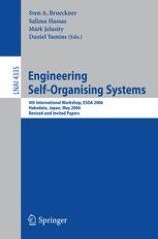
Engineering self-organising systems ; 4th International Workshop, ESOA 2006, Hakodate, Japan, May 9, 2006, Revised and Invited Papers
This book discusses a broad variety of topics in an effort to allow room for new ideas and discussion, and eventually a better understanding of the important directions and techniques of Engineering Self-Organizing.This book raises the important question of whether there are underlying statistical mechanics-like principles that apply to emergent multi-agent systems. Answering this question will in the long run provide an important part of the underlying theory of emergent distributed systems.

Engineering psychology and cognitive ergonomics ; 7th International Conference, EPCE 2007, Held as Part of HCI International 2007, Beijing, China, July 22-27, 2007, Proceedings
This book address the latest research and development efforts and highlight the human aspects of design and use of computing systems. It cover the entire field of Human-Computer Interaction, addressing major - vances in knowledge and effective use of computers in a variety of application areas. This volume contains papers in the thematic area of En- neering Psychology and Cognitive Ergonomics, addressing the following major topics: Cognitive and Affective Issues in User Interface Design, Cognitive Workload and Human Performance, Cognitive Modeling and Measuring, Safety Critical Applications and Systems

Engineering Multi-Agent Systems ; 7th International Workshop, EMAS 2019, Montreal, QC, Canada, May 13–14, 2019, Revised Selected Papers
This book constitutes the thoroughly refereed post-conference proceedings of the 7th International Workshop on Engineering Multi-Agent Systems, EMAS 2019, held in Montreal, QC, Canada, in May 2019. The 13 revised full papers presented in this book were carefully selected and reviewed from 20 submissions. The papers are grouped in the following topical sections: Multi-Agent Interaction and Organization; Simulation; Social Awareness and Explainability; Learning and Reconfiguration; and Implementation Techniques and Tools.

Engineering Interactive Systems ; EIS 2007 Joint Working Conferences, EHCI 2007, DSV-IS 2007, HCSE 2007, Salamanca, Spain, March 22-24, 2007. Selected Papers
This book constitutes the post-conference proceedings of the WG2.7/13.4 10th Conference on Engineering Human Computer Interaction (EHCI 2007), the WG 13.2 First Conference on Human Centred Software Engineering (HCSE 2007), and the 14th Conference on Design Specification and Verification of Interactive Systems (DSV-IS 2007); jointly held as EIS 2007, the international event on Engineering Interactive Systems, in Salamanca, Spain, in March 2007 - under the auspices of IFIP.

Engineering Evolutionary Intelligent Systems
This edited volume 'Engineering Evolutionary Intelligent Systems' deals with the theoretical and methodological aspects, as well as various evolutionary algorithm applications to many real world problems originating from science, technology, business or commerce.

Engineering Environment-Mediated Multi-Agent Systems ; International Workshop, EEMMAS 2007, Dresden, Germany, October 5, 2007. Selected Revised and Invited Papers
This book constitutes the thoroughly refereed proceedings of the International Workshop on Engineering Environment-Mediated Multi-Agent Systems, held in Dresden,The volume includes 16 thoroughly revised papers, selected from the lectures given at the workshop, together with 2 papers resulting from invited talks by prominent researchers in the field. The papers are organized in sections on engineering self-organizing applications, stigmergic interaction, modeling and structuring mediating environments, and environment-based support for context and organizations.

Energy minimization methods in computer vision and pattern recognition ; 5th International Workshop, EMMCVPR 2005, St. Augustine, FL, USA, November 9-11, 2005, Proceedings
Constitutes the refereed proceedings of the 5th International Workshop on Energy Minimization Methods in Computer Vision and Pattern Recognition, EMMCVPR 2005, in St Augustine, FL, USA, in November 2005. This book consists of 24 papers and 18 poster papers organized in topical sections on different approaches.

End-User Development
By now, most people have become familiar with the basic functionality and interfaces of computers. However, developing new or modified applications that effectively support users' goals still requires considerable expertise in programming that cannot be expected from most people. Thus, one fundamental challenge for the coming years is to develop environments that allow users who do not have background in programming to develop or modify their own applications, with the ultimate aim of empowering people to flexibly employ advanced information and communication technologies.

Emergent Properties in Natural and Artificial Dynamical Systems
An important part of the science of complexity is the study of emergent properties arising through dynamical processes in various types of natural and artificial systems. This is the aim of this book, which is the outcome of a discussion meeting within the first European conference on complex systems. It presents multidisciplinary approaches for getting representations of complex systems and using different methods to extract emergent structures. This carefully edited book studies emergent features such as self organization, synchronization, opening on stability and robustness properties. Invariant techniques are presented which can express global emergent properties in dynamical and in temporal evolution systems. This book demonstrates how artificial systems such as a distributed platform can be used for simulation used to search emergent placement during simulation execution.
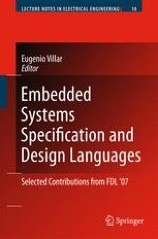
Embedded Systems Specification and Design Languages : Selected contributions from FDL’07
FDL is the most important European and, probably, worldwide forum to present research results, to exchange experiences, and to learn about new trends in the application of specification and design languages and the associated design and modeling methods and tools for complex, heterogeneous HW/SW embedded systems.

Embedded systems design : The ARTIST roadmap for research and development
Embedded systems now include a very large proportion of the advanced products designed in the world, spanning transport (avionics, space, automotive, trains), electrical and electronic appliances (cameras, toys, televisions, home appliances, audio systems, and cellular phones), process control (energy production and distribution, factory automation and optimization), telecommunications (satellites, mobile phones and telecom networks), and security (e-commerce, smart cards), etc. The extensive and increasing use of embedded systems and their integration in everyday products marks a significant evolution in information science and technology. We expect that within a short timeframe embedded systems will be a part of nearly all equipment designed or manufactured in Europe, the USA, and Asia. There is now a strategic shift in emphasis for embedded systems designers: from simply achieving feasibility, to achieving optimality. Optimal design of embedded systems means targeting a given market segment at the lowest cost and delivery time possible. Optimality implies seamless integration with the physical and electronic environment while respecting real-world constraints such as hard deadlines, reliability, availability, robustness, power consumption, and cost. In our view, optimality can only be achieved through the emergence of embedded systems as a discipline in its own right.
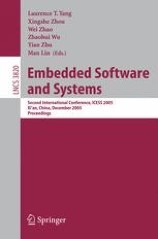
Embedded Software and Systems ; Vol. 3820 ; 2nd International Conference, ICESS 2005, Xi'an, China, December 16-18, 2005, Proceedings
Welcome to the proceedings of the 2005 International Conference on Emb- ded Software and Systems (ICESS 2005) held in Xian, China, December 16-18, 2005. With the advent of VLSI system level integration and system-on-chip, the center of gravity of the computer industry is now moving from personal c- puting into embedded computing. Embedded software and systems are incre- ingly becoming a key technological component of all kinds of complex technical systems, ranging from vehicles, telephones, aircraft, toys, security systems, to medical diagnostics, weapons, pacemakers, climate control systems, etc. The ICESS 2005 conference provided a premier international forum for - searchers, developers and providers from academia and industry to address all resulting profound challenges; to present and discuss their new ideas, - search results, applications and experience; to improve international com- nication and cooperation; and to promote embedded software and system - dustrialization and wide applications on all aspects of embedded software and systems.

Embedded Robotics : Mobile Robot Design and Applications with Embedded Systems
This book presents a unique examination of mobile robots and embedded systems, from introductory to intermediate level. It is structured in three parts, dealing with Embedded Systems (hardware and software design, actuators, sensors, PID control, multitasking), Mobile Robot Design (driving, balancing, walking, and flying robots), and Mobile Robot Applications (mapping, robot soccer, genetic algorithms, neural networks, behavior-based systems, and simulation).

Embedded Robotics : Mobile Robot Design and Applications with Embedded Systems
The EyeBot controller and mobile robots have evolved over more than a decade. This book gives an in-depth introduction to embedded systems and autonomous mobile robots, using the EyeBot controller (EyeCon) and the EyeBot mobile robot family as application examples. This book combines teaching and research material and can be used for courses in Embedded Systems as well as in Robotics and Automation.

Embedded Firmware Solutions : Development Best Practices for the Internet of Things
Embedded Firmware Solutions is the perfect introduction and daily-use field guide--for the thousands of firmware designers, hardware engineers, architects, managers, and developers--to Intel’s new firmware direction (including Quark coverage), showing how to integrate Intel® Architecture designs into their plans. Featuring hands-on examples and exercises using Open Source codebases, like Coreboot and EFI Development Kit (tianocore) and Chromebook, this is the first book that combines a timely and thorough overview of firmware solutions for the rapidly evolving embedded ecosystem with in-depth coverage of requirements and optimization.
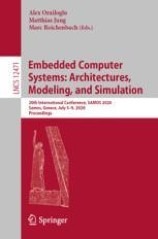
Embedded Computer Systems : Architectures, Modeling, and Simulation; 20th International Conference, SAMOS 2020, Samos, Greece, July 5–9, 2020, Proceedings
This book constitutes the refereed proceedings of the 20th International Conference on Embedded Computer Systems: Architectures, Modeling, and Simulation, SAMOS 2020, held in Samos, Greece, in July 2020.* The 16 regular papers presented were carefully reviewed and selected from 35 submissions. In addition, 9 papers from two special sessions were included, which were organized on topics of current interest: innovative architectures for security and European projects on embedded and high performance computing for health applications.

Elementary logic : For software development
This book teaches readers how to better reason about software development, to communicate reasoning, to distinguish between good and bad reasoning, and to read professional literature that presumes knowledge of elementary logic. It explains fundamental concepts and provides reader-friendly instructions for applying logic to software development.
