



Page 2
Page 2

Automatic Quantum Computer Programming : A Genetic Programming Approach
Computer science will be radically transformed if ongoing efforts to build large-scale quantum computers eventually succeed and if the properties of these computers meet optimistic expectations. Nevertheless, computer scientists still lack a thorough understanding of the power of quantum computing, and it is not always clear how best to utilize the power that it is understood. This dilemma exists because quantum algorithms are difficult to grasp and even more difficult to write. Despite large-scale international efforts, only a few important quantum algorithms are documented, leaving many essential questions about the potential of quantum algorithms unanswered.
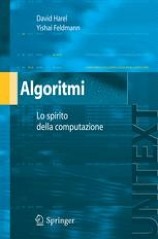
Algoritmi : Lo spirito dell’informatica = Algorithms : The spirit of information technology
Algorithms are the heart of computer science and mathematics, since without them the use of computers would not be possible. In this book, which in its English edition has been a longtime bestseller, Harel and Feldmann answer all questions relating to this topic. They talk about the evaluation, correctness and effectiveness of algorithms, but also clarify some doubts about programming techniques and also refer to the very current discussion on quantum computing. The book is useful both as a basic text for an introductory university course in computer science, and as a general introduction to natural sciences, mathematics or engineering.

Algorithms and computation ; Vol. 4288: 17th International symposium, ISAAC 2006, Kolkata, India, December 18-20, 2006, Proceedings
This book constitutes the refereed proceedings of the 17th International Symposium on Algorithms and Computation, ISAAC 2006, held in Kolkata, India in December 2006. The 73 revised full papers presented were carefully reviewed and selected from 255 submissions. The papers are organized in topical sections on algorithms and data structures, online algorithms, approximation algorithm, graphs, computational geometry, computational complexity, network, optimization and biology, combinatorial optimization and quantum computing, as well as distributed computing and cryptography.

Algorithms and computation ; Vol. 3827 ; 16th International symposium, ISAAC 2005, Sanya, Hainan, China, December 19-21, 2005, Proceedings
This book constitutes the refereed proceedings of the 16th International Symposium on Algorithms and Computation, ISAAC 2005, held in China in 2005. The 112 revised full papers presented were carefully reviewed and selected from 549 submissions. The papers are organized in topical sections on computational geometry, computational optimization, graph drawing and graph algorithms, computational complexity, approximation algorithms, internet algorithms, quantum computing and cryptography, data structure, computational biology, experimental algorithm mehodologies and online algorithms, randomized algorithms, parallel and distributed algorithms, graph drawing and graph algorithms, computational complexity, combinatorial optimization, computational biology, computational complexity, computational optimization, computational geometry, approximation algorithms, graph drawing and graph algorithms, computational geometry, approximation algorithms, graph drawing and graph algorithms, and data structure.

Algorithms and computation ; 18th International symposium, ISAAC 2007, Sendai, Japan, December 17-19, 2007, Proceedings
This book presented algorithms and data structures, online algorithms, approximation algorithm, graphs, computational geometry, computational complexity, network, optimization and biology, combinatorial optimization and quantum computing, as well as distributed computing and cryptography.
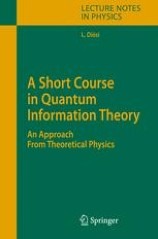
A Short Course in Quantum Information Theory : An Approach From Theoretical Physics
This short and concise primer takes the vantage point of theoretical physics and the unity of physics. It sets out to strip the burgeoning field of quantum information science to its basics by linking it to universal concepts in physics.

6G Mobile Wireless Networks
Specifically, this book covers the following topics: 6G Use Cases, Requirements, Metrics and Enabling Technologies, PHY Technologies for 6G Wireless, Reconfigurable Intelligent Surface for 6G Wireless Networks, Millimeter-wave and Terahertz Spectrum for 6G Wireless, Challenges in Transport Layer for Tbit/s Communications, High-capacity Backhaul Connectivity for 6G Wireless, Cloud Native Approach for 6G Wireless Networks, Machine Type Communications in 6G, Edge Intelligence and Pervasive AI in 6G, Blockchain: Foundations and Role in 6G, Role of Open-source Platforms in 6G, and Quantum Computing and 6G Wireless.
