



Page 2
Page 2

RoboCup 2005 : Robot Soccer World Cup IX
This book constitutes the ninth official archival publication devoted to RoboCup, documenting presentations at the RoboCup 2005 International Symposium, held in Osaka, Japan, July 2005 alongside the RoboCup Competition. The book presents 34 revised full papers and 38 revised short papers together with two award-winning papers. This is a valuable source of reference and inspiration for those interested in robotics or distributed intelligence, and mandatory reading for the rapidly growing RoboCup community.

RoboCup 2004 : Robot Soccer World Cup VIII ; Conference proceedings
The papers presented here document the many innovations in robotics that result from RoboCup. A problem in any branch of science or engineering is how to devise tests that can provide objective comparisons between alt- native methods. In recent years, competitive engineering challenges have been established to motivate researchers to tackle di?cult problems while providing a framework for the comparison of results. RoboCup was one of the first such competitions and has been a model for the organization of challenges foll- ing sound scientifc principles. In addition to the competition, the associated symposium provides a forum for researchers to present refereed papers. But, for RoboCup, the symposium has the greater goal of encouraging the exchange of ideas between teams so that the competition, as a whole, progresses from year to year and strengthens its contribution to robotics.

Research and Development in Intelligent Systems XXIV ; Proceedings of AI-2007, the 27th SGAI International Conference on Innovative Techniques and Applications of Artificial Intelligence
They present new and innovative developments in the field, divided into sections on Constraint Satisfaction, AI Techniques, Data Mining and Machine Learning, Multi-Agent Systems, Data Mining, and Knowledge Acquisition and Management.

Rational, Robust, and Secure Negotiations in Multi-Agent Systems
This book addresses all aspects of negotiation mechanisms in multi-agent systems, including Multi-Issue Negotiations, Concurrent Negotiations, Strategy-proof Mechanisms, Rational Argumentation, Auctions and Voting, and so on. These issues are being explored by researchers from different communities in Multi-Agent systems. They are, for instance, being studied in agent negotiation, multi-issue negotiations, auctions, mechanism design, electronic commerce, voting, secure protocols, matchmaking & brokering, argumentation, and co-operation mechanisms. This workshop will bring together researchers from these communities to learn about each other ’s approaches, form long-term collaborations, and cross-fertilize the different areas to accelerate progress towards scaling up to larger and more realistic applications.

Project Management and Risk Management in Complex Projects : Studies in Organizational Semiotics
The goal of this volume is to prove that mixed utterances in young bilinguals can be analyzed in the same way as adult code-switching. Analyzing a rich corpus of spontaneous child data, the author provides detailed empirical evidence for latest minimalist assumptions on the architecture of mind and confirms that code-switching is only constrained by the two grammars of the languages involved.

Progress in artificial intelligence ; 20th EPIA Conference on Artificial Intelligence, EPIA 2021, Virtual Event, September 7–9, 2021, Proceedings
This book constitutes the refereed proceedings of the 20th EPIA Conference on Artificial Intelligence, EPIA 2021, held virtually in September 2021. The 62 full papers and 6 short papers presented were carefully reviewed and selected from a total of 108 submissions. The papers are organized in the following topical sections: artificial intelligence and IoT in agriculture; artificial intelligence and law; artificial intelligence in medicine; artificial intelligence in power and energy systems; artificial intelligence in transportation systems; artificial life and evolutionary algorithms; ambient intelligence and affective environments; general AI; intelligent robotics; knowledge discovery and business intelligence; multi-agent systems: theory and applications; and text mining and applications.

Progress in Artificial Intelligence ; 13th Portuguese Conference on Artificial Intelligence, EPIA 2007, Workshops: GAIW, AIASTS, ALEA, AMITA, BAOSW, BI, CMBSB, IROBOT, MASTA, STCS, and TEMA, Guimarães, Portugal, December 3-7, 2007, Proceedings
This book constitutes the refereed proceedings of the 13th Portuguese Conference on Artificial Intelligence, EPIA 2007, held in Guimaraes, Portugal, in December 2007 as eleven integrated workshops. In accordance with the eleven constituting workshops, the papers are organized in topical sections on a broad range of subjects.

Progress in Artificial Intelligence ; 12th Portuguese Conference on Artificial Intelligence, EPIA 2005, Covilha, Portugal, December 5-8, 2005, Proceedings
With this edition, EPIA, the Portuguese Conference on Artificial Intelligence, celebrates its 20th anniversary.Like all its previous editions, it has been run - der the auspices of the Portuguese Association for Artificial Intelligence (APPIA), which was established in 1984 and is also celebrating 20 years of activity. The first edition of EPIA was held in Porto, in October 1985, organised by Pavel Brazdil, Miguel Filgueiras, Lu ́ 's Damas and Armando Campos e Matos. EPIA soon evolved to an international conference by adopting in its fourth edition English as the o?cial language and having its proceedings published by Springer, intheLNAIseries.Inrecentyears, theconferencegraduallyprogressed from a plenary organisation to a workshop-based structure. The conference has steadily assumed high-quality standards, both in its scientific management and in the scientific program, with the aim of progressively broadening its audience and improving its impact over young researchers.

Programming Multi-Agent-Systems ; 4th International Workshop, ProMAS 2006, Hakodate, Japan, May 9, 2006, Revised and Invited Papers
Constitutes the thoroughly refereed postproceedings of the 4th International Workshop on Programming Multi-Agent Systems, ProMAS 2006, held in Hakodate, Japan, May 2006.

Programming Multi-Agent Systems ; Vol. 3862 ; 3rd International Workshop, ProMAS 2005, Utrecht, The Netherlands, July 26, 2005, Revised and Invited Papers
Constitutes the thoroughly refereed postproceedings of the Third International Workshop on Programming Multi-Agent Systems, ProMAS 2005, held in Utrecht, The Netherlands in July 2005 as an associated event of AAMAS 2005, the main international conference on autonomous agents and multi-agent systems. The 14 revised full papers presented together with 2 invited articles are organized in topical sections on multi-agent techniques and issues, multi-agent programming, and multi-agent platforms and organisation.

Programming Multi-Agent Systems ; Vol. 3346 : 2nd International Workshop ProMAS 2004, New York, NY, July 20, 2004, Selected Revised and Invited Papers
Focusses on a principled way to combine the two dominant paradigms for building multiagent team plans, namely the “belief-desire-intention” (BDI) approach and distributed POMDPs. In this hybrid BDI-POMDP approach, BDI team plans are exploited to improve distributed POMDP tractability and distributed POMDP-based analysis improves BDI team plan performance. Concretely, we focus on role allocation, a fundamental problem in BDI teams – which agents to allocate to the different roles in the team. The hybrid BDI-POMDP approach provides three key contributions. First, unlike prior work in multiagent role allocation, we describe a role allocation technique that takes into account future uncertainties in the domain. The second contribution is a novel decomposition technique, which exploits the structure in the BDI team plans to significantly prune the search space of combinatorially many role allocations. Our third key contribution is a significantly faster policy evaluation algorithm suited for our BDI-POMDP hybrid approach. Finally, we also present experimental results from two domains: mission rehearsal simulation and RoboCupRescue disaster rescue simulation. In the RoboCupRescue domain, we show that the role allocation technique presented in this paper is capable of performing at human expert levels by comparing with the allocations chosen by humans in the actual RoboCupRescue simulation environment.

Programming Multi-Agent Systems ; 5th International Workshop, ProMAS 2007 Honolulu, HI, USA, May 15, 2007 Revised and Invited Papers
The aim of the ProMAS workshop series is to promote and contribute to the establishment of MAS as a mainstream approach to the development of industrial-strength software. In particular, ProMAS aims to address the technologies that are required for - plementing multi-agentsystems designs or specifications efiectively

Professional Practice in Artificial Intelligence ; IFIP 19th World Computer Congress, TC-12: Professional Practice Stream, August 21-24, 2006, Santiago, Chile
The scope of the series includes: foundations of computer science; software theory and practice; education; computer applications in technology; communication systems; systems modeling and optimization; information systems; computers and society; computer systems technology; security and protection in information processing systems; artificial intelligence; and human-computer interaction. Proceedings and post-proceedings of referred international conferences in computer science and interdisciplinary fields are featured. These results often precede journal publication and represent the most current research. The principal aim of the IFIP series is to encourage education and the dissemination and exchange of information about all aspects of computing.

Production Planning in Production Networks : Models for Medium and Short-term Planning
Production Planning in Production Networks addresses production planning problems in distributed manufacturing networks from strategic, tactical, organisational and operative perspectives. New methodologies for capacity negotiation, allocation and workload assignment in production networks are presented. Specifically, three main problems are focussed on: how to negotiate production capacity availability in the long-term; how to allocate production capacity in medium-term planning; and, how to assign workloads in the short-term. The proposed approaches are based on negotiation algorithms in multi-agent networks. These approaches are compared with classical centralised approaches using discrete event simulation methodologies. Benchmark analysis is provided to understand the effectiveness and efficiency of the proposed approaches.

Proceedings of the 3rd International Symposium on Autonomous Minirobots for Research and Edutainment (AMiRE 2005)
This book contains the proceedings of the 3rd International Symposium on Autonomous Minirobots for Research and Edutainment (AMiRE 2005) held in Awara-Spa, Fukui, JAPAN, from September 20 to 22, 2005. The symposium theme has been "highly intelligent technology for robots," to realize the autonomy in unknown and dynamic environments including humans.

Pervasive Computing for Quality of Life Enhancement ; 5th International Conference On Smart Homes and Health Telematics, ICOST 2007, Nara, Japan, June 21-23, 2007, Proceedings
This book constitutes the refereed proceedings of the 5th International Conference On Smart Homes and Health Telematics, ICOST 2007, held in Nara, Japan in June 2007. It presents the latest approaches and technical solutions in the area of smart homes, health telematics, and emerging enabling technologies.

Organizational Principles for Multi-Agent Architectures
Key topics of this book:- a framework for multi-agent system design, based on human organizational notions and principles for distributed intelligent systems design- "Coordination mechanisms" in the form of "Problem Solving Methods", which can assist "Managers" and agent engineers in reasoning about coordination- the "Five Capabilities (5C) model" which is a conceptual framework bases on a generalization of typical agent intelligence competences, such as "autonomy", "interaction", "pro-activeness" and "reactiveness"- a multi-agent architecture capable of (semi)automatic reuse of Problem Solving Methods- "ontology-based communication", in which the meaning and intention of message contents in agent communication is specified in "message content ontologies".

Open Semantic Technologies for Intelligent System ; 10th International Conference, OSTIS 2020, Minsk, Belarus, February 19–22, 2020, Revised Selected Papers
Constitutes the refereed proceedings of the 10th International Conference on Open Semantic Technologies for Intelligent System, OSTIS 2020, held in Minsk, Belarus, in February 2020. The 14 revised full papers and 2 short papers were carefully reviewed and selected from 62 submissions. The papers mainly focus on standardization of intelligent systems and cover wide research fields including knowledge representation and reasoning, semantic networks, natural language processing, temporal reasoning, probabilistic reasoning, multi-agent systems, intelligent agents.

Ontologies for Agents : Theory and Experiences
On the other hand, ontologies have established themselves as a powerful tool to enable kno- edge sharing, and a growing number of applications have bene?ted from the use of ontologies as a means to achieve semantic interoperability among heterogeneous, distributed systems. In principle ontologies and agents are a match made in heaven, that has failed to happen. What makes a simple piece of software an agent is its ability to communicate in a ”social” environment, to make autonomous decisions, and to be proactive on behalf of its user. Communication ultimately depends on und- standing the goals, preferences, and constraints posed by the user. Autonomy is theabilitytoperformataskwithlittleornouserintervention,whileproactiveness involves acting autonomously with no need for user prompting. Communication, but also autonomy and proactiveness, depend on knowledge. The ability to c- municate depends on understanding the syntax (terms and structure) and the semantics of a language. Ontologies provide the terms used to describe a domain and the semantics associated with them. In addition, ontologies are often comp- mented by some logical rules that constrain the meaning assigned to the terms. These constraints are represented by inference rules that can be used by agents to perform the reasoning on which autonomy and proactiveness are based.
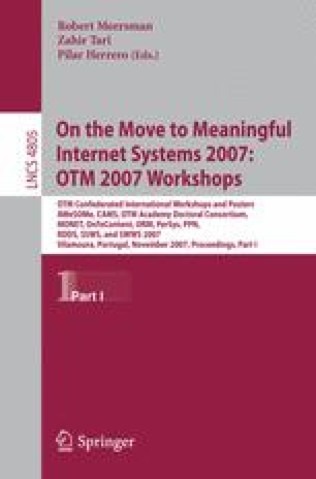
On the move to meaningful internet systems 2007 : OTM 2007 Workshops ; OTM Confederated International Workshops and Posters, AWeSOMe, CAMS, OTM Academy Doctoral Consortium, MONET, OnToContent, ORM, PerSys, PPN, RDDS, SSWS, and SWWS 2007, Vilamoura, Portugal, November 25-30, 2007,
it is clear that there is an acute and increasing need to address and discuss in an integrated forum the implied software and system issues as well as methodological, semantical, theoretical and application issues. As we all know, e-mail, the Internet, and even video conferences are not sufficient for effective and efficient scientific exchange. This is why the OnTheMove (OTM) Federated Conferences series has been created to cover the increasingly wide yet closely connected range of fundamental technologies such as data and Web Semantics.
