



Page 134
Page 134

Advances in decision making under risk and uncertainty
Whether we like it or not we all feel that the world is uncertain. From choosing a new technology to selecting a job, we rarely know in advance what outcome will result from our decisions. Unfortunately, the standard theory of choice under uncertainty developed in the early forties and fifties turns out to be too rigid to take many tricky issues of choice under uncertainty into account. The good news is that we have now moved away from the early descriptively inadequate modeling of behavior. This book brings the reader into contact with the accomplished progress in individual decision making through the most recent contributions to uncertainty modeling and behavioral decision making. It also introduces the reader into the many subtle issues to be resolved for rational choice under uncertainty.
Advances in database technology -- EDBT 2006 ; 10 International conference on extending database technology, Munich, Germany, 26-31 March 2006, Proceedings
The series of International Conferences on Extending Database Technology (EDBT) is an established and prestigious forum for the exchange of the latest research results in data management. It provides unique opportunities for database researchers, practitioners, developers, and users to explore new ideas, techniques, and tools, and to exchange experiences. This volume contains the proceedings of the 10th EDBT Conference, held in Munich, Germany, March 27-29, 2006. The conference included 3 keynote talks, 56 full-size and 4 half-size research papers in 20 sessions, 8 industrial presentations in 3 sessions, 1 panel session, 5 tutorials in 7 sessions, and 20 demonstrations in 4 sessions. All of the research papers as well as papers and abstracts from most of the other sessions are included here.

Advances in data mining : Applications in image mining, medicine and biotechnology, management and environmental control, and telecommunications ; 4th Industrial Conference on Data Mining, ICDM 2004, Leipzig, Germany, July 4-7, 2004, Revised Selected Papers
Constitutes the proceedings of the Industrial Conference on Data Mining ICDM-Leipzig was the fourth meeting in a series of annual events which started in 2000, organized by the Institute of Computer Vision and Applied Computer Sciences (IBaI) in Leipzig. The mission of the conference is to bring together researchers and people from industry in order to discuss together new trends and applications in data mining. This year a broad spectrum of work of different applications was presented ranging from image mining, medicine and biotechnology, management and environmental control, to telecommunications. Besides that an industrial exhibition showed the successful application of data mining methods by industries in different areas such as medical devices, mass data management systems, data mining tools, etc. During the discussion many projects were inspired leading to new and joint work. The fruitful discussions, the exchange of ideas and the spirit of the conference made it a remarkable event for both sides, industry and research.

Advances in Data and Web Management ; Joint 9th Asia-Pacific Web Conference, APWeb 2007, and 8th International Conference on Web-Age Information Management, WAIM 2007, Huang Shan, China, June 16-18, 2007, Proceedings
The rapid prevalence of Web applications requires new technologies for the - sign, implementation and management of Web-based information systems, and for the management and analysis of information on the Web.This book drew research and industrial papers on the theory, design and implementation of Web-based information systems and on the m- agement and analysis of information on the Web.

Advances in cryptology - EUROCRYPT 90 ; Workshop on the theory and application of cryptographic techniques, Aarhus, Denmark, May 21-24, 1990. Proceedings
Eurocrypt is a conference devoted to all aspects of cryptologic research, both theoretical and practical, sponsored by the International Association for Cryptologic Research (IACR). Eurocrypt 90 took place in Åarhus, Denmark, in May 1990. From the 85 papers submitted, 42 were selected for presentation at the conference and for inclusion in this volume. In addition to the formal contributions, short abstracts of a number of informal talks are included in these proceedings. The proceedings are organized into sessions on protocols, number-theoretic algorithms, boolean functions, binary sequences, implementations, combinatorial schemes, cryptanalysis, new cryptosystems, signatures and authentication, and impromptu talks.
Advances in cryptology - CRYPTO -87 ; Conference on the theory and applications of cryptographic techniques : Proceedings
Zero-knowledge interactive proofsystems are a new technique which can be used as a cryptographic tool for designing provably secure protocols. Goldwasser, Micali, and Rackoff originally suggested this technique for controlling the knowledge released in an interactive proof of membership in a language, and for classification of languages. In this approach, knowledge is defined in terms of complexity to convey knowledge if it gives a computational advantage to the receiver, theory, and a message is said for example by giving him the result of an intractable computation. The formal model of interacting machines is described in. A proof-system (for a language L) is an interactive protocol by which one user, the prover, attempts to convince another user, the verifier, that a given input x is in L. We assume that the verifier is a probabilistic machine which is limited to expected polynomial-time computation, while the prover is an unlimited probabilistic machine.

Advances in Cooperative Control and Optimization ; Proceedings of the 7th International Conference on Cooperative Control and Optimization
Each year, the International Conference on Cooperative Control and Optimization (CCO) brings together top researchers from around the world to present new ideas, theories, applications, and advances in the fields of autonomous agents, cooperative systems, control theory, and optimization. The works in this volume are a result of invited papers and selected presentations at the Seventh Annual International Conference on Cooperative Control and Optimization, held in Gainesville, Florida, January 31 – February 2, 2007.The works presented in this book are suitable for faculty, graduate students, and industrial researchers in the fields of optimization, control theory, electrical engineering, computer science, and mathematics.

Advances in Construction Materials 2007
A compilation of recent research results on building construction materials. The construction industry consumes extreme volumes of material, and the growing demand for quality and safety require continuous improvement of materials and material compositions. A deep understanding of material behavior is essential to enable efficient construction: light-weight or heavily burdened structures ask for the development of innovative composites or new material compositions.

Advances in conceptual modeling : Foundations and applications ; ER 2007 Workshops CMLSA, FP-UML, ONISW, QoIS, RIGiM, SeCoGIS, Auckland, New Zealand, November 5-9, 2007, Proceedings
Covering data warehouses, security, model transformation, state diagrams development and model quality.
Advances in computer systems architecture ; Vol. 4186 : 11th Asia-Pacific Conference, ACSAC 2006, Shanghai, China, September 6-8, 2006, Proceedings
This is the 11th in a series of conferences, which started life in Australia, as the computer architecture component of the Australian Computer Science Week. In 1999 it ventured away from its roots for the first time, and the fourth Australasian Computer Architecture Conference was held in the beautiful city of Sails (Auckland, New Zealand). Perhaps it was because of a lack of any other computer architecture conference in Asia or just the attraction of traveling to the Southern Hemisphere but the conference became increasingly international during the subsequent three years and also changed its name to include Computer Systems Architecture, reflecting more the scope of the conference, which embraces both architectural and systems issues. In 2003, .
Advances in computer graphics ; 24th Computer graphics international conference, CGI 2006, Hangzhou, China, June 26-28, 2006, Proceedings
Contains 39 full papers and 39 short papers accepted by CGI 2006. CGI conference was initially founded by the Computer Graphics Society in 1983 and has now become a widely recognized, high-quality academic conference in the field of computer graphics. Recent CGI conferences were held in New York (2005), Crete (2004), Tokyo (2003), Bradford (2002), Hong Kong (2001) and Geneva (2000). The CGI 2006 Program Committee received an overwhelming 387 submissions from many countries worldwide. China and Korea contributed many enthusiastic submissions. Based on the strict review comments of international experts, we selected 38 full papers and 37 short papers for presentations.

Advances in Biometrics ; International Conference, ICB 2007, Seoul, Korea, August 27-29, 2007, Proceedings
Biometrics technology continues to stride forward with its wider acceptance and its real need in various new security facets of modern society. From simply logging on to a laptop to crossing the border of a country, biometrics is being called upon to meet the growing challenges of identity management. This book presents a comprehensive treatment of biometrics and offers coverage of the entire gamut of topics in the field, including data acquisition, pattern-matching algorithms, and issues that impact at the system level, such as standards, security, networks, and databases. It has been organized under three sections: sensors, advances in biometric matching algorithms, and topics that deal with issues at the systems level.

Advances in artificial life ; 8th European Conference, ECAL 2005 , Canterbury, UK, September 5-9, 2005, Proceedings
The Artificial Life term appeared more than 20 years ago . Since then the area has developed dramatically, many researchersjoining enthusiastically and research groups sprouting everywhere.a conceptual track, where papers were judged on criteria like importance and/or novelty of the concepts proposed rather than the experimental / theoretical results, has been introduced this year. A conference on a theme as broad as Artificial Life is bound to be very di-verse, but a few tendencies emerged. First, fields like ‘Robotics and Autonomous Agents’ or ‘Evolutionary Computation’are still extremely active and keep onbringing a wealth of results to the A-Life community. Even there, however, new tendencies appear, like collective robotics, and more specifically self-assembling robotics, which represent now a large subsection. Second, new areas appear.‘Morphogenesis and Development’ which used to be the subject of only a fewpapers, is now one of the largest subsections, and seems to be on the brinkof becoming a field of its own. Finally, most classical themes of A-Life re-search like ‘Artificial Chemistry’, ‘Ant-Inspired Systems’, ‘Cellular Automata’,‘Self-Replication’, ‘Social Simulations’ or ‘Bio-realist Simulations’ are still goingstrong and are well represented within this volume.
Advances in Artificial Economics : The Economy as a Complex Dynamic System
Perceiving the economy as a complex dynamic system, generates a need for new tools for its study. As a constructive simulation method, Agent-Based Computational Economics (ACE) has in recent years proven its strength and extensive applicability. Fields of study are widely spread within economics, with a cluster around financial markets. This book is based on communications given at AE’2006 (Aalborg, Denmark) – the second symposium on Artificial Economics, and covers both wellknown questions of economics, like the existence of market efficiency, as well as new questions raised by the new tools, for example questions related to networks of social interaction.

Advances and technical standards in neurosurgery : Vol. 32
This volume of Advances and Technical Standards in Neurosurgery covers some important new developments in functional neurosurgery and endovascular therapy. In the Technical Standards section a variety of topics are considered, including optic pathway gliomas, pineal lesions, cavernous sinus meningiomas, and the eternal problem of minor and repetitive head injury. Endovascular treatment of a variety of lesions is now common practice, and the state of the art in endovascular treatment for acute ischemic stroke is reviewed. An appraisal of the evidence on whether there is a place for microsurgical vascular decompression for essential hypertension raises interesting questions.
Advances and Innovations in Systems, Computing Sciences and Software Engineering
Acollection of world class paper articles addressing the following topics: Image and Pattern Recognition: Compression, Image processing, Signal Processing Architectures, Signal Processing for Communication, Signal Processing Implementation, Speech Compression, and Video Coding Architectures. Languages and Systems: Algorithms, Databases, Embedded Systems and Applications, File Systems and I/O, Geographical Information Systems, Kernel and OS Structures, Knowledge Based Systems, Modeling and Simulation, Object Based Software Engineering, Programming Languages, and Programming Models and tools. Parallel Processing: Distributed Scheduling, Multiprocessing, Real-time Systems, Simulation Modeling and Development, and Web Applications. New trends in computing: Computers for People of Special Needs, Fuzzy Inference, Human Computer Interaction, Incremental Learning, Internet-based Computing Models, Machine Intelligence, Natural Language Processing, Neural Networks, and Online Decision Support System.
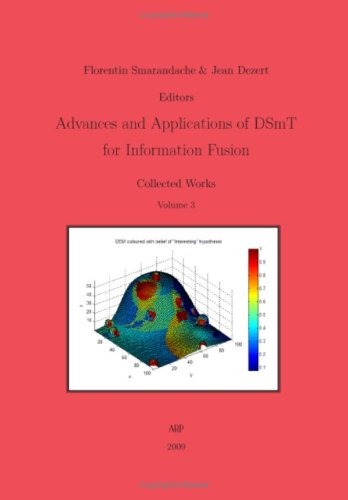
Advances and applications of DSmT for information fusion: Collected works ; Vol.3
One of the most comprehensive and flexible fusion theory based on belief functions. It can work in all fusion spaces: power set, hyper-power set, and super-power set, and has various fusion and conditioning rules that can be applied depending on each application. Some new generalized rules are introduced in this volume with codes for implementing some of them. For the qualitative fusion, the DSm Field and Linear Algebra of Refined Labels (FLARL) is proposed which can convert any numerical fusion rule to a qualitative fusion rule. When one needs to work on a refined frame of discernment, the refinement is done using Smarandache s algebraic codification. New interpretations and implementations of the fusion rules based on sampling techniques and referee functions are proposed, including the probabilistic proportional conflict redistribution rule.
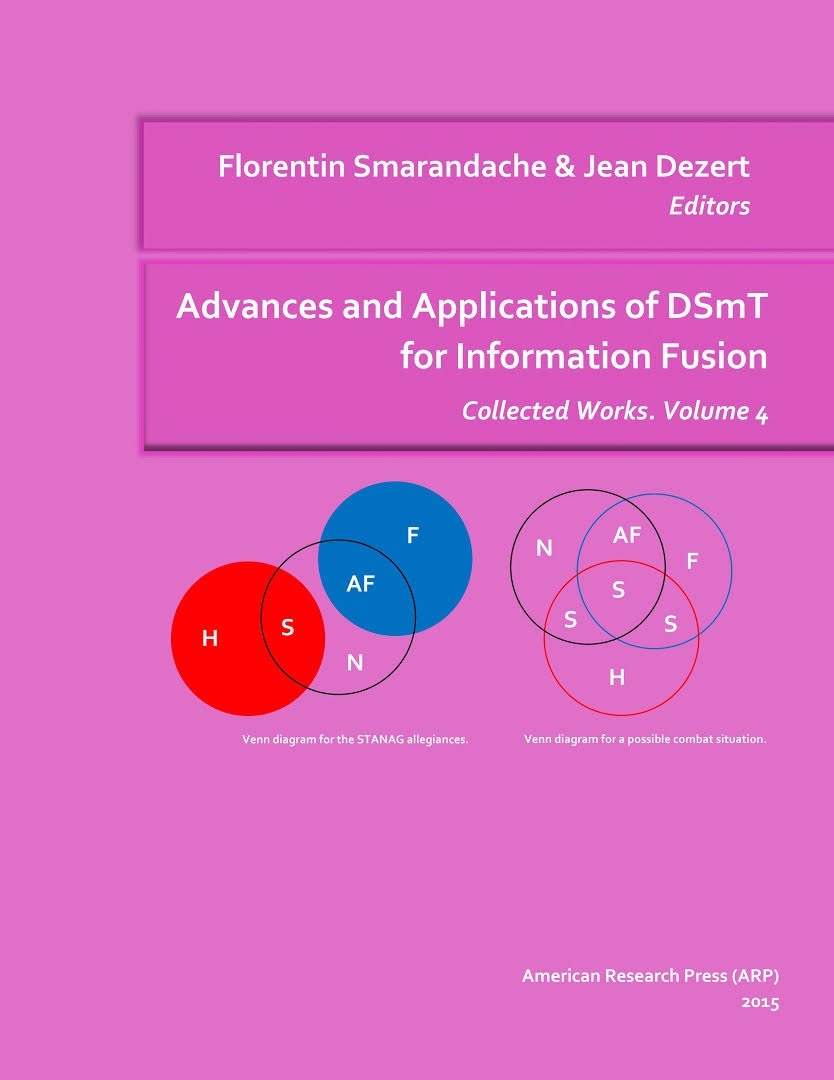
Advances and applications of DSmT for information fusion ; Vol. 4
One of the most comprehensive and flexible fusion theory based on belief functions. It can work in all fusion spaces: power set, hyper-power set, and super-power set, and has various fusion and conditioning rules that can be applied depending on each application. Some new generalized rules are introduced in this volume with codes for implementing some of them. For the qualitative fusion, the DSm Field and Linear Algebra of Refined Labels (FLARL) is proposed which can convert any numerical fusion rule to a qualitative fusion rule. When one needs to work on a refined frame of discernment, the refinement is done using Smarandache s algebraic codification. New interpretations and implementations of the fusion rules based on sampling techniques and referee functions are proposed, including the probabilistic proportional conflict redistribution rule.

Advancement of Deep Learning and its Applications in Object Detection and Recognition
In just the past five years, deep learning has taken the world by surprise, driving rapid progress in fields as diverse as computer vision, natural language processing, automatic speech recognition, etc. This book presents an introduction to deep learning and various applications of deep learning such as recommendation systems, text recognition, diabetic retinopathy prediction of breast cancer, prediction of epilepsy, sentiment, fake news detection, software defect prediction and protein function prediction.

Advanced Web and Network Technologies, and Applications ; APWeb 2006 International Workshops : XRA, IWSN, MEGA, and ICSE, Harbin, China, January 16-18, 2006, Proceedings
The QOS evaluating model for computational grid nodes put forward can help greatly improving the self-adaptability of resource management and accelerating the appli- tion and development of Computational Grid. Now this model has been applied in NPU Campus Computational Grid. And the good effect brought by it has effectively proved its function. References 1. Foster, I. and C. Kesselman, eds. The Grid: Blueprint for a New Computing Infrastructure. Morgan Kaufmann, 1999. 2. Liu Liang, Zhou Xing-she, and Gu Jian-hua: A Multi-Agent System for Grid Computing. The Second International Conference on Active Media Technology, 2003 3. Yao Wang, Julita Vassileva: Trust and Reputation Model in Peer-to-Peer Networks. Farag Azzedin and Muthucumaru Maheswaran: Integrating Trust into Grid Resource M- agement Systems.
