



Page 11
Page 11

Migration and Pandemics : Spaces of Solidarity and Spaces of Exception
This book discusses the socio-political context of the COVID-19 crisis and questions the management of the pandemic emergency with special reference to how this affected the governance of migration and asylum. The book offers critical insights on the impact of the pandemic on migrant workers in different world regions including North America, Europe and Asia.

Middle Ear Surgery
This comprehensive, richly illustrated textbook provides a systematic approach to frequent otological operations. Procedures in surgery of the ear canal, acute and chronic middle ear diseases, otosclerosis, cochlear implantation and vertigo are visualized step-by-step to acquaint the beginner with proven surgical repertoires. The book is written by two famous experts, and even the experienced surgeon will find valuable hints and suggestions to facilitate routine middle ear operations.
Microwave Engineering : Concepts and Fundamentals
Covers everything from wave propagation to reflection and refraction, guided waves, and transmission lines, providing a comprehensive understanding of the underlying principles at the core of microwave engineering. This encyclopedic text not only encompasses nearly all facets of microwave engineering, but also gives all topics—including microwave generation, measurement, and processing—equal emphasis. Packed with illustrations to aid in comprehension. Describes the mathematical theory of waveguides and ferrite devices, devoting an entire chapter to the Smith chart and its applications Discusses different types of microwave components, antennas, tubes, transistors, diodes, and parametric devices Examines various attributes of cavity resonators, semiconductor and RF/microwave devices, and microwave integrated circuits

Microtectonics
The book mainly focusses on optical microscopy as a tool to study microstructures, but also describes other techniques such as EBSD and tomography. Many photographs and explanatory drawings clarify the text. Newest developments in microtectonics have been included in all chapters so that al chapters have been revised and updated, e.g. new information on brittle microstructures. Two new chapters have been added, on primary structures and experimental microstructures. Chapters on veins, shear zones, natural microgauges experimental modelling techniques and alternative techniques have been completely renewed

Micro-Place Homicide Patterns in Chicago : 1965 - 2017
This brief examines 36,263 homicides in Chicago over a 53-year study period, 1965 through 2017, at micro place grid cells of 150 by 150 meters. This study shows not only long-term historical patterns of homicides in Chicago, but also places that historical context of homicide in reference to the dramatic increases in homicides in 2016-2017. It uses several different inequality metrics, as well as kernel density maps to demonstrate that homicides were more clustered in the 1960’s compared to later periods. Using zero inflated group-based trajectory models, it demonstrates the long-term temporal stability of homicides at micro places. This brief will be of interest to researchers in policing, homicide, and research methods in criminology.

Microorganisms in the deterioration and preservation of cultural heritage
This book offers a comprehensive overview of the role and potential of microorganisms in the degradation and preservation of cultural materials (e.g. stone, metals, graphic documents, textiles, paintings, glass, etc.).

Micromanufacturing and Nanotechnology
Micromanufacturing and Nanotechnology is an emerging technological infrastructure and process that involves manufacturing of products and systems at the micro and nano scale levels. Development of micro and nano scale products and systems are underway due to the reason that they are faster, accurate and less expensive. Moreover, the basic functional units of such systems possesses remarkable mechanical, electronic and chemical properties compared to the macro-scale counterparts. Since this infrastructure has already become the prefered choice for the design and development of next generation products and systems it is now necessary to disseminate the conceptual and practical phenomenological know-how in a broader context. This book incorporates a selection of research and development papers. Its scope is the history and background, underlynig design methodology, application domains and recent developments.

Microinvasive Dentistry : Clinical Strategies and Tools
A comprehensive guide to techniques, technologies and tools used in microinvasive dentistry. Divided into four sections, the text begins with an overview of caries and its prevention. The following sections provide in depth discussion on diagnosis through various imaging devices, then different treatment options and technologies. The final section covers future developments including enamel regeneration and photobiomodulation.

mHealth Innovation in Asia : Grassroots Challenges and Practical Interventions
Offers a detailed account of a range of mHealth initiatives across South, Southeast and East Asia. It provides readers with deep insights into the challenges such initiatives face on the ground, and a view of the diverse cultural contexts shaping strategies for overcoming these challenges. The book brings together various discussions on the broader mHealth literature, and demonstrates how a research focus on diverse Asian contexts influences the success and/or failure of current mHealth initiatives. It also highlights the important roles social scientists can play in advancing theoretical approaches, as well as planning, implementing and evaluating mHealth initiatives. The book is a valuable resource for project planners, policy developers in NGOs and government institutions, as well as academics, researchers and students in the fields of public health, communications and development studies.

Metric Spaces
The abstract concepts of metric ces are often perceived as difficult. This book offers a unique approach to the subject which gives readers the advantage of a new perspective familiar from the analysis of a real line. Rather than passing quickly from the definition of a metric to the more abstract concepts of convergence and continuity, the author takes the concrete notion of distance as far as possible, illustrating the text with examples and naturally arising questions. Attention to detail at this stage is designed to prepare the reader to understand the more abstract ideas with relative ease.

Metodi Matematici della Fisica = Mathematical Methods of Physics
This text draws its origin from my old notes, prepared for the course of Mathematical Methods of Physics and gradually arranged, refined and updated over the course of many years of teaching. The aim has always been to provide as simple and direct a presentation as possible of the mathematical methods relevant to Physics: Fourier series, Hilbert spaces, linear operators, functions of complex variables, Fourier and Laplace transforms, distributions. In addition to these basic topics, a brief introduction to the first notions of group theory, Lie algebras and symmetries in view of their applications to Physics is presented in the Appendix.
Methods of Celestial Mechanics: Vol. I: Physical, Mathematical, and Numerical Principles
G. Beutler's Methods of Celestial Mechanics is a coherent textbook for students in physics, mathematics and engineering as well as an excellent reference for practitioners. This Volume I gives a thorough treatment of celestial mechanics and presents all the necessary mathematical details that a professional would need. After a brief review of the history of celestial mechanics, the equations of motion (Newtonian and relativistic versions) are developed for planetary systems (N-body-problem), for artificial Earth satellites, and for extended bodies (which includes the problem of Earth and lunar rotation). Perturbation theory is outlined in an elementary way from generally known mathematical principles without making use of the advanced tools of analytical mechanics. The variational equations associated with orbital motion - of fundamental importance for parameter estimation (e.g., orbit determination), numerical error propagation, and stability considerations - are introduced and their properties discussed in considerable detail. Numerical methods, especially for orbit determination and orbit improvement, are discussed in considerable depth. The algorithms may be easily applied to objects of the planetary system and to Earth satellites and space debris.

Methods of Celestial Mechanics ; Vol. II : Application to Planetary System, Geodynamics and Satellite Geodesy
G. Beutler's Methods of Celestial Mechanics is a coherent textbook for students as well as an excellent reference for practitioners. Volume II is devoted to the applications and to the presentation of the program system CelestialMechanics. Three major areas of applications are covered: (1) Orbital and rotational motion of extended celestial bodies. The properties of the Earth-Moon system are developed from the simplest case (rigid bodies) to more general cases, including the rotation of an elastic Earth, the rotation of an Earth partly covered by oceans and surrounded by an atmosphere, and the rotation of an Earth composed of a liquid core and a rigid shell (Poincaré model). (2) Artificial Earth Satellites. The oblateness perturbation acting on a satellite and the exploitation of its properties in practice is discussed using simulation methods (CelestialMechanics) and (simplified) first order perturbation methods. The perturbations due to the higher-order terms of the Earth's gravitational potential and resonant perturbations are considered thereafter. Special attention is paid to satellites of the Global Navigation Satellite Systems and to geostationary satellites. The characteristics of and models for the two most important non-gravitational forces, atmospheric drag and radiation pressure, are presented as well as the most relevant forces acting on high- and low-orbiting satellites. (3) Evolution of the Planetary System. The outer planetary system consisting of the planets Jupiter to Pluto is studied over long time intervals using simulation methods and spectral analysis (CelestialMechanics). The properties of the inner systems, in particular of the Earth's orbit, are made visible by integrating the entire system over long time intervals relevant for climate change. The distribution of minor planets and their orbital properties, regular orbits, and chaotic orbits are easily generated and analyzed using CelestialMechanics. The volume concludes with the discussion of important mathematical tools of the program system and of the principles of spectral analysis.

Methods in Modern Biophysics
Incorporating recent dramatic advances, this textbook presents a fresh and timely introduction to modern biophysical methods. An array of new, faster and higher-power biophysical methods now enables scientists to examine the mysteries of life at a molecular level. This innovative text surveys and explains the ten key biophysical methods, including those related to biophysical nanotechnology, scanning probe microscopy, X-ray crystallography, ion mobility spectrometry, mass spectrometry, proteomics, and protein folding and structure. Incorporating much information previously unavailable in tutorial form, Nölting employs worked examples and 267 illustrations to fully detail the techniques and their underlying mechanisms.

Methods in consumer research ; Vol 2 : Alternative approaches and special applications
Brings together world leading experts in global consumer research who provide a fully comprehensive state-of-the-art coverage of emerging methodologies and their innovative application. The book puts consumer research in-context with coverage of immersive techniques and virtual reality, While also looking at health-related Issues in consumer science, Including sections on food intake and satiation. Other sections delve into physiological measurements within the context of consumer research and how to design studies for specific populations.
Methods and Applications of Singular Perturbations : Boundary Layers and Multiple Timescale Dynamics
Perturbation theory, one of the most intriguing and essential topics in mathematics, and its applications to the natural and engineering sciences.In a systematic introductory manner, this unique book deliniates boundary layer theory for ordinary and partial differential equations, multi-timescale phenomena for nonlinear oscillations, diffusion and nonlinear wave equations. The book provides analysis of simple examples in the context of the general theory, as well as a final discussion of the more advanced problems.
Methodological Investigations in Agent-Based Modelling : With Applications for the Social Sciences
Examines the methodological complications of using complexity science concepts within the social science domain. The opening chapters take the reader on a tour through the development of simulation methodologies in the fields of artificial life and population biology, then demonstrates the growing popularity and relevance of these methods in the social sciences. Following an in-depth analysis of the potential impact of these methods on social science and social theory, the text provides substantive examples of the application of agent-based models in the field of demography. This work offers a unique combination of applied simulation work and substantive, in-depth philosophical analysis, and as such has potential appeal for specialist social scientists, complex systems scientists, and philosophers of science interested in the methodology of simulation and the practice of interdisciplinary computing research.

Metal Matrix Composites
Metal matrix composites (MMCs) have become real engineering materials. MMCs have gone from "niche" materials to several high performance applications in aerospace, electronic packaging, automotive, and recreational products. This text focuses on the synergistic relationships among processing, microstructure, and properties of metal matrix composites. An introductory chapter is followed by a chapter each on reinforcements and common matrix materials. A chapter on the very important topic of processing of MMC is then presented. This is followed by a chapter on interfaces in MMCs, their characterization and techniques to obtain interfacial properties. Next there are chapters on monotonic mechanical and physical properties; followed by cyclic fatigue, creep, and wear resistance. We conclude with a chapter on applications of MMCs. The book is well-suited for upper level undergraduate students, graduate students, and as general source of reference on the subject for the professionals in the field.
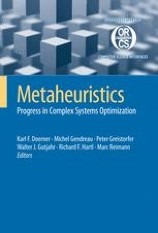
Metaheuristics : Progress in Complex Systems Optimization
The aim of METAHEURISTICS: Progress in Complex Systems Optimization is to provide several different kinds of information: a delineation of general metaheuristics methods, a number of state-of-the-art articles from a variety of well-known classical application areas as well as an outlook to modern computational methods in promising new areas. Therefore, this book may equally serve as a textbook in graduate courses for students, as a reference book for people interested in engineering or social sciences, and as a collection of new and promising avenues for researchers working in this field.

Metabolome Analyses : Strategies for Systems Biology
Metabolome Analyses is intended as a follow-up to Metabolic Profiling: Its Role in Biomarker Discovery and Gene Function Analysis (Kluwer, 2003). That text offered guidelines to currently available technology, bioinformatics and databases. Evidence was presented showing metabolic profiling as a valuable addition to genomics and proteomics strategies devoted to drug discovery and development. This book focuses on how metabolic profiling is being more comprehensively integrated with the other "omics" technologies. It provides more practical applications of such "panomics" or "Systems Biology" approaches. The expanding use of mass spectrometry as a measurement technology in metabolic profiling is addressed through demonstrated applications. The integration of metabolic profiling and proteomics is probably most developed for plant-based studies, which was not addressed in Volume 1. Other areas related to metabolic profiling continue to show significant development. These include database strategies and an increased acceptance by the pharmaceutical industry of metabolic profiling. Also covered is the use of in silico metabolic networks. Again the focus is primarily on the pharmaceutical industry but the importance of metabolic profiling to studies on human nutrition (a burgeoning area) is discussed.
