



Page 10
Page 10
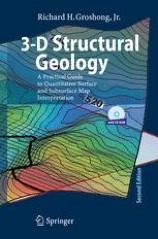
3-D Structural Geology : A Practical Guide to Quantitative Surface and Subsurface Map Interpretation
This book provides an overview of techniques for constructing structural interpretations in 2-D, 2½-D and 3-D environments; for interpolating - tween and extrapolating beyond the control points; and for validating the final int- pretation. The underlying philosophy is that structures are three-dimensional solid bodies and that data from throughout the structure, whether in 2-D or 3-D format, should be integrated into an internally consistent 3-D interpretation. It is assumed that most users of this book will do their work on a computer. C- sequently, the book provides quantitative structural methods and techniques that are designed for use with spreadsheets, mapping software, and three-dimensional c- puter-graphics programs. The book is also intended to provide the background for understanding what interpretive software, for example, a computer contouring p- gram, does automatically. Most techniques are presented in both a traditional format appropriate for paper, pencil, and a pocket calculator, and in quantitative format for use with spreadsheets and computer-graphics or computer-aided-design programs.
100 cases in obstetrics and gynaecology
Presents 100 obstetric- or gynaecology-related scenarios commonly seen by medical students and junior doctors in the emergency department, outpatient clinic or on the ward. A succinct summary of the patient's history, examination and initial investigations – including photographs where relevant – is followed by questions on the diagnosis and management of each case. The answer includes a detailed discussion on each topic, with further illustration where appropriate, providing an essential revision aid as well as a practical guide for students and junior doctors.
100 cases in clinical pathology and laboratory medicine
Presents 100 clinical scenarios commonly seen by medical students and junior doctors in the emergency department, outpatient clinic, operating theatre or in general practice. A succinct summary of the patient's history, examination and initial investigations is followed by questions on each case, with particular emphasis on the interpretation of the results and in which an understanding of the underlying clinical pathology is central to arriving at the correct diagnosis. The answer includes a detailed discussion on each topic, providing an essential revision aid as well as a practical guide for students and junior doctors, especially those preparing for undergraduate and postgraduate examinations.
100 cases in acute medicine
A succinct summary of the patient's history, examination and initial investigations, including photographs where relevant, is followed by questions on the diagnosis and management of each case. The answer includes a detailed discussion on each topic, with further illustration where appropriate, providing an essential revision aid as well as a practical guide for students and junior doctors. Making clinical decisions and choosing the best course of action is one of the most challenging and difficult parts of training to become a doctor. Fully revised and updated for this second edition, these cases will teach students and junior doctors to recognize important clinical symptoms and signs, and to develop their diagnostic and management skills.
