



Page 1
Page 1

Water resource systems planning and management : An introduction to methods, models, and applications
This revised, updated textbook presents a systems approach to the planning, management, and operation of water resources infrastructure in the environment. Previously published in 2005 by UNESCO and Deltares (Delft Hydraulics at the time), this new edition, written again with contributions from Jery R. Stedinger, Jozef P. M. Dijkman, and Monique T. Villars, is aimed equally at students and professionals. It introduces readers to the concept of viewing issues involving water resources as a system of multiple interacting components and scales. It offers guidelines for initiating and carrying out water resource system planning and management projects. It introduces alternative optimization, simulation, and statistical methods useful for project identification, design, siting, operation and evaluation and for studying post-planning issues.

Validity and reliability in built environment research : A selection of case studies
Presents case studies that emphasize reliability and validity in different examples of qualitative, quantitative and mixed method data sets, as well as covering action research and grounded theory. The reader is guided through case studies that demonstrate: An understanding of the reliability and validity approaches from social science and built environment perspectives in alignment with the relevant research philosophies, approaches and data collection strategies / Real research projects that have been conducted by expert researchers on topics such as Lean, BIM, Housing and Sustainability to answer specific or evolving questions in relation to the reliability and validity of research / A simple and easy method that students at Masters and PhD levels can relate to in order to adopt a sound reliability and validity approach to their research

Univariate Time Series in Geosciences : Theory and Examples
The author introduces the statistical analysis of geophysical time series. The book includes also a chapter with an introduction to geostatistics, many examples and exercises which help the reader to work with typical problems. More complex derivations are provided in appendix-like supplements to each chapter. Readers are assumed to have a basic grounding in statistics and analysis. The reader is invited to learn actively from genuine geophysical data. He has to consider the applicability of statistical methods, to propose, estimate, evaluate and compare statistical models, and to draw conclusions. This book is also a guide to using "R" for the statistical analysis of time series. "R" is a powerful environment for the statistical and graphical analysis of data."R" is available under GNU conditions.

Univariate Stable Distributions : Models for Heavy Tailed Data
Highlights the many practical uses of stable distributions, exploring the theory, numerical algorithms, and statistical methods used to work with stable laws. Because of the author’s accessible and comprehensive approach, readers will be able to understand and use these methods. Both mathematicians and non-mathematicians will find this a valuable resource for more accurately modelling and predicting large values in a number of real-world scenarios.The following chapters present the theory of stable distributions, a wide range of applications, and statistical methods, with the final chapters focusing on regression, signal processing, and related distributions. Each chapter ends with a number of carefully chosen exercises. Links to free software are included as well, where readers can put these methods into practice.

Tools and Algorithms for the Construction and Analysis of Systems ; 14th International Conference, TACAS 2008, Held as Part of the Joint European Conferences on Theory and Practice of Software, ETAPS 2008, Budapest, Hungary, March 29-April 6, 2008. Proceedings
The book is organized in topical sections on parameterized systems, model checking, applications, static analysis, concurrent/distributed systems, symbolic execution, abstraction, interpolation, trust, and reputation.

The Statistical Analysis of Recurrent Events
Recurrent event data arise in diverse fields such as medicine, public health, insurance, social science, economics, manufacturing and reliability. The purpose of this book is to present models and statistical methods for the analysis of recurrent event data. No single comprehensive treatment of these areas currently exists. The authors provide broad but detailed coverage of the major approaches to analysis, while also emphasizing the modeling assumptions that they are based on. Thus, they consider important models such as Poisson and renewal processes, with extensions to incorporate covariates or random effects.

The Nature of Statistical Evidence
The purpose of this book is to discuss whether statistical methods make sense. That is a fair question, at the heart of the statistician-client relationship, but put so boldly it may arouse anger. The many books entitled something like Foundations of Statistics avoid controversy by merely describing the various methods without explaining why certain conclusions may be drawn from certain data. But we statisticians need a better answer then just shouting a little louder. To avoid a duel, we prejudge the issue and ask the narrower question: "In what sense do statistical methods provide scientific evidence.

Teaching, Research and Academic Careers : An Analysis of the Interrelations and Impacts
Evaluates research quality, quality of teaching and the relationship between the two through sound statistical methods, and in a comparative perspective with other European countries. In so doing, it covers an increasingly important topic for universities that affects university funding. It discusses whether university evaluation should be limited to a single factor or consider multiple dimensions of research, since academic careers, teaching and awarding degrees are intertwined. The chapters included in the book evaluate teaching and research, also taking the gender dimension into account, in order to understand where and when gender discrimination occurs in assessment. Divided into five sections, the book analyses the administrative data on the determinants of career completion of university students; increasing precariousness of academic careers, especially of young researchers; methods designed to assess research productivity when co-authorship and team production are becoming the standard practice; and interrelations between students’ achievements and teachers’ careers driven by research assessment. It brings together contributions from a large group of economists, statisticians and social scientists working under a project sponsored by ANVUR, the Italian agency for the evaluation of teaching and research of academic institutions. From an international perspective, the findings in this book are particularly interesting because despite low tuition costs, tertiary education in Italy has relatively low enrolment rates and even lower completion rates compared to those in other European and American countries.

Statistics in the health sciences : Theory, applications, and computing
Introduces classical and novel statistical methods that can be used by theoretical and applied biostatisticians to develop efficient solutions for real-world problems encountered in clinical trials and epidemiological studies. The authors provide a detailed discussion of methodological and applied issues in parametric, semi-parametric and nonparametric approaches, including computationally extensive data-driven techniques, such as empirical likelihood, sequential procedures, and bootstrap methods. Many of these techniques are implemented using popular software such as R and SAS

Statistics for business and economics : Compendium of essential formulas, 3rd ed.
Includes explanations on the use of so-called dummy variables, which are useful because of their operational relevance in practice, especially in financial statistics. topics covered include: statistical signs and symbols, descriptive statistics, empirical distributions, ratios and indexes, correlation analysis, regression analysis, inferential statistics, probability, probability distributions, theoretical distributions, statistical estimation methods, confidence intervals, statistical testing methods, the peren-clement index, and standard statistical tables.

Statistics Applied to Clinical Trials
This book explains classical statistical analyses of clinical trials,andaddresses relatively novel issues, including equivalence testing, interim analyses, sequential analyses, and meta-analyses, and provides a framework of the best statistical methods currently available for such purposes.

Statistical quantitative methods in finance : From theory to quantitative portfolio management
Explores the theoretical foundations of statistical models, from ordinary least squares (OLS) to the generalized method of moments (GMM) used in econometrics. additionally, the book delves into non-linear methods and bayesian approaches, which are becoming increasingly popular among practitioners thanks to advancements in computational resources. the book also offers valuable insights into quantitative portfolio management, showcasing how traditional data science tools can be enhanced with machine learning models. these enhancements are illustrated through real-world examples from finance and econometrics, accompanied by python code.

Statistical Quality Control : Using MINITAB, R, JMP and Python
Introduces Statistical Quality Control and the elements of Six Sigma Methodology, illustrating the widespread applications that both have for a multitude of areas, including manufacturing, finance, transportation, and more. It places emphasis on both the theory and application of various SQC techniques and offers a large number of examples using data encountered in real life situations to support each theoretical concept.

Statistical Physics for Cosmic Structures
The physics of scale-invariant and complex systems is a novel interdisciplinary field. Its ideas allow us to look at natural phenomena in a radically new and original way, eventually leading to unifying concepts independent of the detailed structure of the systems. The objective is the study of complex, scale-invariant, and more general stochastic structures that appear both in space and time in a vast variety of natural phenomena, which exhibit new types of collective behaviors, and the fostering of their understanding. This book has been conceived as a methodological monograph in which the main methods of modern statistical physics for cosmological structures and density fields (galaxies, Cosmic Microwave Background Radiation, etc.) are presented in detail. The main purpose is to present clearly, to a workable level, these methods, with a certain mathematical accuracy, providing also some paradigmatic examples of applications.

Statistical Models and Methods for Financial Markets
Pesents statistical methods and models of importance to quantitative finance and links finance theory to market practice via statistical modeling and decision making. Part I provides basic background in statistics, which includes linear regression and extensions to generalized linear models and nonlinear regression, multivariate analysis, likelihood inference and Bayesian methods, and time series analysis. It also describes applications of these methods to portfolio theory and dynamic models of asset returns and their volatilities. Part II presents advanced topics in quantitative finance and introduces a substantive-empirical modeling approach to address the discrepancy between finance theory and market data. It describes applications to option pricing, interest rate markets, statistical trading strategies, and risk management.

Statistical Methods in Quantum Optics 2 : Non-Classical Fields
Statistical Methods in Quantum Optics 2 - Non-Classical Fields continues the development of the methods used in quantum optics to treat open quantum systems and their fluctuations. Its early chapters build upon the phase-space methods introduced in the first volume Statistical Methods in Quantum Optics 1 - Matter Equations and Fokker-Planck Equations: the difficulties these methods face in treating non-classical light are exposed, where the regime of large fluctuations – failure of the system size expansion – is shown to be particularly problematic. Cavity QED is adopted as a natural vehicle for extending quantum noise theory into this regime. In response to the issues raised, the theory of quantum trajectories is presented as a universal approach to the treatment of fluctuations in open quantum systems.

Statistical Methods in Molecular Evolution
This book provides an overview of the statistical theory and methods used in studies of molecular evolution. It includes an introductory section suitable for readers that are new to the field, a section discussing practical methods for data analysis, and more specialized sections discussing specific models and addressing statistical issues relating to estimation and model choice. The chapters are written by the leaders in the field and they will take the reader from basic introductory material to the state-of the-art statistical methods.

Statistical Methods in Counterterrorism : Game Theory, Modeling, Syndromic Surveillance, and Biometric Authentication
All the data was out there to warn us of this impending attack, why didn't we see it?" This was a frequently asked question in the weeks and months after the terrorist attacks on the World Trade Center and the Pentagon on September 11, 2001. In the wake of the attacks, statisticians moved quickly to become part of the national response to the global war on terror. This book is an overview of the emerging research program at the intersection of national security and statistical sciences.
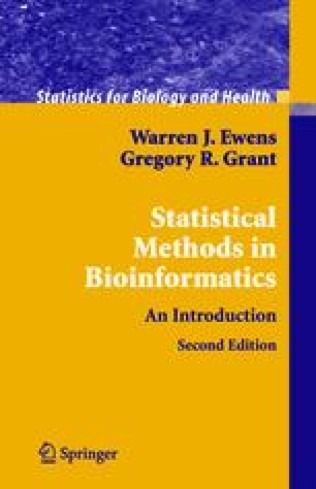
Statistical Methods in Bioinformatics : An Introduction
Advances in computers and biotechnology have had a profound impact on biomedical research, and as a result complex data sets can now be generated to address extremely complex biological questions. Correspondingly, advances in the statistical methods necessary to analyze such data are following closely behind the advances in data generation methods. The statistical methods required by bioinformatics present many new and difficult problems for the research community. This book provides an introduction to some of these new methods. The main biological topics treated include sequence analysis, BLAST, microarray analysis, gene finding, and the analysis of evolutionary processes. The main statistical techniques covered include hypothesis testing and estimation, Poisson processes, Markov models and Hidden Markov models, and multiple testing methods.

Statistical Methods for Human Rights
Human rights issues are shaping the modern world. They define the expectations by which nations are judged and affect the policy of governments, corporations, and foundations. They have set the agenda in prosecutions at the International Criminal Court at the Hague, funding decisions by the International Monetary Fund, and corporate expansion programs by multinationals. Statistics is central to the modern perspective on human rights. It allows researchers to measure the effect of health care policies, the penetration of educational opportunity, and progress towards gender equality. The new wave of entrepreneurial charities demands impact assessments and documentation of milestone achievement. Non-governmental organizations need statistics to build cases, conduct surveys, and target their efforts.
