



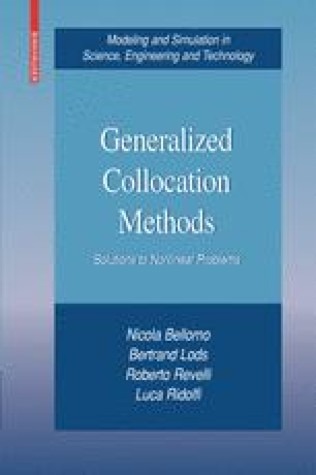
Generalized collocations methods : Solutions to nonlinear problems
This book examines various mathematical tools—based on generalized collocation methods—to solve nonlinear problems related to partial differential and integro-differential equations. Covered are specific problems and models related to vehicular traffic flow, population dynamics, wave phenomena, heat convection and diffusion, transport phenomena, and pollution. Based on a unified approach combining modeling, mathematical methods, and scientific computation, each chapter begins with several examples and problems solved by computational methods; full details of the solution techniques used are given. The last section of each chapter provides problems and exercises giving readers the opportunity to practice using the mathematical tools already presented.
Related Books

Recent advances in industrial and applied mathematics
Contains review papers authored by thirteen plenary invited speakers to the 9th International Congress on Industrial and Applied Mathematics (Valencia, July 15-19, 2019). The scientific contributions cover a wide range of cutting-edge topics of industrial and applied mathematics: mathematical modeling, industrial and environmental mathematics, mathematical biology and medicine, reduced-order modeling and cryptography.

Principles of statistics for engineers and scientists
Emphasizes statistical methods and how they can be applied to problems in science and engineering. The book contains many examples that feature real, contemporary data sets, both to motivate students and to show connections to industry and scientific research. Because statistical analyses are done on computers, the book contains exercises and examples that involve interpreting, as well as generating, computer output.

Malliavin Calculus for Lévy Processes with Applications to Finance
While the original works on Malliavin calculus aimed to study the smoothness of densities of solutions to stochastic differential equations, this book has another goal. It portrays the most important and innovative applications in stochastic control and finance, such as hedging in complete and incomplete markets, optimisation in the presence of asymmetric information and also pricing and sensitivity analysis. In a self-contained fashion, both the Malliavin calculus with respect to Brownian motion and general Lévy type of noise are treated. Besides, forward integration is included and indeed extended to general Lévy processes. The forward integration is a recent development within anticipative stochastic calculus that, together with the Malliavin calculus, provides new methods for the study of insider trading problems.

Basic Probability Theory with Applications
This book presents elementary probability theory with interesting and well-chosen applications that illustrate the theory. An introductory chapter reviews the basic elements of differential calculus which are used in the material to follow. The theory is presented systematically, beginning with the main results in elementary probability theory. This is followed by material on random variables. Random vectors, including the all important central limit theorem, are treated next. The last three chapters concentrate on applications of this theory in the areas of reliability theory, basic queuing models, and time series. Examples are elegantly woven into the text and over 400 exercises reinforce the material and provide students with ample practice.
