



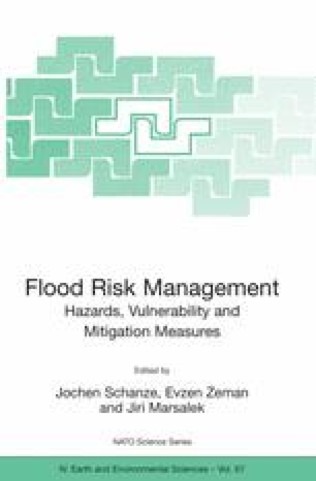
Flood Risk Management : Hazards, Vulnerability and Mitigation Measures
Floods are of increasing public concern world-wide due to increasing damages and unacceptably high numbers of injuries. Previous approaches of flood protection led to limited success especially during recent extreme events. Therefore, an integrated flood risk management is required which takes into consideration both the hydrometeorogical and the societal processes. Moreover, real effects of risk mitigation measures have to be critically assessed. The book draws a comprehensive picture of all these aspects and their interrelations. It furthermore provides a lot of detail on earth observation, flood hazard modelling, climate change, flood forecasting, modelling vulnerability, mitigation measures and the various dimensions of management strategies. In addition to local and regional results of science, engineering and social science investigations on modelling and management, transboundary co-operation of large river catchments are of interest.
Related Books

Microplastic in the Environment : Pattern and Process
This book examines global plastic pollution, an issue that has become a critical societal challenge with implications for environmental and public health. This volume provides a comprehensive, holistic analysis on the plastic cycle and its subsequent effects on biota, food security, and human exposure. Importantly, global environmental change and its associated, systems-level processes, including atmospheric deposition, ecosystem complexity, UV exposure, wind patterns, water stratification, ocean circulation, etc., are all important direct and indirect factors governing the fate, transport and biotic and abiotic processing of plastic particles across ecosystem types.
Green economy in the transport sector : A case study of Limpopo Province, South Africa
This book provides policy framework on “towards a Green Economy in the Transport Sector” draws inspiration from the UNEP report on Green Economy Modeling (2014), which focused on South Africa with respect to Transport, Natural Resource Management, Agriculture, and Energy sectors. This is because in the last 10 years natural resources, environmental risks and ecological issues have come to the attention of the international community because the subject is fundamentally important for overarching sustainable growth. It is important to note that environmental problems such as greenhouse gas emissions and climate change in different regions of the world including South Africa result in significant problems.
From decoding turbulence to unveiling the fingerprint of climate change : Klaus Hasselmann—Nobel Prize Winner in Physics 2021
Serves as a reference for the key elements and their significance of Klaus Hasselmann's work on climate science and on ocean wave research, all based on a rigorous and deeply physical thinking. It summarizes the original articles (mostly from the 1970 and 1980s; some of which are hard to find nowadays) and brings them in a present-day context.
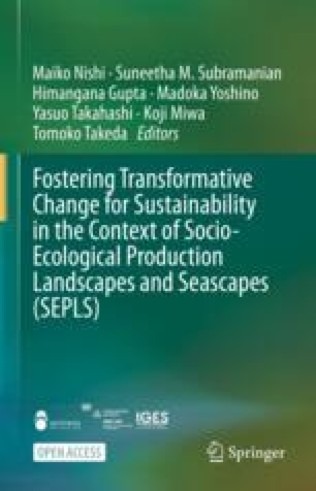
Fostering transformative change for sustainability in the context of socio-ecological production landscapes and seascapes (SEPLS)
This book is a compilation of case studies that provide useful knowledge and lessons that derive from on-the-ground activities and contribute to policy recommendations, focusing on the relevance of social-ecological production landscapes and seascapes (SEPLS) to “transformative change.” The concept of “transformative change” has been gaining more attention to deal with today’s environmental and development problems, whereas both policy and scientific communities have been increasingly calling for transformative change toward sustainable society. The Intergovernmental Science-Policy Platform on Biodiversity and Ecosystem Services (IPBES) has planned to start the so-called “assessment on transformative change” if approved by the IPBES plenary to be held in 2021
