



Page 1
Page 1
Nutrient Cycling in Terrestrial Ecosystems
The first part of the book presents the fundamentals of nutrient cycling. Topics included are cycling of carbon, nitrogen, phosphorus, sulphur and micronutrients. The second part discusses nutrient cycling at an ecosystem scale, covering cropping systems, pastures, natural grasslands, arid lands, tundras and forests. The final chapter reviews current models of nutrient cycling.

Micromammals and Macroparasites : From Evolutionary Ecology to Management
Small mammals are among the most ubiquitous and important components of terrestrial ecosystems. They have coevolved, and now coexist, with a diverse array of parasites, such that not only are all aspects of their biology influenced by parasitism but they also play key roles in the transmission and maintenance of parasitic diseases. This book provides a comprehensive survey of the diversity and biology of metazoan parasites affecting small mammals, of their impact on host individuals and populations, and of the management implications of these parasites for conservation biology and human welfare. Designed for a broad, multidisciplinary audience, it will be an essential resource for researchers, students, and practitioners alike in the fields of parasitology, evolutionary ecology, wildlife management, and conservation biology.

Insects and Ecosystem Function
In the past two decades, an increasing number of ecologists have started to investigate the importance of biodiversity for ecological processes such as energy flow and nutrient cycling, often referred to as 'ecosystem functioning'. Insects are a dominant component of biodiversity in terrestrial ecosystems and play a key role in mediating the relationship between plants and ecosystem processes. This volume is the first to summarize their effects on ecosystem functioning, focusing mainly, but not exclusively, on herbivorous insects. Renowned authors with extensive experience in the field of plant-insect interactions, contribute to the volume using examples from their own work. In addition to providing concise reviews of the field, this volume discusses in detail the advantages and disadvantages of various techniques of manipulating insect herbivory. Thus, the text provides both a theoretical basis as well as practical advice for future manipulative studies of biodiversity-ecosystem functioning.
Forest ecosystems and environments : Scaling up from shoot module to watershed
The Global Change Impacts on Terrestrial Ecosystems in Monsoon Asia (TEMA) project was carried out as a unique contribution to the international project Global Change and Terrestrial Ecosystems. TEMA aimed to integrate forest ecosystem processes. This volume presents the scaling-up concept for better understanding of ecosystem functioning.

Ecological Informatics : Scope, Techniques and Applications
Ecological Informatics promotes interdisciplinary research between ecology and computer science on elucidation of principles of information processing in ecosystems, ecological sustainability by informed decision making, and bio-inspired computation. The 2nd edition of the book consolidates the scope, concepts, and techniques of this newly emerging discipline by a new preface and additional chapters on cellular automata, qualitative reasoning, hybrid evolutionary algorithms and artificial neural networks. It illustrates numerous applications of Ecological Informatics for aquatic and terrestrial ecosystems, image recognition at micro- and macro-scale as well as computer hardware design.

Dryland Ecohydrology
By combining the analysis of biotic and abiotic components of terrestrial ecosystems, this volume provides a synthesis of material on arid and semiarid landscapes, which is currently scattered in a number of books and journal articles. The focus on water-limited ecosystems is motivated by their high sensitivity to daily, seasonal, and decadal perturbations in water availability, and by the ecologic, climatic, and economic significance of most of the world's drylands. Conceived as a tool for scientists working in the area of the earth and environmental sciences, this book presents the basic principles of eco-hydrology as well as a broad spectrum of topics and advances in this research field.

Land-Use and Land-Cover Change : Local Processes and Global Impacts
The book presents recent estimates of the rates in changes of major land classes such as forest, cropland and pasture. Among the causative mechanisms behind land change, synergetic factor combinations are found to be more common than single key factor explanations. Aggregated globally, multiple impacts of local land changes are shown to significantly affect central aspects of Earth System functioning. Innovative developments and applications in the fields of modeling and scenario construction are presented. Finally, conclusions are drawn about the most pressing implications for the design of appropriate intervention policies, and on new directions and frontiers of research.
Chernobyl: Catastrophe and Consequences
The long-term effects of the Chernobyl incident on the environment are still becoming apparent, twenty years after the event. This book, written by two researchers with frontline experience in this field, provides a detailed review of these over a wide range of ecosystems. It also discusses the responses and countermeasures utilised to combat the effects of the accident, as well as considering the health, social, psychological and economic impacts on the human population. Chernobyl - Catastrophe and Consequences / provides a comprehensive assessment of the Chernobyl accident and its long-term consequences draws on the most recent measurements of contamination in the terrestrial and aquatic food chains / discusses the sociological consequences of such disasters in detail / This book adds valuable weight to the debate about the environmental cost of nuclear power and the issue of nuclear safety.
Carbon and nitrogen in the terrestrial environment
Carbon and Nitrogen in the Terrestrial Environment is a comprehensive, interdisciplinary description of C and N fluxes between the atmosphere and the terrestrial biosphere; issues related to C and N management in different ecosystems and their implications for the environment and global climate change; and the approaches to mitigate emission of greenhouse gases.Drawing upon the most up-to-date books, journals, bulletins, reports, symposia proceedings and internet sources documenting interrelationships between different aspects of C and N cycling in the terrestrial environment, Carbon and Nitrogen in the Terrestrial Environment fills the gap left by most of the currently available books on C and N cycling. They either deal with a single element of an ecosystem, or are related to one or a few selected aspects like soil organic matter (SOM) and agricultural or forest management, emission of greenhouse gases, global climate change or modeling of SOM dynamics.
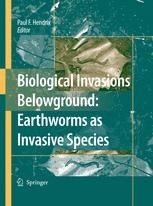
Biological Invasions Belowground : Earthworms as Invasive Species
he most conspicuous biological invasions in terrestrial ecosystems have been by exotic plants, insects and vertebrates. Less conspicuous but possibly of equal importance are invasions by soil invertebrates, which are occurring literally beneath our feet. Familiar examples include the South American fire ant (Solenopsis invicta) which has invaded North America and Australia, and the New Zealand flatworm (Arthurdendyus triangulatus) which has become wide-spread in the United Kingdom; both have caused considerable ecological and economic damage. There is now evidence that exotic earthworm invasions are increasing world-wide and may be having significant impacts on soil processes and plant communities in some regions. Much remains to be learned about these ‘cryptic’ biological invasions. The papers in this book are based on efforts by an international group of soil ecologists to assess the biological and ecological mechanisms of earthworm invasions, their geographic extent and impacts on terrestrial ecosystems, and possible means by which earthworm invasions might be mitigated.

Acid Rain - Deposition to Recovery
Acid rain is still with us. Although it is a problem that people have worked diligently to solve, there are still many problem areas throughout the world. In reality the focus of acid rain research has shifted, and this book adds new vision to the topic. It contains papers, selected from Acid Rain 2005, the 7th International Conference on Acid Deposition, that take a broad perspective of the issues, emphasizing a number of themes: - the emission, concentration and deposition of pollutants / - nitrogen and trace elements in ecosystems and their effects on forests, water and soil / - studies of material damage and recovery - critical loads / The book is aimed at scientists and researchers who are working in the area of acid rain and its effects, and on nutrient cycling. This latest research will be of value to those concerned with the mitigation of acid rain effects.
