



Page 1
Page 1

Multinational Enterprises, Foreign Direct Investment and Growth in Africa : South African Perspectives
How can Africa, the world’s most lagging region, benefit from globalisation and achieve sustained economic growth? Africa needs greater investment by Multinational Enterprises (MNEs) to improve competitiveness and generate more growth through positive spill-over effects. Despite the fact that Africa’s returns on investment averaged 29% since 1990, Africa has gained merely 1% of global Foreign Direct Investment (FDI) flows. The challenge for African countries is how to be a more desirable destination for FDI. The study integrates three currents of economic research, namely from the literature on (endogenous) economic growth, convergence and regional integration, the explanations for Africa’s poor growth and the growing understanding of the role of MNEs in a global economy. The empirical side of the book is based on an econometric study of the determinants of FDI in Africa as well as a detailed firm-level survey conducted in 2000.

Multilateralism, regionalism and bilateralism in trade and investment : 2006 World report on regional integration
The present first volume of the World Report on Regional Integration is a timely product of the research undertaken at UNU-CRIS. This new series of World Reports will certainly contribute to the discussion on the interaction between regional and global governance. And by bringing together insights from different parts of the UN system, in particular the five UN regional economic commissions and UNCTAD, this report will also contribute to a better understanding of the role of regions in the UN.

Monetary Policy and Macroeconomic Stabilization in Latin America
Latin America is a very important region of the globe, which has been buffeted by successive waves of economic instability within the last decades. These waves have caused several episodes of hyperinflation or near hyperinflation, and several currency and financial crises, which, in certain moments, have even spilled over and affected other emerging markets. This has resulted in huge costs in terms of lost potential growth, and, as is inevitable, the markets most affected by this have been the least capable of defending themselves. In a region plagued by still considerable rates of social exclusion, with some of the highest rates of income concentration in the whole globe, the human costs of these crises have been very substantial. Starting in the early 1990s, the slow implementation of reforms, plus the resumption of more sustained growth—to a substantial degree linked to the increase in commodity prices, especially since the early 2000s—seems to have resulted in a more stable situation. Initially, in early reformers like Chile, later in the larger economies of the region, like Brazil and Mexico, a consensus— embraced by both sides of the political spectrum—towards integration in global markets, both in their trade and financial components, floating exchange rates, independent monetary authorities, and sustainable fiscal policies has emerged.

International business
Provides thorough coverage, delving into fundamental concepts and theory; the cultural, political, and economic environment; international business strategies; and even functional management areas. More comprehensive than competing books, this new edition of International Business includes: New chapter on the digitalization of the global economy and its implications for firm strategy and organizations New examinations of the forces of de-globalization, implications of rising trade protectionism, challenges of geopolitical conflicts, and a friction framework for understanding the effects of cultural differences Enriched and expanded discussions about potential reconfigurations of global value chains following the Covid-19 pandemic, changing perspectives on the role of the government with renewed attention to industrial policy, shifts in regional integration with the emergence of such new trade blocks as CPTPP and RCEP, and fresh insights on factors influencing a country's balance of payments Strengthened, expanded global cases, examples, and "industry" and "country" mini-cases that give students practical insight into the ways companies actually behave within a competitive, global environment.
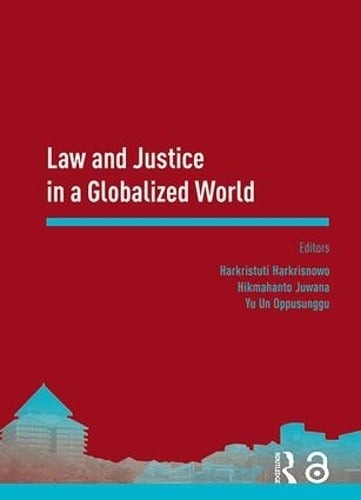
Law and Justice in a globalized world
Consists of a selection of papers presented at the Asia-Pacific Research Conference on Social Sciences and Humanities. It contains essays on current legal issues in law and justice, and their role and transformation in a globalizing world. Topics covered include human rights, criminal law, law of the sea, good governance, democracy, foreign investment, and regional integration. The conference focused on Asia and the Pacific, two regions where law has taken an important position in creating and shaping the regional integrations, new legal institutions, and norms.
