



Page 1
Page 1

Online Storage Systems and Transportation Problems with Applications : Optimization Models and Mathematical Solutions
This books covers the analysis and development of online algorithms involving exact optimization and heuristic techniques, and their application to solve two real life problems. The first problem is concerned with a complex technical system: a special carousel based high-speed storage system - Rotastore. It is shown that this logistic problem leads to an NP-hard Batch PreSorting problem which is not easy to solve optimally in offline situations. The second problem originates in the health sector and leads to a vehicle routing problem. Reasonable solutions for the offline case covering a whole day with a few hundred orders are constructed with a heuristic approach, as well as by simulated annealing. Optimal solutions for typical online instances are computed by an efficient column enumeration approach leading to a set partitioning problem and a set of routing-scheduling subproblems. The latter are solved exactly with a branch-and-bound method which prunes nodes if they are value-dominated by previous found solutions or if they are infeasible with respect to the capacity or temporal constraints.
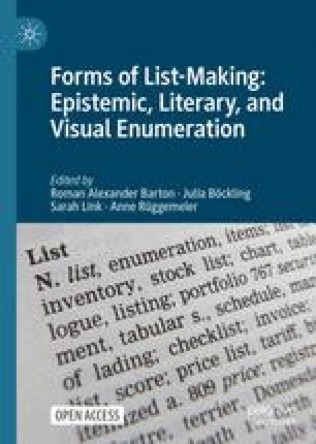
Forms of List-Making : Epistemic, Literary, and Visual Enumeration
This book attempts to show that an examination of the list’s formal features has the potential to produce genuine insights into the production of knowledge, the poetics of literature and the composition of visual art. Following a conceptual introduction, the twelve single-authored chapters place the list in a variety of well-researched contexts, including ancient Roman historiography, medieval painting, Enlightenment periodicals, nineteenth-century botanical geography, American Beat poetry and contemporary photobooks.
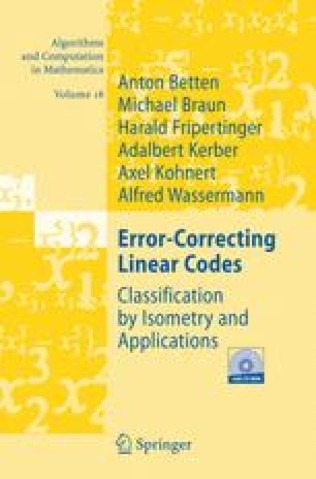
Error-Correcting Linear Codes : Classification by Isometry and Applications
This text offers a thorough introduction to the mathematical concepts behind the theory of error-correcting linear codes. Care is taken to introduce the necessary algebraic concepts, for instance the theory of finite fields, the polynomial rings over such fields and the ubiquitous concept of group actions that allows the classification of codes by isometry. The book provides in-depth coverage of important topics like cyclic codes and the coding theory used in compact disc players. The final four chapters cover advanced and algorithmic topics like the classification of linear codes by isometry, the enumeration of isometry classes, random generation of codes, the use of lattice basis reduction to compute minimum distances, the explicit construction of codes with given parameters, as well as the systematic evaluation of representatives of all isometry classes of codes.
Computing the Continuous Discretely : Integer-Point Enumeration in Polyhedra
This textbook illuminates the field of discrete mathematics with examples, theory, and applications of the discrete volume of a polytope. The authors have weaved a unifying thread through basic yet deep ideas in discrete geometry, combinatorics, and number theory.

Computer science : Theory and applications ; 15th International computer science symposium in Russia, CSR 2020, Yekaterinburg, Russia, June 29 – July 3, 2020, Proceedings
This book constitutes the proceedings of the 15th International Computer Science Symposium in Russia, CSR 2020, held in Yekaterinburg, Russia, in June 2020. The 25 full papers and 6 invited papers were carefully reviewed and selected from 49 submissions. The papers cover a broad range of topics, such as: algorithms and data structures; computational complexity, including hardness of approximation and parameterized complexity; randomness in computing, approximation algorithms, fixed-parameter algorithms; combinatorial optimization, constraint satisfaction, operations research; computational geometry; string algorithms; formal languages and automata, including applications to computational linguistics; codes and cryptography; combinatorics in computer science; computational biology; applications of logic to computer science, proof complexity; database theory; distributed computing; fundamentals of machine learning, including learning theory, grammatical inference and neural computing; computational social choice; quantum computing and quantum cryptography; theoretical aspects of big data.

Combinatorics of Coxeter Groups
Coxeter groups are of central importance in several areas of algebra, geometry, and combinatorics. This clear and rigorous exposition focuses on the combinatorial aspects of Coxeter groups, such as reduced expressions, partial order of group elements, enumeration, associated graphs and combinatorial cell complexes, and connections with combinatorial representation theory. While Coxeter groups have already been exposited from algebraic and geometric perspectives, this text is the first one to focus mainly on the combinatorial aspects of Coxeter groups. The first part of the book provides a self-contained introduction to combinatorial Coxeter group theory. The emphasis here is on the combinatorics of reduced decompositions, Bruhat order, weak order, and some aspects of root systems. The second part deals with more advanced topics, such as Kazhdan-Lusztig polynomials and representations, enumeration, and combinatorial descriptions of the classical finite and affine Weyl groups. A wide variety of exercises, ranging from easy to quite difficult are also included.

Combinatorial Stochastic Processes : Ecole d'Eté de Probabilités de Saint-Flour XXXII - 2002
This volume contains the course “Combinatorial stochastic processes” of Professor Pitman. We cordially thank the author for his performance in Saint-Flour and for these notesThere is particular focus on the theory of random combinatorial structures such as partitions, permutations, trees, forests, and mappings, and connections between the asymptotic theory of enumeration of such structures and the theory of stochastic processes like Brownian motion and Poisson processes.
A Course in Enumeration
Leads the reader in a leisurely way from the basic notions to a variety of topics, ranging from algebra to statistical physics. Its aim is to introduce the student to a fascinating field, and to be a source of information for the professional mathematician who wants to learn more about the subject.
