



Page 31
Page 31

Computational intelligence : Methods and techniques
This book focuses on various techniques of computational intelligence, both single ones and those which form hybrid methods. Those techniques are today commonly applied issues of artificial intelligence, e.g. to process speech and natural language, build expert systems and robots.

Computational Granular Dynamics : Models and Algorithms
Computer simulations not only belong to the most important methods for the theoretical investigation of granular materials, but also provide the tools that have enabled much of the expanding research by physicists and engineers. The present book is intended to serve as an introduction to the application of numerical methods to systems of granular particles. Accordingly, emphasis is placed on a general understanding of the subject rather than on the presentation of the latest advances in numerical algorithms. Although a basic knowledge of C++ is needed for the understanding of the numerical methods and algorithms in the book, it avoids usage of elegant but complicated algorithms to remain accessible for those who prefer to use a different programming language. While the book focuses more on models than on the physics of granular material, many applications to real systems are presented.

Computational Geometry : Algorithms and Applications
This introduction to computational geometry focuses on algorithms. Modern insights in computational geometry are used to provide solutions that are both efficient and easy to understand and implement.

Computational Electromagnetics
Computational Electromagnetics is a young and growing discipline, expanding as a result of the steadily increasing demand for software for the design and analysis of electrical devices. This book introduces three of the most popular numerical methods for simulating electromagnetic fields: the finite difference method, the finite element method and the method of moments. In particular it focuses on how these methods are used to obtain valid approximations to the solutions of Maxwell's equations, using, for example, "staggered grids" and "edge elements." The main goal of the book is to make the reader aware of different sources of errors in numerical computations, and also to provide the tools for assessing the accuracy of numerical methods and their solutions. To reach this goal, convergence analysis, extrapolation, von Neumann stability analysis, and dispersion analysis are introduced and used frequently throughout the book. Another major goal of the book is to provide students with enough practical understanding of the methods so they are able to write simple programs on their own. To achieve this, the book contains several MATLAB programs and detailed description of practical issues such as assembly of finite element matrices and handling of unstructured meshes.

Computational Discovery of Scientific Knowledge : Introduction, Techniques, and Applications in Environmental and Life Sciences
Advances in technology have enabled the collection of data from scientific observations, simulations, and experiments at an ever-increasing pace. For the scientist and engineer to benefit from these enhanced data collecting capabilities, it is becoming clear that semi-automated data analysis techniques must be applied to find the useful information in the data. Computational scientific discovery methods can be used to this end: they focus on applying computational methods to automate scientific activities, such as finding laws from observational data. In contrast to mining scientific data, which focuses on building highly predictive models, computational scientific discovery puts a strong emphasis on discovering knowledge represented in formalisms used by scientists and engineers, such as numeric equations and reaction pathways. This state-of-the-art survey provides an introduction to computational approaches to the discovery of scientific knowledge and gives an overview of recent advances in this area, including techniques and applications in environmental and life sciences.

Command-Line Rust : A Project-Based Primer for Writing Rust CLIs
Rather than focusing on the language as a whole, this guide teaches Rust using a single small, complete, focused program in each chapter. Author Ken Youens-Clark shows you how to start, write, and test each of these programs to create a finished product. You'll learn how to handle errors in Rust, read and write files, and use regular expressions, Rust types, structs, and more.

Combinatorics, Algorithms, Probabilistic and Experimental Methodologies ; 1st International Symposium, ESCAPE 2007, Hangzhou, China, April 7-9, 2007, Revised Selected Papers
This book address practical large data processing problems with different, and eventually converging, methodologies from major important disciplines such as computer science, combinatorics, and statistics. The symposium provides an interdisciplinary forum for researchers across their discipline boundaries to exchange their approaches, to search for ideas, methodologies, and tool boxes, to find better, faster and more accurate solutions thus fostering innovative ideas as well as to develop research agenda of common interest.

Combinatorial pattern matching ; Vol.4009) ; 17th Annual Symposium, CPM 2006, Barcelona, Spain, July 5-7, 2006, Proceedings
The book presents 33 revised full papers together with 3 invited talks, organized in topical sections on data structures, indexing data structures, probabilistic and algebraic techniques, applications in molecular biology, string matching, data compression, and dynamic programming

Combinatorial pattern matching ; 19th Annual Symposium, CPM 2008, Pisa, Italy, June 18-20, 2008 Proceedings
This book constitutes the refereed proceedings of the 19th Annual Symposium on Combinatorial Pattern Matching, CPM 2008, held in Pisa, Italy, in June 2008.

Combinatorial pattern matching ; 18th Annual Symposium, CPM 2007, London, Canada, July 9-11, 2007, Proceedings
This book presented original research contri- tions on computational pattern matching and analysis, data compression and compressed text processing, sufix arrays and trees, and computational biology. Combinatorial Pattern Matching addresses issues of searching and matching strings and more complicated patterns such as trees, regular expressions, graphs, point sets, and arrays.The goal is to derive non-trivial combinatorial properties of such structures and to exploit these properties in order to either achieve superior performance for the corresponding computational problems or pinpoint conditions under which searches cannot be performed eficiently.

Combinatorial Optimization in Communication Networks
Combinatorial optimization algorithms are used in many applications including the design, management, and operations of communication networks. The objective of this book is to advance and promote the theory and applications of combinatorial optimization in communication networks. The book collects a distinguished set of papers on subjects such as wireless communication systems, satellite networks, optical networks, and ad hoc networks. The topics covered range from topology control, routing optimization, and resource allocation to QoS provisioning. It is the first book that integrates rich theory from operations research with cutting-edge research in communication networks.

Combinatorial optimization and applications ; 2nd International Conference, COCOA 2008, St. John’s, NL, Canada, August 21-24, 2008. Proceedings
This book constitutes the refereed proceedings of the Second International Conference on Combinatorial Optimization and Applications, COCOA 2008, held in St. John's, Canada, in August 2008.

Combinatorial Optimization : Theory and Algorithms
Puts special emphasis on theoretical results and algorithms with provably good performance, in contrast to heuristics. It has arisen as the basis of several courses on combinatorial optimization and more special topics at graduate level. Since the complete book contains enough material for at least four semesters (4 hours a week), one usually selects material in a suitable way. The book contains complete but concise proofs, also for many deep results, some of which did not appear in a book before. Many very recent topics are covered as well, and many references are provided. Thus this book represents the state of the art of combinatorial optimization. This third edition contains a new chapter on facility location problems, an area which has been extremely active in the past few years. Furthermore there are several new sections and further material on various topics. New exercises and updates in the bibliography were added.

Combinatorial Optimization : Theory and Algorithms
Places special emphasis on theoretical results and algorithms with provably good performance, in contrast to heuristics. It has arisen as the basis of several courses on combinatorial optimization and more special topics at graduate level. It contains complete but concise proofs, also for many deep results, some of which did not appear in a textbook before. Many very recent topics are covered as well, and many references are provided. Thus this book represents the state of the art of combinatorial optimization.

Combinatorial Image Analysis ; 12th International Workshop, IWCIA 2008, Buffalo, NY, USA, April 7-9, 2008. Proceedings
This volume contains the proceedings of the 12th International Workshop on Combinatorial Image Analysis. Coverage includes digital geometry, curves and surfaces, applications of computational geometry, as well as medical imaging and biometrics.

Column Generation
Column Generation is an insightful overview of the state of the art in integer programming column generation and its many applications. The volume begins with "A Primer in Column Generation" which outlines the theory and ideas necessary to solve large-scale practical problems, illustrated with a variety of examples. Other chapters follow this introduction on "Shortest Path Problems with Resource Constraints," "Vehicle Routing Problem with Time Window," "Branch-and-Price Heuristics," "Cutting Stock Problems," each dealing with methodological aspects of the field. Three chapters deal with transportation applications: "Large-scale Models in the Airline Industry," "Robust Inventory Ship Routing by Column Generation," and "Ship Scheduling with Recurring Visits and Visit Separation Requirements." Production is the focus of another three chapters: "Combining Column Generation and Lagrangian Relaxation," "Dantzig-Wolfe Decomposition for Job Shop Scheduling," and "Applying Column Generation to Machine Scheduling." The final chapter by François Vanderbeck, "Implementing Mixed Integer Column Generation," reviews how to set-up the Dantzig-Wolfe reformulation, adapt standard MIP techniques to the column generation context (branching, preprocessing, primal heuristics), and deal with specific column generation issues (initialization, stabilization, column management strategies).

Cognitive engineering : A distributed approach to machine intelligence
Cognitive Engineering: A Distributed Approach to Machine Intelligence explores the design issues of intelligent engineering systems. Beginning with the foundations of psychological modeling of the human mind, the main emphasis is given to parallel and distributed realization of intelligent models for application in reasoning, learning, planning and multi-agent co-ordination problems. The last two chapters provide case studies on human-mood detection and control, and behavioral co-operation of mobile robots. This is the first comprehensive text of its kind, bridging the gap between Cognitive Science and Cognitive Systems Engineering. Each chapter includes plenty of numerical examples and exercises with sufficient hints, so that the reader can solve the exercises on their own. Computer simulations are also included in most chapters to give a clear idea about the application of the algorithms undertaken in the book. In addition, mathematical analysis on convergence and stability of the neuro-fuzzy models will enable the reader to pursue their research career in cognitive engineering.

Closing the POWER gap between ASIC & custom : Tools and techniques for low power design
Details design tools and techniques for realizing low power and energy efficiency in a highly productive design methodology.Important topics include: - Microarchitectural techniques to reduce energy per operation / - Power reduction with timing slack from pipelining / - Analysis of the benefits of using multiple supply and threshold voltages / - Placement techniques for multiple supply voltages - Verification for multiple voltage domains / - Improved algorithms for gate sizing, and assignment of supply and threshold voltages / - Power gating design automation to reduce leakage / - Relationships among statistical timing, power analysis, and parametric yield optimization / Design examples illustrate that these techniques can improve energy efficiency by two to three times.

Mathematical Modeling of Biological Systems ; Vol. II : Epidemiology, Evolution and Ecology,Immunology, Neural Systems and the Brain, and Innovative Mathematical Methods
This two-volume, interdisciplinary work is a unified presentation of a broad range of state-of-the-art topics in the rapidly growing field of mathematical modeling in the biological sciences. Highlighted throughout both works are mathematical and computational approaches to examine central problems in the life sciences, ranging from the organizational principles of individual cells to the dynamics of large populations.
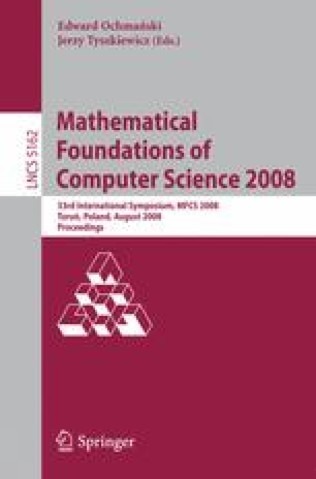
Mathematical Foundations of Computer Science 2008 ; 33rd International Symposium, MFCS 2008, Toru´n, Poland, August 25-29, 2008. Proceedings
Constitutes the refereed proceedings of the 33rd International Symposium on Mathematical Foundations of Computer Science, MFCS 2008, held in Torun, Poland, in August 2008.The 45 revised full papers presented together with 5 invited lectures were carefully reviewed and selected from 119 submissions. All current aspects in theoretical computer science and its mathematical foundations are addressed, ranging from algorithmic game theory, algorithms and data structures, artificial intelligence, automata and formal languages, bioinformatics, complexity, concurrency and petrinets, cryptography and security, logic and formal specifications, models of computations, parallel and distributed computing, semantics and verification.
