



Page 31
Page 31

Knowledge management : Value creation through organizational learning, 2nd
Features substantial updates to all chapters, reflecting the implications of the digital transformation on knowledge work and knowledge management. It also addresses three new topics: the impact of knowledge management practices on performance; knowledge management in the public sector; and an introduction to ISO 9001:2015 as an implementation framework.The book is intended not only for academic education but also as an essential guide for managers, consultants, trainers, coaches, and all those engaged in business, public administration or non-profit work who are interested in learning about organizations in a knowledge economy.

Knowledge Enterprise : Intelligent Strategies in Product Design, Manufacturing, and Management ; Proceedings of PROLAMAT 2006, IFIP TC5, International Conference, June 15-17 2006, Shanghai, China
Contains the edited version of the technical presentations of PROLMAT 2006, the IFIP TC5 international conference held on June 15-17, 2006 at the Shanghai University in China. The main theme of this conference is Knowledge Enterprise – Intelligent Strategies in Product Design, Manufacturing and Management. These proceedings focus on the issue of how to translate data and information into knowledge in manufacturing enterprises.

Knowledge and Institutions
Bridges the disciplinary boundaries within the social sciences to explore the role of social institutions in shaping geographical contexts, and in creating new knowledge. It includes theorizations as well as original empirical case studies on the emergence, maintenance and change of institutions as well as on their constraining and enabling effects on innovation, entrepreneurship, art and cultural heritage, often at regional scales across Europe and North America. Rooted in the disciplines of management and organization studies, sociology, geography, political science, and economics the contributors all take comprehensive approaches to carve out the specific contextuality of institutions as well as their impact on societal outcomes. Not only does this book offer detailed insights into current debates in institutional theory, it also provides background for scholars, students, and professionals at the intersection between regional development, policy-making, and regulation.
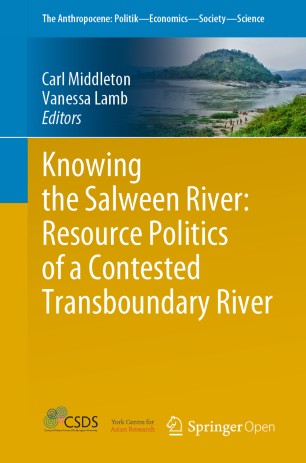
Knowing the Salween River : Resource Politics of a Contested Transboundary River
Focuses on the Salween River, shared by China, Myanmar, and Thailand, that is increasingly at the heart of pressing regional development debates. The basin supports the livelihoods of over 10 million people, and within it there is great socio-economic, cultural and political diversity. The basin is witnessing intensifying dynamics of resource extraction, alongside large dam construction, conservation and development intervention, that is unfolding within a complex terrain of local, national and transnational governance. With a focus on the contested politics of water and associated resources in the Salween basin, this book offers a collection of empirical case studies that highlights local knowledge and perspectives. Given the paucity of grounded social science studies in this contested basin, this book provides conceptual insights at the intersection of resource governance, development, and politics of knowledge relevant to researchers, policy-makers and practitioners at a time when rapid change is underway.

Kidney complications & transplantation
Kidney diseases are worldwide public health problems with a high cost and increasing incidence. By revealing the genetic and cellular mechanism behind mammalian kidney development, better diagnostic methods and novel therapies can be expected to be developed. The mammalian kidney is a typical organ that develops on the basis of sequential and reciprocal cell and tissue interactions. Pyelonephritis, Glomerulonephritis, Kidney stones, Nephrotic syndrome, and Acute or chronic kidney failure are the most complications in the kidney kingdom, so that living kidney transplantation has become the preferred treatment for those patients who can’t have the powerful capacity of the kidney function, and here it has a very rejection risk in the first month and we can controlled in this situation with long term immunosuppressant therapy involved in the post-transplantation protocol.
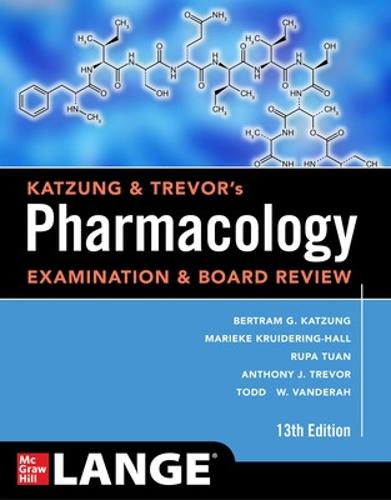
Katzung & Trevor's pharmacology : Examination & board review
Excellent Q & A and rationales for course exams and USMLE Step 1. With 1,000+ board-style questions/answers and fully up-to-date content, this is the most popular review in pharmacology. Organized to reflect the syllabi in pharmacology courses, Katzung & Trevor's Pharmacology Exam and Board Review covers all current drugs and retrovirals, immunologic agents, and chemotherapies. Each chapter begins with 20 pages of informative text, followed by questions and answers, and includes concise discussions of the concepts underlying basic principles or specific drug groups. Edited by the world leading figures in pharmacology and medicine, this high-yield text focuses on basic principles, autonomic drugs, cardiovascular-renal drugs, and drugs with actions on smooth muscle, central nervous system drugs, and drugs used to treat chemotherapeutic drugs, and toxicology.
Journal on Data Semantics XI
The LNCS Journal on Data Semantics is devoted to the presentation of notable work that, in one way or another, addresses research and development on issues related to data semantics. The scope of the journal ranges from theories supporting the formal definition of semantic content to innovative domain-specific applications of semantic knowledge. The journal addresses researchers and advanced practitioners working on the semantic web, interoperability, mobile information services, data warehousing, knowledge representation and reasoning, conceptual database modeling, ontologies, and artificial intelligence.
Journal on Data Semantics X
Web semantics and semi-structured data , Semantic caching , Data warehousing and semantic data mining , Spatial, temporal, multimedia and multimodal semantics , Semantics in data visualization , Semantic services for mobile users , Supporting tools , Applications of semantic-driven approaches These topics are to be understood as specifically related to semantic issues. Contributions submitted to the journal and dealing with semantics of data will be considered even if they are not from the topics in the list. While the physical appearance of the journal issues is like the books from the we- known Springer LNCS series, the mode of operation is that of a journal. Contributions can be freely submitted by authors and are reviewed by the Editorial Board.
Journal on Data Semantics VIII
Springer's LNCS Journal on Data Semantics aims at providing a highly visible dissemination channel for most remarkable work that in one way or another addresses research and development on issues related to the semantics of data. The target domain ranges from theories supporting the formal definition of semantic content to innovative domain-specific application of semantic knowledge. This publication channel should be of the highest interest to researchers and advanced practitioners working on the Semantic Web, interoperability, mobile information services, data warehousing, knowledge representation and reasoning, conceptual database modeling, ontologies, and artificial intelligence.
Journal on Data Semantics VII
The LNCS Journal on Data Semantics is devoted to the presentation of notable work that, in one way or another, addresses research and development on issues related to data semantics. Based on the highly visible publication platform Lecture Notes in Computer Science, this new journal is widely disseminated and available worldwide. The scope of the journal ranges from theories supporting the formal definition of semantic content to innovative domain-specific applications of semantic knowledge. The journal addresses researchers and advanced practitioners working on the semantic web, interoperability, mobile information services, data warehousing, knowledge representation and reasoning, conceptual database modeling, ontologies, and artificial intelligence.
Journal on Data Semantics VI
Data warehousing and semantic data mining • Spatial, temporal, multimedia and multimodal semantics • Semantics in data visualization • Semantic services for mobile users • Supporting tools • Applications of semantic-driven approaches These topics are to be understood as speci?cally related to semantic issues. Contributions submitted to the journal and dealing with semantics of data will be considered even if they are not within the topics in the list. While the physical appearanceof the journal issues looks like the books from the well-known Springer LNCS series, the mode of operation is that of a jo- nal. Contributions can be freely submitted by authors and are reviewed by the Editorial Board. Contributions may also be invited, and nevertheless carefully reviewed, as in the case for issues that contain extended versions of best papers from major conferences addressing data semantics issues. Special issues, foc- ing on a speci?c topic, are coordinated by guest editors once the proposal for a special issue is accepted by the Editorial Board.
Journal on Data Semantics V
The LNCS Journal on Data Semantics is devoted to the presentation of notable work that, in one way or another, addresses research and development on issues related to data semantics. Based on the highly visible publication platform Lecture Notes in Computer Science, this new journal is widely disseminated and available worldwide. The scope of the journal ranges from theories supporting the formal definition of semantic content to innovative domain-specific applications of semantic knowledge. The journal addresses researchers and advanced practitioners working on the semantic web, interoperability, mobile information services, data warehousing, knowledge representation and reasoning, conceptual database modeling, ontologies, and artificial intelligence.
Journal on Data Semantics IX
The LNCS Journal on Data Semantics is devoted to the presentation of notable work that, in one way or another, addresses research and development on issues related to data semantics. The scope of the journal ranges from theories supporting the formal definition of semantic content to innovative domain-specific applications of semantic knowledge.
Journal on Data Semantics IV
• Semantics in data visualization • Semantic services for mobile users • Supporting tools • Applications of semantic-driven approaches These topics are to be understood as specifically related to semantic issues. Contributions submitted to the journal and dealing with semantics of data will be considered even if they are not within the topics in the list. While the physical appearance of the journal issues is like the books from the we- known Springer LNCS series, the mode of operation is that of a journal. Contributions can be freely submitted by authors and are reviewed by the Editorial Board. Contributions may also be invited, and nevertheless carefully reviewed, as in the case for issues that contain extended versions of the best papers from major conferences addressing data semantics issues. Special issues, focusing on a specific topic, are coordinated by guest editors once the proposal for a special issue is accepted by the Editorial Board. Finally, it is also possible that a journal issue be devoted to a single text.
Journal on Data Semantics III
– semantic caching – data warehousing and semantic data mining – spatial, temporal, multimedia and multimodal semantics – semantics in data visualization – semantic services for mobile users – supporting tools – applications of semantic-driven approaches These topics are to be understood as speci?cally related to semantic issues. Contributions submitted to the journal and dealing with semantics of data will be considered even if they are not within the topics in the list. While the physical appearance of the journal issues looks like the books from the well-known Springer LNCS series, the mode of operation is that of a journal. Contributions can be freely submitted by authors and are reviewed by the Editorial Board. Contributions may also be invited, and nevertheless carefully reviewed, as in the case for issues that contain extended versions of best papers from major conferences addressing data semantics issues. Special issues, focusing on a speci?c topic, are coordinated by guest editors once the proposal for a special issue is accepted by the Editorial Board. Finally, it is also possible that a journal issue be devoted to a single text.
Journal on Data Semantics II
The LNCS Journal on Data Semantics is devoted to the presentation of notable work that, in one way or another, addresses research and development on issues related to data semantics. Based on the highly visible publication platform Lecture Notes in Computer Science, this new journal is widely disseminated and available worldwide. The scope of the journal ranges from theories supporting the formal definition of semantic content to innovative domain-specific applications of semantic knowledge. The journal addresses researchers and advanced practitioners working on the semantic web, interoperability, mobile information services, data warehousing, knowledge representation and reasoning, conceptual database modeling, ontologies, and artificial intelligence.
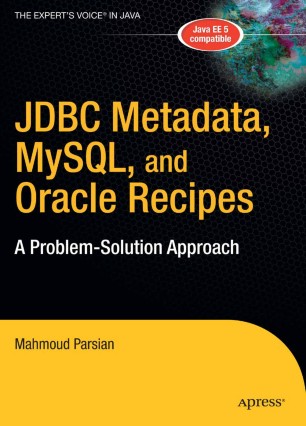
JDBC Metadata, MySQL, and Oracle Recipes : A Problem-Solution Approach
JDBC Metadata, MySQL, and Oracle Recipes is the only book that focuses on metadata or annotation-based code recipes for JDBC API for use with Oracle and MySQL. It continues where the authors other book, JDBC Recipes: A Problem-Solution Approach, leaves off. This edition is also a Java EE 5-compliant book, perfect for lightweight Java database development. And it provides cut-and-paste code templates that can be immediately customized and applied in each developer's application development.

Java Challenges 100+ : Proven Tasks that Will Prepare You for Anything
Expand your knowledge of Java with this entertaining learning guide, which features 100+ exercises and programming challenges. Java Challenges will prepare you for your next exam or job interview, and covers many practical topics, such as strings, arrays, data structures, recursion, and date and time. The APIs and other material included in this book are Java 17 compatible. You will: Improve your Java knowledge by solving enjoyable but challenging programming puzzles / Solve mathematical problems, recursions, strings, arrays and more / Manage data processing and data structures like lists, sets, maps / Handle advanced recursion as well as binary trees, sorting and searching / Gamify key fundamentals for fun and easier reinforcement
Java 17 Recipes : A Problem-Solution Approach
Quickly find solutions to dozens of common programming problems encountered while building Java applications, with recipes presented in the popular problem-solution format. Look up the programming problem that you want to resolve. Read the solution. Apply the solution directly in your own code. Problem solved! covers of some of the newest features, APIs, and more such as pattern matching for switch, Restore Always-Strict-Floating-Point-Semantics, enhanced pseudo-random number generators, the vector API, sealed classes, and enhancements in the use of String. Source code for all recipes is available in a dedicated GitHub repository. This must-have reference belongs in your library. You will learn : Look up solutions to everyday problems involving Java SE 17 LTS and other recent releases / Develop Java SE applications using the latest in Java SE technology / Incorporate Java major features introduced in versions 17, 16, and 15 into your code

Java 17 Quick Syntax Reference : A Pocket Guide to the Java SE Language, APIs, and Library
Packed with useful information and is a must-have for any Java programmer. You will: Run a Java file with a single command / Learn what a switch expression is and how to use it / Use pattern matching / Code with Java modules / Create text blocks to handle multiline strings / Learn what sealed classes are and how to use these and more
