



Page 25
Page 25

Defence Applications of Multi-Agent Systems; International Workshop, DAMAS 2005, Utrecht, The Netherlands, July 25, 2005, Revised and Invited Papers
This book constitutes the thoroughly refereed post-proceedings of the International Workshop on Defence Applications of Multi-Agent Systems, DAMAS 2005, held in Utrecht, The Netherlands in July 2005 as an associated event of AAMAS 2005, the main international conference on autonomous agents and multi-agent systems. The 10 revised full papers presented together with 1 invited article are organized in topical sections on decision support and simulation, unmanned aerial vehicles, as well as on systems and security.
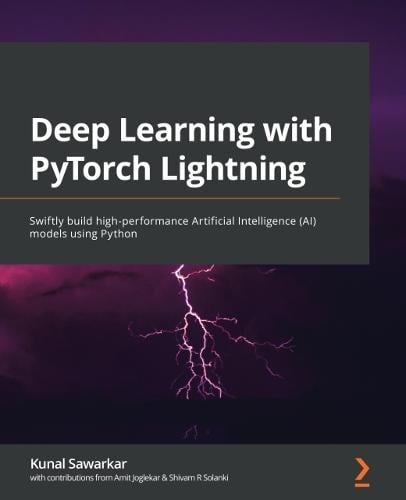
Deep Learning with PyTorch Lightning : Build and train high-performance artificial intelligence and self-supervised models using Python
You’ll learn how to configure PyTorch Lightning on a cloud platform, understand the architectural components, and explore how they are configured to build various industry solutions. You’ll build a neural network architecture, deploy an application from scratch, and see how you can expand it based on your specific needs, beyond what the framework can provide. In the later chapters, you’ll also learn how to implement capabilities to build and train various models like Convolutional Neural Nets (CNN), Natural Language Processing (NLP), Time Series, Self-Supervised Learning, Semi-Supervised Learning, Generative Adversarial Network (GAN) using PyTorch Lightning.

Deep learning pipeline : Building a deep learning model with TensorFlow
Build your own pipeline based on modern TensorFlow approaches rather than outdated engineering concepts. This book shows you how to build a deep learning pipeline for real-life TensorFlow projects. You'll learn what a pipeline is and how it works so you can build a full application easily and rapidly. Then troubleshoot and overcome basic Tensorflow obstacles to easily create functional apps and deploy well-trained models. Step-by-step and example-oriented instructions help you understand each step of the deep learning pipeline while you apply the most straightforward and effective tools to demonstrative problems and datasets.

Decomposition Techniques in Mathematical Programming : Engineering and Science Applications
This textbook for students and practitioners presents a practical approach to decomposition techniques in optimization. It provides an appropriate blend of theoretical background and practical applications in engineering and science, which makes the book interesting for practitioners, as well as engineering, operations research and applied economics graduate and postgraduate students. "Decomposition Techniques in Mathematical Programming" is based on clarifying, illustrative and computational examples and applications from electrical, mechanical, energy and civil engineering as well as applied mathematics and economics. It addresses decomposition in linear programming, mixed-integer linear programming, nonlinear programming, and mixed-integer nonlinear programming, and provides rigorous decomposition algorithms as well as heuristic ones.

Declarative programming for knowledge management ; 16th International conference on applications of declarative programming and knowledge management, INAP 2005, Fukuoka, Japan, October 22-24, 2005. Revised Selected Papers
Presents a selection of papers presented at the 16th Inter- tional Conference on Applications of Declarative Programming and Knowledge Management, INAP 2005,held in October 2005 at Waseda University, Fukuoka, Japan. These papers re?ect a snapshot of ongoing research and current app- cations in knowledge management and declarative programming.

Declarative agent languages and technologiesV ; 5th International Workshop, DALT 2007, Honolulu, HI, USA, May 14, 2007, Revised Selected and Invited Papers
This book constitutes the thoroughly refereed post-workshop proceedings of the 5th International Workshop on Declarative Agent Languages and Technologies, DALT 2007, held in Honolulu, USA, in 2007.

Declarative agent languages and technologies IV ; 4th International Workshop, DALT 2006, Hakodate, Japan, May 8, 2006, Selected, Revised and Invited Papers
Constitutes the thoroughly refereed post-proceedings of the 4th International Workshop on Declarative Agent Languages and Technologies, DALT 2006, held in Japan in May 2006. This was an associated event of AAMAS 2006, the main international conference on autonomous agents and multi-agent systems. The 12 revised full papers presented together with one invited talk and three invited papers were carefully selected for inclusion in the book.

Declarative agent languages and technologies III ; 3rd International Workshop, DALT 2005, Utrecht, The Netherlands, July 25, 2005, Selected and Revised Papers
The workshop on Declarative Agent Languages and Technologies is a we- established venue for researchers interested in sharing their experiences in the areas of declarative and formal aspects of agents and multi-agent systems, and in engineering and technology. Today it is still a challenge to develop techno- gies that can satisfy the requirements of complex agent systems. The design and development of multi-agent systems still calls for models and technologies that ensure predictability, enable feature discovery, allow for the veri?cation of properties, and guarantee ?exibility. Declarative approaches are potentially a valuable means for satisfying the needs of multi-agent system developers and for specifying multi-agent systems.

Declarative agent languages and technologies II ; 2nd international workshop, DALT 2004, New York, NY, USA, July 19, 2004, revised selected papers
Nearly 40 research groups worldwide were motivated to contribute to this event by submitting their most recent research achievements, covering a wide variety of the topics listed in the call for papers. More than 30 top researchers agreed to join the Program Committee, which then collectively faced the hard task of selecting the one-day event program. The fact that research in multi-agent systems is no longer only a novel and promising research horizon at dawn is, in our opinion, the main reason behind DALT’s (still short) success story. On the one hand, agent theories and app- cations are mature enough to model complex domains and scenarios, and to successfully address a wide range of multifaceted problems, thus creating the urge to make the best use of this expressive and versatile paradigm, and also pro?t from all the important results achieved so far. On the other hand, bui- ing multi-agent systems still calls for models and technologies that could ensure system predictability, accommodate ?exibility, heterogeneity and openness, and enable system veri?cation.

Decision Support for Forest Management
While earlier books concerning forest planning have tended to focus on linear programming, economic aspects, or specific multi-criteria decision aid tools, this book provides a much broader range of tools to meet a variety of planning situations. The methods themselves cover a range of decision situations – from cases involving single decision makers, through group decision making, to participatory planning. They include traditional decision support tools, from optimization to utility functions, as well as methods that are just gaining ground in forest planning – such as problem structuring methods and social choice theory. Including examples which illustrate the application of each technique to specific management planning problems, the book offers an invaluable resource for both researchers and advanced students specializing in management and planning issues relating to forestry.

Datatype-Generic Programming ; International Spring School, SSDGP 2006, Nottingham, UK, April 24-27, 2006, Revised Lectures
A leitmotif in the evolution of programming paradigms has been the level and extent of parametrisation that is facilitated — the so-called genericity of the paradigm. The sorts of parameters that can be envisaged in a programming language range from simple values, like integers and fioating-point numbers, through structured values, types and classes, to kinds (the type of types and/or classes).Datatype-generic programming is about parametrising programsby the structure of the data that they manipulate. To appreciate the importance of data type genericity,one need look no further than the internet. The internet is a massive repository of structured data, but the structure is rarely exploited. For example, compression of data can be much more efiective if its structure is known, but most compression algorithms regard the input data as simply a string of bits, and take no account of its internal organisation. Datatype-generic programming is about exploiting the structure of data when it is relevant and ignoring it when it is not. Programming languages most c- monly used at the present time do not provide efiective mechanisms for do- menting and implementing datatype genericity.

Databases and information systems ; 14th International Baltic Conference, DB&IS 2020, Tallinn, Estonia, June 16–19, 2020, Proceedings
This book constitutes the refereed proceedings of the 14th International Baltic Conference on Databases and Information Systems, DB&IS 2020, held in Tallinn, Estonia, in June 2020.* The 22 revised papers presented were carefully reviewed and selected from 52 submissions. The papers are centered around topics like architectures and quality of information systems, artificial intelligence in information systems, data and knowledge engineering, enterprise and information systems engineering, security of information systems.

Database Programming Languages ; 8th International Workshop, DBPL 2001, Frascati, Italy, September 8-10, 2001. Revised Papers
The papers here are organized in topical sections on semistructured data OL AP and data mining systems, schema integration, and index concurrency XML spatial databases user languages and rules.

Database Programming Languages ; 11th International Symposium, DBPL 2007, Vienna, Austria, September 23-24, 2007, Revised Selected Papers
This volume contains works at the intersection of database and programming language research.It also cover algorithms, XML query languages, inconsistency handling, data provenance, emerging data models, and type checking.

Database Programming Languages ; 10th international symposium, DBPL 2005, Trondheim, Norway, August 28-29, 2005, revised selected papers
Constitutes the refereed post-proceedings of the 10th International Workshop on Database Programming Languages, DBPL 2005. This book presents papers organized in topical sections on XML languages, XML and P2P data integration, XML query languages, types and XML, grammars, automata, and tree, as well as dependencies and constraints.

Database and XML Technologies ; Vol. 3671 ; 3rd international XML database symposium, XSym 2005, Trondheim, Norway, August 28-29, 2005, Proceedings
Constitutes the proceedings of the Third International XML Database Symposium, XSym 2005, held in Trondheim, Norway in August 2005. The 15 papers are organized in sections on indexing support for the evaluation of XPath and XQuery; benchmarks and algorithms for XQuery and XPath evaluation; algorithms for constraint satisfaction checking, and more.

Database and expert systems applications ; 31st International conference, DEXA 2020, Bratislava, Slovakia, September 14–17, 2020, Proceedings, Part I
The double volumes LNCS 12391-12392 constitutes the papers of the 31st International Conference on Database and Expert Systems Applications, DEXA 2020, which will be held online in September 2020. The 38 full papers presented together with 20 short papers plus 1 keynote papers in these volumes were carefully reviewed and selected from a total of 190 submissions.

Data structures and algorithm : Analysis in C++
An advanced algorithms book that bridges the gap between traditional CS2 and Algorithms Analysis courses. As the speed and power of computers increases, so does the need for effective programming and algorithm analysis. By approaching these skills in tandem, Mark Allen Weiss teaches readers to develop well-constructed, maximally efficient programs using the C++ programming language

Data structure and algorithms using C++ : A practical implementation
Intended to flow from the basic concepts of C++ to technicalities of the programming language, its approach and debugging. The chapters of the book flow with the formulation of the problem, it's designing, finding the step-by-step solution procedure along with its compilation, debugging and execution with the output. Keeping in mind the learner’s sentiments and requirements, the exemplary programs are narrated with a simple approach so that it can lead to creation of good programs that not only executes properly to give the output, but also enables the learners to incorporate programming skills in them. The style of writing a program using a programming language is also emphasized by introducing the inclusion of comments wherever necessary to encourage writing more readable and well commented programs. As practice makes perfect, each chapter is also enriched with practice exercise questions so as to build the confidence of writing the programs for learners.

Data science in theory and practice : Techniques for big data analytics and complex data sets
Delivers a comprehensive treatment of the mathematical and statistical models useful for analyzing data sets arising in various disciplines, like banking, finance, health care, bioinformatics, security, education, and social services. Written in five parts, the book examines some of the most commonly used and fundamental mathematical and statistical concepts that form the basis of data science. The authors go on to analyze various data transformation techniques useful for extracting information from raw data, long memory behavior, and predictive modeling. Readers will also learn from topics like: Analyses of foundational theoretical subjects, including the history of data science, matrix algebra and random vectors, and multivariate analysis A comprehensive examination of time series forecasting, including the different components of time series and transformations to achieve stationarity Introductions to both the R and Python programming languages, including basic data types and sample manipulations for both languages An exploration of algorithms, including how to write one and how to perform an asymptotic analysis A comprehensive discussion of several techniques for analyzing and predicting complex data sets
