



Page 24
Page 24
Frontiers in Algorithmics ; 2nd Annual International Workshop, FAW 2008, Changsha, China, June 19-21, 2008, Proceeedings
This book constitutes the refereed proceedings of the Second International Frontiers of Algorithmics Workshop, FAW 2008, held in Changsha, China, in June 2008.The 33 revised full papers presented together with the abstracts of 3 invited talks were carefully reviewed and selected from 80 submissions. The papers were selected for 9 special focus tracks in the areas of biomedical informatics, discrete structures, geometric information processing and communication, games and incentive analysis.

Frontiers in Algorithmics ; 1st Annual International Workshop, FAW 2007, Lanzhou, China, August 1-3, 2007, Proceedings
This book constitutes the refereed proceedings of the First Annual International Frontiers of Algorithmics Workshop, FAW 2007, held in Lanzhou, China in August 2007. The 33 revised full papers presented were carefully reviewed and selected from 141 submissions.
Frontiers in Algorithmics ; 14th International Workshop, FAW 2020, Haikou, China, October 19-21, 2020, Proceedings
This book constitutes the proceedings of the 14th International Workshop on Frontiers in Algorithmics, FAW 2020, held in Haikou, China, in May 2020. The conference was held virtually due to the COVID-19 pandemic. The 12 full papers presented in this volume were carefully reviewed and selected from 15 submissions. The workshop provides a focused forum on current trends of research on algorithms, discrete structures, and their applications, and brings together international experts at the research frontiers in these areas to exchange ideas and to present significant new results. The papers detail graph theory, scheduling and algorithm and complexity.
From Nano to Space : Applied Mathematics Inspired by Roland Bulirsch
Graduate students and postgraduates in Mathematics, Engineering and the Natural Sciences want to understand Applied Mathematics for the solution of everyday problems. Scholars of Roland Bulirsch working at universities, at research institutions and in industry combine research and review papers in this anthology. Their work is summed up under the title "From Nano to Space – Applied Mathematics Inspired by Roland Bulirsch". More than 20 contributions are divided into scales: nano, micro, macro, space and real life. The contributions survey current research and present case studies very interesting and informative for both graduate students and postgraduates. The contributions show how modern Applied Mathematics influences our everyday lives. Several contributions include complex graphics and illustrations, many of them in color.

Fractal Dimensions of Networks
The goal of the book is to provide a unified treatment of fractal dimensions of sets and networks. Since almost all of the major concepts in fractal dimensions originated in the study of sets, the book achieves this goal by first clearly presenting, with an abundance of examples and illustrations, the theory and algorithms for sets, and then showing how the theory and algorithms have been applied to networks. For example, the book presents the classical theory and algorithms for the box counting dimension for sets, and then presents the box counting dimension for networks. All the major fractal dimensions are studied, e.g., the correlation dimension, the information dimension, the Hausdorff dimension, the multifractal spectrum, as well as many lesser known dimensions. Algorithm descriptions are accompanied by worked examples, with many applications of the methods presented.
FPGA Implementations of Neural Networks
During the 1980s and early 1990s there was signi?cant work in the design and implementation of hardware neurocomputers. Nevertheless, most of these efforts may be judged to have been unsuccessful: at no time have have ha- ware neurocomputers been in wide use. This lack of success may be largely attributed to the fact that earlier work was almost entirely aimed at developing custom neurocomputers, based on ASIC technology, but for such niche - eas this technology was never suf?ciently developed or competitive enough to justify large-scale adoption. On the other hand, gate-arrays of the period m- tioned were never large enough nor fast enough for serious arti?cial-neur- network (ANN) applications.
Fourth IFIP International Conference on Theoretical Computer Science - TCS 2006 ; IFIP 19th World Computer Congress, TC-1, Foundations of Computer Science, August 23-24, 2006, Santiago, Chile
The IFIP series publishes state-of-the-art results in the sciences and technologies of information and communication. The scope of the series includes: foundations of computer science; software theory and practice; education; computer applications in technology; communication systems; systems modeling and optimization; information systems; computers and society; computer systems technology; security and protection in information processing systems; artificial intelligence; and human-computer interaction. Proceedings and post-proceedings of referred international conferences in computer science and interdisciplinary fields are featured. These results often precede journal publication and represent the most current research. The principal aim of the IFIP series is to encourage education and the dissemination and exchange of information about all aspects of computing.

Foundations of Trusted Autonomy
This book establishes the foundations needed to realize the ultimate goals for artificial intelligence, such as autonomy and trustworthiness. Aimed at scientists, researchers, technologists, practitioners, and students, it brings together contributions offering the basics, the challenges and the state-of-the-art on trusted autonomous systems in a single volume. The book is structured in three parts, with chapters written by eminent researchers and outstanding practitioners and users in the field. The first part covers foundational artificial intelligence technologies, while the second part covers philosophical, practical and technological perspectives on trust. Lastly, the third part presents advanced topics necessary to create future trusted autonomous systems. The book augments theory with real-world applications including cyber security, defence and space.

Foundations of software science and computational structures ; Vol.3441 : 8th International Conference, FOSSACS 2005, Held as part of the joint European conferences on theory and practice of software, ETAPS 2005
ETAPS 2005 was the eighth instance of the European Joint Conferences on Theory and Practice of Software. ETAPS is an annual federated conference that was est- lished in 1998 by combining a number of existing and new conferences. This year it comprised ?ve conferences (CC, ESOP, FASE, FOSSACS, TACAS), 17 satellite wo- shops (AVIS, BYTECODE, CEES, CLASE, CMSB, COCV, FAC, FESCA, FINCO, GCW-DSE, GLPL, LDTA, QAPL, SC, SLAP, TGC, UITP), seven invited lectures (not including those that were speci?c to the satellite events), and several tutorials. We - ceived over 550 submissions to the ?ve conferences this year, giving acceptance rates below 30% for each one. Congratulations to all the authors who made it to the ?nal program! I hope that most of the other authors still found a way of participating in this exciting event and I hope you will continue submitting. The events that comprise ETAPS address various aspects of the system devel- ment process, including speci?cation, design, implementation, analysis and impro- ment. The languages, methodologies and tools which support these activities are all well within its scope.
Foundations of Object-Oriented Programming Using .NET 2.0 Patterns
Foundations of Object-Oriented Programming Using .NET 2.0 Patterns solves the object-oriented and pattern-programming problem by mixing the two—the book teaches object-oriented concepts using patterns, or a solutions-based approach. The book's material is organized around tasks and patterns, and illustrated through development problems and solutions that include persistence, code efficiency, and good design. This book is of special interest to those who want to learn how to use .NET 2.0 Generics in conjunction with patterns. This unique book is based on the author's lectures, and the information unfolds in a practical manner.

Foundations of learning classifier systems
This volume brings together recent theoretical work in Learning Classifier Systems (LCS), which is a Machine Learning technique combining Genetic Algorithms and Reinforcement Learning. It includes self-contained background chapters on related fields (reinforcement learning and evolutionary computation) tailored for a classifier systems audience and written by acknowledged authorities in their area - as well as a relevant historical original work by John Holland.

Foundations of Intelligent Systems ; Vol. 3488 ; 15th International Symposium ISMIS 2005, Saratoga Springs, NY, USA, May 25-28, 2005, Proceedings
This volume contains the papers selected for presentation at the 15th International S- posiumonMethodologiesforIntelligentSystems, ISMIS2005, heldinSaratogaSprings, NewYork,25-28May,2005. ThesymposiumwasorganizedbySUNYatAlbany. Itwas sponsored by the Army Research Of?ce and by several units of the University at Albany including its Division for Research, College of Arts and Sciences, Department of C- puter Science, and Institute for Informatics, Logics, and Security Studies (formerly the Institute for Programming and Logics). The Program Committee selected the following major areas for ISMIS 2005: intelligent information systems, knowledge discovery and data mining, knowledge - formation and integration, knowledge representation, logic for arti?cial intelligence, soft computing, Web intelligence, Web services, and papers dealing with applications of intelligent systems in complex/novel domains. The contributed papers were selected from almost 200 full draft papers by the Program Committee members.

Foundations of Global Genetic Optimization
This book is devoted to the application of genetic algorithms in continuous global optimization. Some of their properties and behavior are highlighted and formally justified. Various optimization techniques and their taxonomy are the background for detailed discussion. The nature of continuous genetic search is explained by studying the dynamics of probabilistic measure, which is utilized to create subsequent populations. This approach shows that genetic algorithms can be used to extract some areas of the search domain more effectively than to find isolated local minima. The biological metaphor of such behavior is the whole population surviving by rapid exploration of new regions of feeding rather than caring for a single individual. One group of strategies that can make use of this property are two-phase global optimization methods. In the first phase the central parts of the basins of attraction are distinguished by genetic population analysis. Afterwards, the minimizers are found by convex optimization methods executed in parallel.

Foundations of Genetic Algorithms ; 9th International Workshop, FOGA 2007, Mexico City, Mexico, January 8-11, 2007, Revised Selected Papers
Readers will find here a fascinating text that is the thoroughly refereed post-proceedings of the 9th Workshop on the Foundations of Genetic Algorithms, FOGA 2007, held in Mexico City in January 2007.

Foundations of genetic algorithms ; 8th International Workshop, FOGA 2005, Aizu-Wakamatsu City, Japan, January 5-9, 2005, Revised Selected Papers
The8thWorkshopontheFoundationsofGeneticAlgorithms,FOGA-8,washeld at the University of Aizu in Aizu-Wakamatsu City, Japan, January 5–9, 2005. This series of workshops was initiated in 1990 to encourage further research on the theoretical aspects of genetic algorithms, and the workshops have been held biennially ever since. The papers presented at these workshops are revised, edited and published as volumes during the year following each workshop. This series of (now eight) volumes provides an outstanding source of reference for the theoretical work in this ?eld. At the same time this series of volumes provides a clear picture of how the theoretical research has grown and matured along with the ?eld to encompass many evolutionary computation paradigms including evolution strategies (ES), evolutionary programming (EP), and genetic programming (GP), as well as the continuing growthininteractionswith other ?elds suchas mathematics,physics, and biology.
Foundations of generic optimization ; Vol.2 : Applications of fuzzy control, genetic algorithms and neural networks
This is a comprehensive overview of the basics of fuzzy control, which also brings together some recent research results in soft computing, in particular fuzzy logic using genetic algorithms and neural networks. This book offers researchers not only a solid background but also a snapshot of the current state of the art in this field.

Foundations of generic optimization : Vol.1 : A combinatorial approach to epistasis
This is a comprehensive overview of the basics of fuzzy control, which also brings together some recent research results in soft computing, in particular fuzzy logic using genetic algorithms and neural networks. This book offers researchers not only a solid background but also a snapshot of the current state of the art in this field.

Foundations of fuzzy logic and soft computing ; 12th International Fuzzy Systems Association World Congress, IFSA 2007, Cancun, Mexico, Junw 18-21, 2007, Proceedings
This book comprises a selection of papers from IFSA 2007 on new methods and theories that contribute to the foundations of fuzzy logic and soft computing. methodologies. Soft computing consists of several computing paradigms which can be used to produce powerful intelligent systems for solving real-world problems.
Formal Techniques for Networked and Distributed Systems – FORTE 2007 ; 27th IFIP WG 6.1 International Conference, Tallinn, Estonia, June 27-29, 2007, Proceedings
These proceedings contain papers from the 27th FORTE conference. FORTE (Formal Techniques for Networked and Distributed Systems) is the joint int- national annual conference combining the former PSTV (Protocol Speci?cation Testing and Veri?cation) and former FORTE (Formal Description Techniques for Distributed Systems and Communication Protocols) conferences.
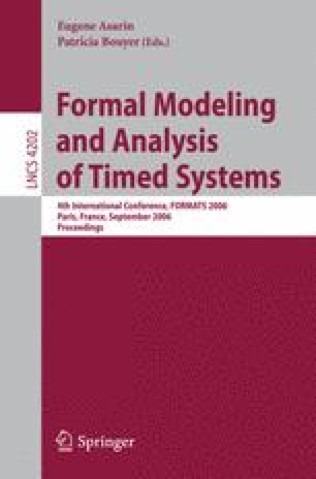
Formal Modeling and Analysis of Timed Systems ; Vol.4202 ; 4th International Conference, FORMATS 2006, Paris, France, September 25-27, 2006, Proceedings
The aim of FORMATS is to promote the study of fundamental and practical aspects of timed systems, and to bring together researchers from di?erent d- ciplines that share interests in modelling and analysis of timed systems. In this volume, there are articles on: – Foundations and Semantics: contributions to the theoretical foundations of timed systems and timed formal languages as well as comparison between di?erentmodelsusedbydi?erentcommunities(timedautomata,timedPetri nets, timed MSCs, hybrid automata, timed process algebra, timed temporal logics, timed abstract state machines, as well as probabilistic models). – Methods and Tools: techniques, algorithms, data structures, and software toolsforanalyzingtimedsystemsandresolvingtemporalconstraints(mod- checking, simulation, robustness analysis, scheduling, etc).
