



Page 2
Page 2

Digital Peripheries : The Online Circulation of Audiovisual Content from the Small Market Perspective
This is book. Media industry research and EU policymaking are predominantly tailored to large (and, in the latter case, Western) European markets. This open access book addresses the specific qualities of smaller media markets, highlighting their vulnerability to global digital competition and outlining survival strategies for them.

Designing Information : Human Factors and Common Sense in Information Design
It is a diagram of clarification, containing hundreds of examples of work by those who favor the communication of information over style and academic postulation—and those who don't. Many blurbs such as this are written without a thorough reading of the book. Not so in this case. I read it and love it. I suggest you do the same.

Design Thinking for Visual Communication
Identifies methods and thought processes used by designers in order to start the process that eventually leads to a finished piece of work. Step-by-step guidance for each part of the process is highlighted by real-life case studies, enabling the student to see teaching in practice. This focus on ideas and methods eschews an abstract, academic approach in favour of a useable approach to design as a problem-solving activity. The new edition now includes contributions from a broader international range of design practices and adds depth to existing case studies by looking in greater detail at some of the processes used
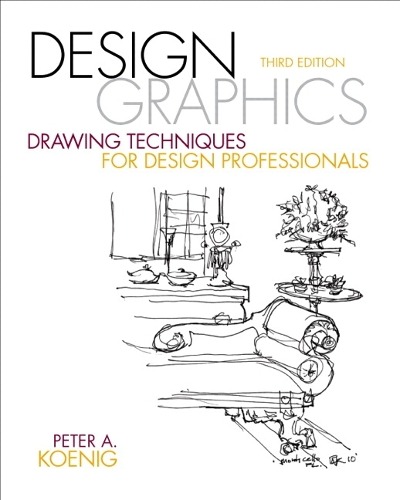
Design Graphics : Drawing Techniques for Design Professionals
Combines–in a single volume–simple techniques and skills related to sketching, design-development, and the schematic or preliminary phase of design presentation. Emphasizing drawing as a mental as well as physical exercise, the text helps students draw designs on paper faster and easier, showing them how visual communication with clients can provide better, more economical design solutions. Practical, straightforward, and reader-friendly, Design Graphics provides more complete coverage of the basics, making concepts and techniques accessible to students with highly diversified educational and technical backgrounds.

Design for visual communication : Challenges and priorities
Based on ideas discussed within the framework of the 2016 International Conference on Typography and Visual Communication (ICTVC). This event was initiated at the beginning of the new millennium and has since developed into an internationally respected event. The chapters included in this volume provide evidence of visual communication as an established discipline where critical research informs design practice, printing history lays the foundations for future projects, and professional practice benefits from cross-disciplinary collaborations.

Conceptual Landscapes : Fundamentals in the Beginning Design Process
Explores the dilemma faced in the early moments of design thinking through a gradient of work in landscape and environmental design media by both emerging and well-established designers and educators of landscape architecture. It questions where and, more importantly, how the process of design starts. Deconstructs the steps of conceptualizing design in order to reignite pedagogical discussions about timing and design fundamentals, and to reveal how the spark of an idea happens – from a range of unique perspectives. Through a careful arrangement of visual essays that integrate analog, digital, and mixed-media works and processes, the book highlights differences between diverse techniques and triggers debate between design, representation, technology, and creative culture in the field.

Computational Maps in the Visual Cortex
For more than 30 years, the visual cortex has been the source of new theories and ideas about how the brain processes information. Understanding the computations in the visual cortex is therefore an important step toward a general theory of computational brain theory

Comfort and Perception in Architecture
This book discusses the design of comfortable buildings and shows that design perception and, as a result, comfort should be an intentional feature of architectural design. Modern buildings are often sealed boxes without operable windows or daylighting design. However, contemporary designers increasingly find themselves faced with the task of creating spaces that are comfortable in terms of thermal and visual aspects.

Collage and architecture
This new edition includes: A stronger focus on contemporary practices, including digital methods; New designers and architects, including Marshall Brown, WAI Architecture Think Tank, and Tatiana Bilbao, bringing their methods and work to life; An expanded global and diverse perspective of architecture as collage; Collage is an important instrument for analysis and design. Through its 261 color images, this book shows how this versatile medium can be adapted and transformed in your own work.

Coding, shaping, making : experiments in form and form-making
Combines inspiration from architecture, mathematics, biology, chemistry, physics and computation to look towards the future of architecture, design and art. It presents ongoing experiments in the search for fundamental principles of form and form-making in nature so that we can better inform our own built environment.

Mapping selfies and memes as Touch
This book offers a rich and nuanced analysis of digitally networked socialities as culturally meaningful relationships of Touch. Focusing on the ways Touch is practised in everyday social interactions serves as a basis for understanding how Touch is multiply significant – physically, emotionally, intellectually and politically. Fiona Andreallo initiates a map of the fundamentals of Touch and how they can be considered for future research in considering digitally networked cultures. This map also serves as a basis for closely examining selfies and memes.

Machine Learning for Multimedia Content Analysis
Challenges in complexity and variability of multimedia data have led to revolutions in machine learning techniques. Multimedia data, such as digital images, audio streams and motion video programs, exhibit richer structures than simple, isolated data items. A number of pixels in a digital image collectively conveys certain visual content to viewers. A TV video program consists of both audio and image streams that unfold the underlying story. To recognize the visual content of a digital image, or to understand the underlying story of a video program, we may need to label sets of pixels or groups of image and audio frames jointly.
LINQ for Visual C# 2008
Every C# programmer needs to learn about LINQ (Language–Integrated Query), Microsoft's breakthrough technology for simplifying and unifying data access from any data source. With LINQ, you can write more elegant and flexible code—not just to access databases and files, but to manipulate data structures and XML. This book is a short, yet comprehensive guide to the major features of LINQ and the significant enhancements introduced with .NET 3.5. There is no better source for getting a head–start on the future of these technologies than this book.
LINQ for Visual C# 2005
LINQ for Visual C# 2005 is a short, yet comprehensive guide to the major features of LINQ. It thoroughly covers LINQ to Objects, LINQ to SQL, LINQ to DataSet, and LINQ to XML. It also details significant enhancements to C#, .NET, and ADO.NET.

Layce (Image data poisoning) = لايس (تسميم بيانات الصور )
The ongoing growth of image generative artificial intelligence models was paved with existing drawings and art pieces by great artists both past and present, and while generative models are very useful and helpful, there is the issue of the origin of the datasets trained on, and the morality of usage regarding copyrights and artistic identity. A novel line of defense that helps artists and visual content creators actively protect their pieces emerged, dubbed Data Poisoning and it works by misleading Artificial Intelligence models that attempt to use a Poisoned Image for training, or as a reference, as the Poisoned Image will appear to the human eye identical to the original art piece, while the Artificial Intelligence model will be seeing a remarkably different image, causing generative models to generate false positive results when given a prompt poisoned by the author or when trained on data poisoned by the original owner. This study aims to study image data poisoning methods and technologies, and build an application containing multiple image models, and poisoning models as well, accompanied by a Community for artists to share art and interact with each other.

Complex Motion ; 1st International Workshop, IWCM 2004, Günzburg, Germany, October 12-14, 2004, Revised Papers
The world we live in is a dynamic one: we explore it by moving through it, and many of the objects which we are interested in are also moving. Trafic, for instance, is an example of a domain where detecting and processing visual motion is of vital interest, both in a metaphoric as well as in a purely literal sense. Visual communication is another important example of an area of science which is dominated by the need to measure, understand, and represent visual motion in an eficient way. Visual motion is a subject of research which forces the investigator to deal with complexity; complexity in the sense of facing efiects of motion in a very large diversity of forms, starting from analyzing simple motion in a changing envir- ment (illumination, shadows, . . . ), under adverse observation conditions, such as bad signal-to-noiseratio (low illumination, small-scaleprocesses, low-dosex-ray, etc. ), covering also multiple motions of independent objects, occlusions, and - ing as far as dealing with objects which are complex in themselves (articulated objects such as bodies of living beings). The spectrum of problems includes, but does not end at, objects which are not ‘bodies’ at all, e. g. , when anal- ing fiuid motion, cloud motion, and so on. Analyzing the motion of a crowd in a shopping mall or in an airport is a further example that implies the need to struggle against the problems induced by complexity.
C++ /CLI : The Visual C++ Language for .NET
C++/CLI: The Visual C++ Language for .NET introduces Microsoft's extensions to the C++ syntax that allow you to target the common language runtime the key to the heart of the .NET 3.0 platform. In 12 no-fluff chapters, Microsoft insider Gordon Hogenson takes you into the core of the C++/CLI language and explains both how the language elements work and how Microsoft intends them to be used.

Brand guidelines
في أزقة دمشق العتيقة حيث تختبئ الذاكرة تحت أنقاض الحرب، تولد حكاية صامتة .. المفاتيح هي قصة مصورة من إنتاج شركة حكايات تروي رحلة أبو حسن (حرفي عجوز) ولونا (طفلة فضولية) لإحياء أنغام المدينة المنسية عبر مفاتيح سحرية تصنع من التراب والتراث.

Brain, vision, and artificial intelligence ; 1st International Symposium, BVAI 2005, Naples, Italy, October 19-21, 2005, Proceedings
This book constitutes the refereed proceedings of the First International Symposium on Brain, Vision and Artificial Intelligence, BVAI 2005, held in Naples, Italy in October 2005. The 48 revised papers presented together with 6 invited lectures were carefully reviewed and selected from more than 80 submissions for inclusion in the book. The papers are addressed to the following main topics and sub-topics: brain basics - neuroanatomy and physiology, development, plasticity and learning, synaptic, neuronic and neural network modelling; natural vision - visual neurosciences, mechanisms and model systems, visual perception, visual cognition; artificial vision - shape perception, shape analysis and recognition, shape understanding; artificial inteligence - hybrid intelligent systems, agents, and cognitive models.
Beginning Visual C# 2005 Express ed. : From novice to professional
Wright took the same approach with this book that he did with the VB titles, and inside you'll find a fast–paced guide to the essentials to get you programming fast. You'll learn the C# language and the tools Visual C# 2005 Express provides. He covers everything from simple console programs to code that talks to the Internet, and even how to write your own database programs. Whatever your reasons for wanting to learn to program with C#, this book will get you where you want to be quickly, and hopefully with a smile on your face. So dive in and change the way you use computers forever.
