



الصفحة 1
الصفحة 1

Numerical Mathematics
Numerical mathematics is the branch of mathematics that proposes, develops, analyzes and applies methods from scientific computing to several fields including analysis, linear algebra, geometry, approximation theory, functional equations, optimization and differential equations. Other disciplines, such as physics, the natural and biological sciences, engineering, and economics and the financial sciences frequently give rise to problems that need scientific computing for their solutions. As such, numerical mathematics is the crossroad of several disciplines of great relevance in modern applied sciences, and can become a crucial tool for their qualitative and quantitative analysis.

Number Theory ; Vol.15 : Tradition and Modernization
This book appears varied, they are unified by two underlying principles:first, making everything readable as a book, and second, making a smooth transition from traditional approaches to modern ones by providing a rich array of examples. The chapters are presented in quite different in depth and cover a variety of descriptive details.The book emphasizes a few common features such as functional equations for various zeta-functions, modular forms, congruence conditions, exponential sums, and algorithmic aspects.

Modeling decisions : Information fusion and aggregation operators
This book covers the underlying science and application issues related to aggregation operators, focusing on tools used in practical applications that involve numerical information. Starting with detailed introductions to information fusion and integration, measurement and probability theory, fuzzy sets, and functional equations.

Fuzzy Implications
Fuzzy Implications (FIs) generalize the classical implication and play a similar important role in Fuzzy Logic (FL), both in FL_n and FL_w in the sense of Zadeh. Their importance in applications of FL, viz., Approximate Reasoning (AR), Decision Support Systems, Fuzzy Control (FC), etc., is hard to exaggerate. This treatise is perhaps the first attempt at dealing exclusively with this class of operations.

Functional Equations and How to Solve Them
This book covers topics in the theory and practice of functional equations. Special emphasis is given to methods for solving functional equations that appear in mathematics contests, such as the Putnam competition and the International Mathematical Olympiad. This book will be of particular interest to university students studying for the Putnam competition, and to high school students working to improve their skills on mathematics competitions at the national and international level. Mathematics educators who train students for these competitions will find a wealth of material for training on functional equations problems.

Discrete Spectral Synthesis and Its Applications
In order to study discrete Abelian groups with wide range applications, the use of classical functional equations, difference and differential equations, polynomial ideals, digital filtering and polynomial hypergroups is required. This book covers several different problems in this field and is unique in being the only comprehensive coverage of this topic.

Matematica generale con il calcolatore
By introducing mathematical objects, it teaches students how to use a computer to perform numerical and symbolic calculations, define a function and calculate its values, plot and explore graphs, and execute simple algorithms. The course is rich in examples, applications, and models, drawn from economics, physics, biology, statistics, and mathematics itself. The analysis of these models constitutes, in a certain sense, the true purpose of the mathematical theory covered. Automatic calculation tools (mathematics software, spreadsheets) are used extensively to explore and illustrate concepts and properties. Mathcad® software, in particular, was used, both as a calculation tool and as a simple yet powerful programming language. Considerable space is devoted to approximation, emphasizing the distinction between numerical and symbolic calculation; to algorithms as a synthesis of the syntactic and semantic aspects of mathematical objects; and to computer simulation, interpreted as a "physical" experiment and a source of conjecture. The ability to use a calculator marks a sort of "democratization" of mathematics: even complex results, which have always required a broad background of knowledge and laborious calculations, are now quickly accessible to anyone who understands the meaning of mathematical objects and knows how to use the syntax.
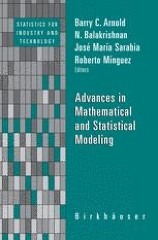
Advances in Mathematical and Statistical Modeling
Enrique Castillo is a leading figure in several mathematical, statistical, and engineering fields, having contributed seminal work in such areas as statistical modeling, extreme value analysis, multivariate distribution theory, Bayesian networks, neural networks, functional equations, artificial intelligence, linear algebra, optimization methods, numerical methods, reliability engineering, as well as sensitivity analysis and its applications. Organized to honor Castillo's significant contributions, this volume is an outgrowth of the International Conference on Mathematical and Statistical Modeling and covers recent advances in the field. Also presented are applications to safety, reliability and life-testing, financial modeling, quality control, general inference, as well as neural networks and computational techniques.

A Generalization of Bohr-Mollerup's Theorem for Higher Order Convex Functions
This book develops a far-reaching generalization of Bohr-Mollerup's theorem to higher order convex functions, along lines initiated by Wolfgang Krull, Roger Webster, and some others but going considerably further than past work. In particular, this generalization shows using elementary techniques that a very rich spectrum of functions satisfy analogues of several classical properties of the gamma function, including Bohr-Mollerup's theorem itself, Euler's reflection formula, Gauss' multiplication theorem, Stirling's formula, and Weierstrass' canonical factorization.
