



الصفحة 1
الصفحة 1
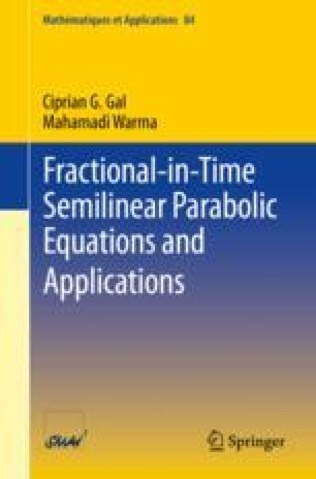
Fractional-in-time semilinear parabolic equations and applications
This book provides a unified analysis and scheme for the existence and uniqueness of strong and mild solutions to certain fractional kinetic equations. This class of equations is characterized by the presence of a nonlinear time-dependent source, generally of arbitrary growth in the unknown function, a time derivative in the sense of Caputo and the presence of a large class of diffusion operators. The global regularity problem is then treated separately and the analysis is extended to some systems of fractional kinetic equations, including prey-predator models of Volterra–Lotka type and chemical reactions models, all of them possibly containing some fractional kinetics.
Continuous-Time Systems
The book systematically covers major foundations of the systems theory. First, the quantitative and qualitative methods of systems description are presented along with the stability analysis. The representation of linear time-invariant systems in the time domain is provided using the convolution, ordinarily differential equations (ODEs), and state space. In the frequency domain, these systems are analyzed using the Fourier and Laplace transforms. The linear time-varying systems are represented using the general convolution, ODEs, and state space. The nonlinear time-invariant systems are described employing the Taylor and Volterra series expansions, ODEs, state space, and approximate methods such as averaging, equivalent linearization, and describing function. Finally, the representation of nonlinear time-varying systems is given using the Taylor and Volterra series, ODEs, modulation functions method, and state space modelling.
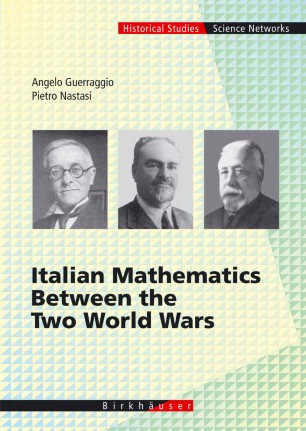
Italian Mathematics Between the Two World Wars
This book describes Italian mathematics in the period between the two World Wars. We analyze its development by focusing on both the interior and the external influences. Italian mathematics in that period was shaped by a colorful array of strong personalities who concentrated their efforts on a select number of fields and won international recognition and respect in an incredibly short time. Italy was also dominated by a fascist regime. This political situation and the social and academic structure of Italian society are included in the analysis as influences external to mathematics itself. The authors have provided a fascinating study of a most difficult time in the history of the world and of mathematics.
Adaptive Nonlinear System Identification : The Volterra and Wiener Model Approaches
Adaptive Nonlinear System Identification: The Volterra and Wiener Model Approaches introduces engineers and researchers to the field of nonlinear adaptive system identification. The book includes recent research results in the area of adaptive nonlinear system identification and presents simple, concise, easy-to-understand methods for identifying nonlinear systems. These methods use adaptive filter algorithms that are well known for linear systems identification. They are applicable for nonlinear systems that can be efficiently modeled by polynomials.After a brief introduction to nonlinear systems and to adaptive system identification, the author presents the discrete Volterra model approach. This is followed by an explanation of the Wiener model approach. Adaptive algorithms using both models are developed. The performance of the two methods are then compared to determine which model performs better for system identification applications.
