



الصفحة 1
الصفحة 1

Model-based Process Supervision : A Bond Graph Approach
Model-based fault detection and isolation requires a mathematical model of the system behaviour. Modelling is important and can be difficult because of the complexity of the monitored system and its control architecture. The authors use bond-graph modelling, a unified multi-energy domain modelling method, to build dynamic models of process engineering systems by composing hierarchically arranged sub-models of various commonly encountered process engineering devices. The structural and causal properties of bond-graph models are exploited for supervisory systems design.
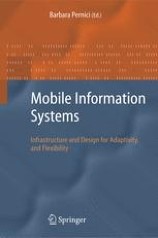
Mobile Information Systems : Infrastructure and Design for Adaptivity and Flexibility
The book is divided into three parts: core technologies for mobile information systems (e.g., adaptive middleware and flexible e-services), enabling technologies (like data management on small devices or adaptive low-power hardware architectures or wireless networks), and methodological aspects of mobile information systems design (such as service profiling or user interface and e-service design for context-aware applications). It provides researchers in academia and industry with a comprehensive vision on innovative aspects which can be used as a basis for the development of new frameworks and applications.
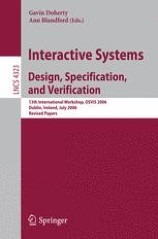
Interactive systems design, specification, and verification ; 13th International Workshop, DSVIS 2006, Dublin, Ireland, July 26-28, 2006, Revised Papers
This book constitutes the thoroughly refereed post-proceedings of the 13th International Workshop on Design, Specification, and Verification of Interactive Systems, DSVIS 2006, held in Dublin, Ireland in July 2006.

Intelligent systems design and applications ; 19th International Conference on intelligent systems design and applications (ISDA 2019) held December 3-5, 2019
This book highlights recent research on intelligent systems and nature-inspired computing. It presents 62 selected papers from the 19th International Conference on Intelligent Systems Design and Applications (ISDA 2019), which was held online. The ISDA is a premier conference in the field of computational intelligence, and the latest installment brought together researchers, engineers and practitioners whose work involves intelligent systems and their applications in industry. Including contributions by authors from 33 countries, the book offers a valuable reference guide for all researchers, students and practitioners in the fields of Computer Science and Engineering.

Intelligent decision support : Current challenges and approaches
This anthology contains contributions addressing current challenges and approaches of intelligent decision support in organizations. The main foci are on: - quantitative decision problems in transportation, production, finance and marketing - business process optimization and information systems design - special problems of intelligent decision support which have their source in areas such as human resources management, information management and economic theory.

Integrated Circuit and System Design. Power and Timing Modeling, Optimization and Simulation ; Vol. 4148 ; 16th International Workshop, PATMOS 2006, Montpellier, France, September 13-15, 2006, Proceedings
Welcome to the proceedings of PATMOS 2006, the 16th in a series of international workshops. PATMOS 2006 was organized by LIRMM with CAS technical - sponsorship and CEDA sponsorship. Over the years, the PATMOS workshop has evolved into an important European event, where researchers from both industry and academia discuss and investigate the emerging challenges in future and contemporary applications, design methodologies, and tools required for the development of upcoming generations of integrated circuits and systems. The technical program of PATMOS 2006 contained state-of-the-art technical contributions, three invited talks, a special session on hearing-aid design, and an embedded tutorial. The technical program focused on timing, performance and power consumption, as well as architectural aspects with particular emphasis on modeling, design, characterization, analysis and optimization in the nanometer era. The Technical Program Committee, with the assistance of additional expert reviewers, selected the 64 papers presented at PATMOS. The papers were organized into 11 technical sessions and 3 poster sessions. As is always the case with the PATMOS workshops, full papers were required, and several reviews were received per manuscript.

Infrastructure for Agents, Multi-Agent Systems, and Scalable Multi-Agent Systems ; International Workshop on Infrastructure for Scalable Multi-Agent Systems, Barcelona, Spain, June 3-7, 2000 Revised Papers
Building research grade multi-agent systems usually involves a broad variety of software infrastructure ingredients like planning, scheduling, coordination, communication, transport, simulation, and module integration technologies and as such constitutes a great challenge to the individual researcher active in the area. The book presents a collection of papers on approaches that will help make deployed and large scale multi-agent systems a reality. The first part focuses on available infrastructure and requirements for constructing research-grade agents and multi-agent systems. The second part deals with support in infrastructure and software development methods for multi-agent systems that can directly support coordination and management of large multi-agent communities; performance analysis and scalability techniques are needed to promote deployment of multi-agent systems to professionals in software engineering and information technology.
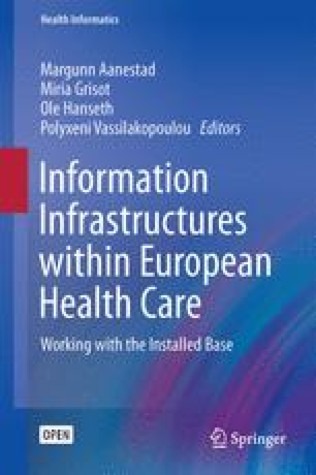
Information infrastructures within European health care : Working with the installed base
This book consolidates experiences from across Europe on the design, development, implementation and evolution of inter-organisational information infrastructures for healthcare. It provides insights with practical relevance for those involved or interested in the planning and implementation of such infrastructures and includes 11 empirical cases on the introduction of core infrastructural arrangements in different national settings: six cases investigate the use of e-prescriptions and five the public platforms for patient-oriented eHealth services. Both are linked to different types of aims.
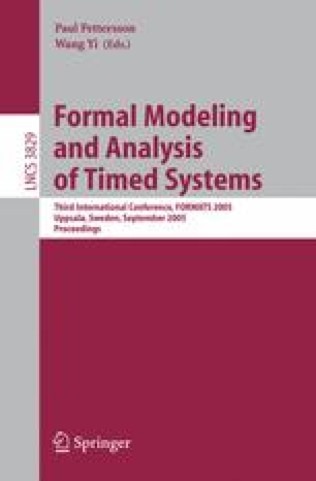
Formal Modeling and Analysis of Timed Systems ; Vol. 3829 ; 3rd International Conference, FORMATS 2005, Uppsala, Sweden, September 26-28, 2005, Proceedings
This book constitutes the thoroughly refereed post-proceedings of the Third International Conference on Formal Modeling and Analysis of Timed Systems, FORMATS 2005, held in Uppsala, Sweden in September 2005 in conjunction with ARTIST2 summer school on Component Modelling, Testing and Verification, and Static analysis of embedded systems. The 19 revised full papers presented together with the abstracts of 3 invited talks were carefully selected from 43 submissions. The papers cover work on semantics and modeling of timed systems, formalisms for modeling and verification including timed automata, hybrid automata, and timed petri nets, games for verification and synthesis, model-checking, case studies and issues related to implementation, security and performance analysis.
Formal Methods for Performance Evaluation ; 7th International School on Formal Methods for the Design of Computer, Communication, and Software Systems, SFM 2007, Bertinoro, Italy, May 8-June 2, 2007, Advanced Lectures
This book presents a set of 11 papers accompanying the lectures of leading researchers given at the 7th edition of the International School on Formal Methods for the Design of Computer, Communication and Software Systems, SFM 2007.
Formal Methods for Mobile Computing ; 5th International School on Formal Methods for the Design of Computer, Communication, and Software Systems, SFM-Moby 2005, Bertinoro, Italy, April 26-30, 2005, Advanced Lectures
This book presents 8 tutorial survey papers by leading researchers who lectured at the 5th International School on Formal Methods for the Design of Computer, Communication, and Software Systems, SFM 2005, held in Bertinoro, Italy in April 2005. SFM 2005 was devoted to formal methods and tools for the design of mobile systems and mobile communication infrastructures. The 8 lectures are organized into topical sections on models and languages, scalability and performance, dynamic power management, and middleware support.

Formal Methods and Testing : An Outcome of the FORTEST Network, Revised Selected Papers
This book constitutes the thoroughly refereed and peer-reviewed outcome of the Formal Methods and Testing (FORTEST) network - formed as a network established under UK EPSRC funding that investigated the relationships between formal (and semi-formal) methods and software testing - now being a subject group of two BCS Special Interest Groups: Formal Aspects of Computing Science (BCS FACS) and Special Interest Group in Software Testing (BCS SIGIST).
Formal approaches to software testing ; Vol. 3997 ; 5th International Workshop, FATES 2005, Edinburgh, UK, July 11, 2005, Revised Selected Papers
This book constitutes the thoroughly refereed post-proceedings of the 5th International Workshop on Formal Approaches to Software Testing, FATES 2005, held in Edinburgh, UK, in July 2005 in conjunction with CAV 2005.
Formal approaches to software testing ; Vol. 3395 ; 4th International workshop, FATES 2004, Linz, Austria, September 21, 2004, Revised Selected Papers
Testing often accounts for more than 50% of the required e?ort during system development.Thechallengeforresearchistoreducethesecostsbyprovidingnew methods for the speci?cation and generation of high-quality tests. Experience has shown that the use of formal methods in testing represents a very important means for improving the testing process. Formal methods allow for the analysis andinterpretationofmodelsinarigorousandprecisemathematicalmanner.The use of formal methods is not restricted to system models only. Test models may alsobeexamined.Analyzingsystemmodelsprovidesthepossibilityofgenerating complete test suites in a systematic and possibly automated manner whereas examining test models allows for the detection of design errors in test suites and their optimization with respect to readability or compilation and execution time. Due to the numerous possibilities for their application, formal methods have become more and more popular in recent years. The Formal Approaches in Software Testing (FATES) workshop series also bene?ts from the growing popularity of formal methods. After the workshops in Aalborg (Denmark, 2001), Brno (Czech Republic, 2002) and Montr´ eal (Canada, 2003), FATES 2004 in Linz (Austria) was the fourth workshop of this series. Similar to the workshop in 2003, FATES 2004 was organized in a?liation with the IEEE/ACM Conference on Automated Software Engineering (ASE 2004). FATES 2004 received 41 submissions. Each submission was reviewed by at least three independent reviewers from the Program Committee with the help of some additional reviewers. Based on their evaluations, 14 full papers and one wo- in-progress paper from 11 di?erent countries were selected for presentation.

Fault-Tolerance Techniques for SRAM-Based FPGAs
This book discusses fault-tolerance techniques for SRAM-based Field Programmable Gate Arrays (FPGAs). It starts by showing the model of the problem and the upset effects in the programmable architecture. In the sequence, it shows the main fault tolerance techniques used nowadays to protect integrated circuits against errors. A large set of methods for designing fault tolerance systems in SRAM-based FPGAs is described. Some presented techniques are based on developing a new fault-tolerant architecture with new robustness FPGA elements. Other techniques are based on protecting the high-level hardware description before the synthesis in the FPGA.

Exploring C for Microcontrollers : A Hands on Approach
The market is flooded with numbers of good books on Embedded Systems designed especially with the most popular MCS51 family. These books are traditional in nature i.e. they start with the routine architectural features of 8051, description of registers, ports, interrupts etc. Most of these things are already covered in the device data sheet and application notes. In this book all such routine things are skipped. The focus is on programming microcontrollers, to be specific MCS-51 family in ‘C’ using Keil IDE. Exploring C for Microcontrollers presents seventeen live case studies apart from the many basic programs organized around every on-chip resource like port, time/counter, interrupt , serial I/O etc. Rather than introducing the underpinning theory or reproducing lengthy data sheets, our approach is "learning-through-doing" and one that appeals to busy electronics designers. The ‘C’ codes given are well supported by easy to understand comments wherever required.

Embedded systems design : The ARTIST roadmap for research and development
Embedded systems now include a very large proportion of the advanced products designed in the world, spanning transport (avionics, space, automotive, trains), electrical and electronic appliances (cameras, toys, televisions, home appliances, audio systems, and cellular phones), process control (energy production and distribution, factory automation and optimization), telecommunications (satellites, mobile phones and telecom networks), and security (e-commerce, smart cards), etc. The extensive and increasing use of embedded systems and their integration in everyday products marks a significant evolution in information science and technology. We expect that within a short timeframe embedded systems will be a part of nearly all equipment designed or manufactured in Europe, the USA, and Asia. There is now a strategic shift in emphasis for embedded systems designers: from simply achieving feasibility, to achieving optimality. Optimal design of embedded systems means targeting a given market segment at the lowest cost and delivery time possible. Optimality implies seamless integration with the physical and electronic environment while respecting real-world constraints such as hard deadlines, reliability, availability, robustness, power consumption, and cost. In our view, optimality can only be achieved through the emergence of embedded systems as a discipline in its own right.

Digital VLSI Systems Design : A Design Manual for Implementation of Projects on FPGAs and ASICs Using Verilog
The book presents new material and theory as well as synthesis of recent work with complete Project Designs using industry standard CAD tools and FPGA boards, enabling the serious readers to design VLSI Systems on their own. The reader is taken step by step through the design right from implementing a single digital gate to a massive design consuming well over 100,000 gates. The Verilog codes developed for these designs are universal and can work on any FPGA or ASIC and are technology independent. The book presents the development of novel algorithms and architectures for optimum realization of high tech. products. All the design codes developed in this book are Register Transfer Level (RTL) compliant and can be readily used or amended to suit new projects.

Dialogue as a Means of Collective Communication
In the book, readers are introduced to five sections: Section I examines the historical and cultural perspectives of conversation. This examination helps to create a foundation for a deeper study of the emergent and salient aspects of conversation as it relates to cultural creativity and human systems design. Sections II offers the reader an examination of dialogue through different philosophical and theoretical perspectives as well as methodological ideas related to conversation. Section III explores different modalities of conversation and the application of design conversation within and across various types of design settings and human experiences. Section IV examines the field of practice as related to use of different forms of conversation.

Dialogue as a Collective Means of Design Conversation
Dialogue as a Collective Means of Design Conversation is the second volume edited by Patrick M. Jenlink and Bela H. Banathy to offer a cross-disciplinary approach to examining dialogue as a communicative medium. In this Compendium, the contributing authors set forth their ideas, experiences, and perspectives as the path of a learning journey—a journey of new meaning, of new understanding, and of becoming self-aware of design conversation as future creating and consciousness evolving. In particular, this volume comes at a time when we as a global society are faced with the question of how we shape our actions and in turn shape our future, through conversation that is focused on resolving global conflict and fostering world peace. The volume evokes in the reader a realization that our greatest potential rests, in no small measure, with our collective capacity for cultural creativity and in our capacity to achieve new levels of consciousness through dialogue and design conversation.
