



الصفحة 1
الصفحة 1

Moment Analysis for Subsurface Hydrologic Applications
This book deals with the concept of moments, and how they find application in subsurface hydrologic problems-particularly those dealing with solute transport. This book will be very valuable to researchers who are beginning to learn about moment analysis, and will also be of interest to advanced researchers as well. Both temporal and spatial moments are dealt with in some detail for a wide variety of problems. Several examples using experimental data, both from laboratory columns and field experiments, are provided to give the readers a clear idea about the scope of this method. Apart from conventional uses of moments for solute transport problems, this book contains chapters dealing with use of moments in interval computing, vapour phase transport applications, transfer functions to subsurface tile drains, and construction of breakthrough curves from knowledge of moments.

Groundwater Recharge from Run-off, Infiltration and Percolation
This book first discusses the recharge fluxes relating both to the quantity and quality of groundwater. In order to face the threats to the water supply and to be able to maintain a sustainable water management policy, detailed knowledge is needed in between others on the surface to subsurface transformation link in the water cycle. Secondly, the presentation and comparison of both the traditional and modern approach to determine groundwater recharge is discussed. The traditional approach to determine groundwater recharge, is based on water balance estimates and hydraulic considerations, which yield instantaneous values at best but do not integrate the totality of recharge pathways in time and space. In contrast, environmental tracers do integrate these factors. Finally, the fate of groundwater recharge in the subsurface by hydraulic and geologic means is discussed in detail, in order to stimulate adapted groundwater management strategies and to better assess consequences of climate changes on groundwater resources as a whole.

Groundwater : Resource evaluation, augmentation, contamination, restoration, modeling and management
The demand for water resources is increasing day by day due to ever increasing population, mostly from developing countries. This has resulted in abstracting more water from the subsurface stratum and forcing the water managers to manage the limited groundwater resources in a more scientific way, which in turn needs a more sophisticated way of assessing the underground resource and manage it optimally.
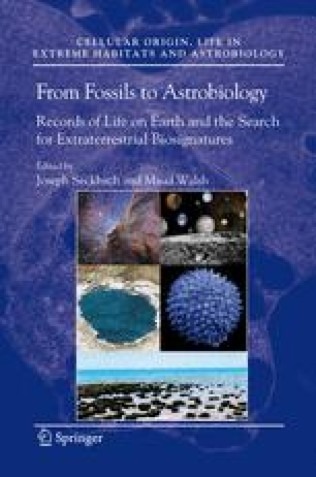
From Fossils to Astrobiology : Records of Life on Earth and Search for Extraterrestrial Biosignatures
From Fossils to Astrobiology reviews developments in paleontology and geobiology that relate to the rapidly-developing field of Astrobiology, the study of life in the Universe. Many traditional areas of scientific study, including astronomy, chemistry and planetary science, contribute to Astrobiology, but the study of the record of life on planet Earth is critical in guiding investigations in the rest of the cosmos. In this varied book, expert scientists from 15 countries present peer-reviewed, stimulating reviews of paleontological and astrobiological studies. The overviews of established and emerging techniques for studying modern and ancient microorganisms on Earth and beyond, will be valuable guides to evaluating biosignatures which could be found in the extraterrestrial surface or subsurface within the Solar System and beyond.

Contaminant Geochemistry : Interactions and Transport in the Subsurface Environment
This book combines earth science, subsurface hydrology and environmental geochemistry, providing a comprehensive background for specialists interested in the protection and sustainable management of the subsurface environment.The major focus of the book is on contaminant reactions in soil solutions, groundwater and porous media solid phases, accounting for their persistence and transformation in the subsurface, as they are transported from the land surface into groundwater.
Applied Hydrogeophysics
This book focuses on how hydrogeophysical methods can be applied to solve problems facing environmental engineers, geophysicists, agronomists, hydrologists, soil scientists and hydrogeologists. We present applications of hydrogeophysical methods to the understanding of hydrological processes and environmental problems dealing with the flow of water and the transport of solutes and contaminants. The majority of the book is organized as a series of process-driven chapters, each authored by leading experts. Areas covered include: infiltration and solute transport processes, biogeochemical functioning of soil-water systems, coastal groundwater interactions, cold region hydrology, engineered barriers and landfill processes. In addition, the book offers insight into the development of new data fusion methodologies, of value to many hydrogeophysical investigations, and provides an account how the rapidly developing self-potential technique can give valuable information about water fluxes and hydrochemical states within the subsurface.
3-D Structural Geology : A Practical Guide to Quantitative Surface and Subsurface Map Interpretation
This book provides an overview of techniques for constructing structural interpretations in 2-D, 2½-D and 3-D environments; for interpolating - tween and extrapolating beyond the control points; and for validating the final int- pretation. The underlying philosophy is that structures are three-dimensional solid bodies and that data from throughout the structure, whether in 2-D or 3-D format, should be integrated into an internally consistent 3-D interpretation. It is assumed that most users of this book will do their work on a computer. C- sequently, the book provides quantitative structural methods and techniques that are designed for use with spreadsheets, mapping software, and three-dimensional c- puter-graphics programs. The book is also intended to provide the background for understanding what interpretive software, for example, a computer contouring p- gram, does automatically. Most techniques are presented in both a traditional format appropriate for paper, pencil, and a pocket calculator, and in quantitative format for use with spreadsheets and computer-graphics or computer-aided-design programs.
