



الصفحة 1
الصفحة 1

Verification of Object-Oriented Software : The KeY Approach
Features of the programming languages we employ in these programs are plentiful, including object-oriented organizations of data, facilities for specifying di?erent c- trol ?ow for rare situations, constructs for iterating over the elements of a collection, and the grouping together of operations into atomic transactions. These language features were designed to facilitate simpler and more natural encodings of programs, and ideally they are accompanied by simpler proof rules. But the variety and increased number of these features make it harder to remember all that needs to be proved about their uses. As a third problem, we have come to expect a higher degree of rigor from our proofs. A proof carried out or replayed by a machine somehow gets more credibility than one that requires human intellect to understand.

Software Engineering 1 : Abstraction and Modelling
Volume 1 covers the basic principles and techniques of formal methods abstraction and modelling. First this book provides a sound, but simple basis of insight into discrete mathematics: numbers, sets, Cartesians, types, functions, the Lambda Calculus, algebras, and mathematical logic. Then it trains its readers in basic property- and model-oriented specification principles and techniques. The model-oriented concepts that are common to such specification languages as B, VDM-SL, and Z are explained here using the RAISE specification language (RSL). This book then covers the basic principles of applicative (functional), imperative, and concurrent (parallel) specification programming. Finally, the volume contains a comprehensive glossary of software engineering, and extensive indexes and references.

Embedded System Design
Embedded System Design starts with an introduction into the area and a survey of specification languages for embedded systems. A brief overview is provided of hardware devices used for embedded systems and also presents the essentials of software design for embedded systems. Real-time operating systems and real-time scheduling are covered briefly. Techniques for implementing embedded systems are also discussed, using hardware/software codesign. It closes with a survey on validation techniques. Embedded System Design can be used as a text book for courses on embedded systems and as a source which provides pointers to relevant material in the area for PhD students and teachers. The book assumes a basic knowledge of information processing hardware and software.
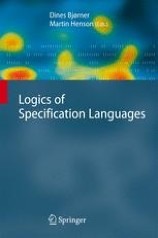
Logics of Specification Languages
Dedicated chapters address : the use of ASM (Abstract State Machines) in the classroom; the Event-B modelling method; a methodological guide to CafeOBJ logic; CASL, the Common Algebraic Specification Language; the Duration Calculus; the logic of the RAISE specification language (RSL); the specification language TLA+; the typed logic of partial functions and the Vienna Development Method (VDM); and Z logic and its applications. Each chapter is self-contained, with references, and symbol and concept indexes. Finally, in a unique feature, the book closes with short commentaries on the specification languages written by researchers closely associated with their original development.
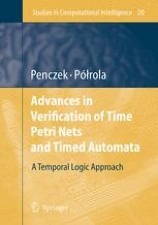
Advances in verification of time Petri Nets and timed automata : A temporal logic approach
This monograph presents a comprehensive introduction to timed automata (TA) and time Petri nets (TPNs) which belong to the most widely used models of real-time systems. Some of the existing methods of translating time Petri nets to timed automata are presented, with a focus on the translations that correspond to the semantics of time Petri nets, associating clocks with various components of the nets. "Advances in Verification of Time Petri Nets and Timed Automata – A Temporal Logic Approach" introduces timed and untimed temporal specification languages and gives model abstraction methods based on state class approaches for TPNs and on partition refinement for TA. Moreover, the monograph presents a recent progress in the development of two model checking methods, based on either exploiting abstract state spaces or on application of SAT-based symbolic techniques.
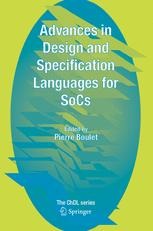
Advances in Design and Specification Languages for SoCs : Selected Contributions from FDL'04
Presents a selection of the articles from the Forum on Specification and Design Languages (FDL'04). The Analog and Mixed-Signal Systems contributions bring some answers to the difficult problem of co-simulating discrete and continuous models of computati

Advances in Design and Specification Languages for Embedded Systems : Selected Contributions from FDL’06
Advances in Design and Specification Languages for Embedded Systems is the latest contribution to the Chip Design Languages series and it consists of selected papers presented at the Forum on Specifications and Design Languages (FDL'06), which took place in September 2006 at Technische Universität Darmstadt, Germany. FDL, an ECSI conference, is the premier European forum to present research results, to exchange experiences, and to learn about new trends in the application of specification and design languages as well as of associated design and modelling methods and tools for integrated circuits, embedded systems, and heterogeneous systems. Modelling and specification concepts push the development of new methodologies for design and verification to system level, they thus provide the means for a model-driven design of complex information processing systems in a variety of application domains.
