



الصفحة 1
الصفحة 1

Multiscale processes in the earth’s magnetosphere : From interball to cluster ; Proceedings of the NATO ARW on Multiscale Processes in the Earth's Magnetosphere: From Interball to Cluster, Prague, Czech Republic from 9 to 12 September 2003
The past forty years of space research have seen a substantial improvement in our understanding of the Earth’s magnetosphere and its coupling with the solar wind and interplanetary magnetic ?eld (IMF). The magnetospheric str- ture has been mapped and major processes determining this structure have been de?ned. However, the picture obtained is too often static. We know how the magnetosphere forms via the interaction of the solar wind and IMF with the Earth’s magnetic ?eld. We can describe the steady state for various upstream conditions but do not really understand the dynamic processes leading from one state to another. The main dif?culty is that the magnetosphere is a comp- cated system with many time constants ranging from fractions of a second to days and the system rarely attains a steady state. Two decades ago, it became clear that further progress would require multi-point measurements. Since then, two multi-spacecraft missions have been launched — INTERBALL in 1995/96 and CLUSTER II in 2000. The objectives of these missions d- fered but were complementary: While CLUSTER is adapted to meso-scale processes, INTERBALL observed larger spatial and temporal scales. However, the number of papers taking advantage of both missions simul- neously is rather small.
Mercury
Mercury, the planet closest to the Sun, is different in several respects from the other three terrestrial planets. In appearance, it resembles the heavily cratered surface of the Moon, but its density is high, it has a magnetic field and magnetosphere, but no atmosphere or ionosphere. This book reviews the progress made in Mercury studies since the flybys by Mariner 10 in 1974-75, based on the continued research using the Mariner 10 archive, on observations from Earth, and on increasingly realistic models of its interior evolution.

Handbook of Solar-Terrestrial Environment
Recognized international leaders in their field contribute basic topics of solar physics, space plasmas and the Earth's magnetosphere. The book further covers applied topics like the aurora, magnetospheric storms, space weather, space climatology and planetary science.

Coronal Mass Ejections
This volume offers a comprehensive and integrated overview of our present knowledge and understanding of Coronal Mass Ejections (CMEs) and their descendants, Interplanetary CMEs (ICMEs). It results from a series of workshops held between 2000 and 2004. An international team of about sixty experimenters involved e.g. in the SOHO, ULYSSES, VOYAGER, PIONEER, HELIOS, WIND, IMP, and ACE missions, ground observers, and theoreticians worked jointly on interpreting the observations and developing new models for CME initiations, development, and interplanetary propagation. The book provides researchers active in space physics with an overview of the current understanding of CMEs and ICMEs, and their effects in the heliosphere. It also provides the advanced graduate student with introductory material on this active field of research.
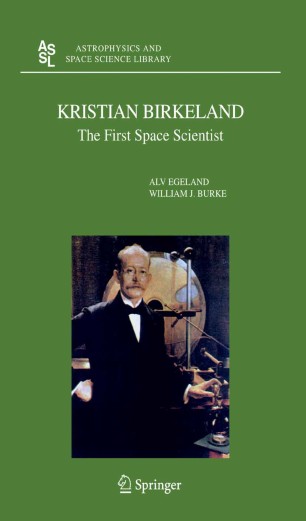
Kristian Birkeland : The First Space Scientist
PREFACEThisscientific biography of Kristian Birkeland (1867–1917) was written to bring the story ofa Norwegian national hero to the attention ofthe English-speaking world. Birkeland’sheroic stature was established not on a field of military battle,but in the bitter cold of the Artic wilderness ashe sought to answer basic questions abouthow the Sun controlled northern lights andmag-netic storms. He was also afather of Norsk Hydro one ofNorway’s largest industries. Birkel and died before reaching the age of 50.Because Birkel and never kept adiary, documented information about his family and private life is sparse. Before he died, Olaf Devik, the last of Birke-ffland’s close friends, gave along interview and graciously transferred his personal archive to A.E. Birkeland’s 82 scientific papers and three book-length publications map the progress of his investigations. addressed this book questions that had vexed European scientists for centuries. Why do the northern lights appear overhead when the Earth’s magnetic field is disturbed? How are magnetic storms connected to disturbances on the Sun? To answer these questions Birkeland interpreted his advance laboratory simulations and daring campaigns in the Arctic wilderness in the light of Maxwell’s newly discovered laws of electricity and magnetism. Birkeland’s ideas were dismissed for decades, only to be vindicated when satellites could fly above the Earth’s atmosphere.
Aurora : Observing and Recording Nature's Spectacular Light Show
The uniquely beautiful light display of an aurora is the result of charged particles colliding with tenuous atmospheric oxygen and nitrogen, more than 60 miles above the Earth, when the magnetosphere is disturbed by changes in the solar wind. Often - and incorrectly - regarded as being confined to high northern and southern latitudes, major auroral displays are visible from even the southern USA and the south of England, and occur perhaps twenty times in each eleven-year sunspot cycle. This book describes the aurora from the amateur observational viewpoint, discusses professional studies of auroral and geomagnetic phenomena to put amateur work in context, and explains how practical observers can go about observing and recording auroral displays.
