



الصفحة 1
الصفحة 1

Information security theory and practices : Smart cards, mobile and ubiquitous computing systems ; 1st IFIP TC6 / WG 8.8 / WG 11.2 International Workshop, WISTP 2007, Heraklion, Crete, Greece, May 9-11, 2007
Constitutes the refereed proceedings of the First IFIP TC6 / WG 8.8 / WG 11.2 International Workshop on Information Security Theory and Practices: Smart Cards, Mobile and Ubiquitous Computing Systems, WISTP 2007, held in Heraklion, Crete, Greece in May 2007. This book includes sections on hardware and cryptography, and cryptography schemes.
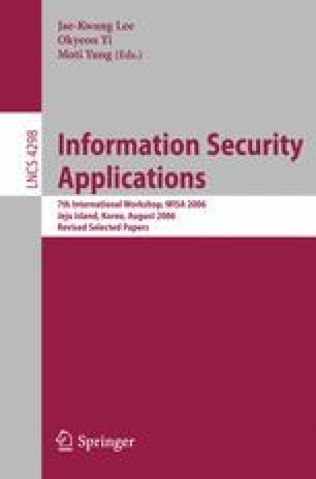
Information security applications ; 7th International Workshop, WISA 2006, Jeju Island, Korea, August 28-30, 2006, Revised Selected Papers
This book constitutes the thoroughly refereed post-proceedings of the 12th International Monterey Workshop on Networked Systems with special focus on realization of reliable systems on top of unreliable networked platforms, held in Laguna Beach, CA, USA, in September 2005.
Information security applications : Vol. 3325 : 5th International Workshop, WISA 2004, Jeju Island, Korea, August 23-25, 2004, Revised Selected Papers
The 5th International Workshop on Information Security Applications (WISA 2004) was held in Jeju Island, Korea during August 23-25, 2004. The workshop was sponsored by the Korea Institute of Information Security and Cryptology (KIISC), the Electronics and Telecommunications Research Institute (ETRI) and the Ministry of Information and Communication (MIC). The aim of the workshop is to serve as a forum for new conceptual and - perimental research results in the area of information security applications from the academic community as well as from the industry. The workshop program covers a wide range of security aspects including cryptography, cryptanalysis, network/system security and implementation aspects. The programcommittee received169 papersfrom 22 countries,andaccepted 37 papers for a full presentation track and 30 papers for a short presentation track. Each paper was carefully evaluated through peer-review by at least three members of the programcommittee. This volume contains revised versions of 36 papers accepted and presented in the full presentation track. Short papers were only published in the WISA 2004 pre-proceedings as preliminary versions and are allowed to be published elsewhere as extended versions. In addition to the contributed papers, Professors Gene Tsudik and Ross Andersongaveinvitedtalks,entitledSecurityinOutsourcedDatabasesandWhat does ‘Security’ mean for Ubiquitous Applications?, respectively.

Information Security ; Vol. 4176 ; 9th International Conference; ISC 2006, Samos Island, Greece, August 30 - September 2, 2006, Proceedings
th This volume contains the papers presented at the 9 Information Security Conference (ISC 2006) held on Samos Island, Greece, during August 30 – September 2, 2006. The Conference was organized by the University of the Aegean, Greece. ISC was first initiated as a workshop, ISW in Japan in 1997, ISW 1999 in Mal- sia, ISW 2000 in Australia and then changed to the current name ISC when it was held in Spain in 2001 (ISC 2001). The latest conferences were held in Brazil (ISC 2002), UK (ISC 2003), USA (ISC 2004), and Singapore (ISC 2005). ISC 2006 provided an international forum for sharing original research results and application experiences among specialists in fundamental and applied problems of - formation security. In response to the Call for Papers, 188 papers were submitted. Each paper was - viewed by three members of the PC, on the basis of their significance, novelty, and technical quality. Of the papers submitted, 38 were selected for presentation, with an acceptance rate of 20%.

Foundations of Security Analysis and Design IV ; FOSAD 2006/2007 Turtorial Lectures
This book presents thoroughly revised versions of eight tutorial lectures given by leading researchers during two International Schools on Foundations of Security Analysis and Design, FOSAD 2006/2007, held in Bertinoro, Italy, in September 2006 and September 2007.

Foundations of security analysis and design III : FOSAD 2004/2005 tutorial lectures
The increasing relevance of security to real-life applications, such as electronic commerce and Internet banking, is attested by the fast-growing number of - search groups, events, conferences, and summer schools that address the study of foundations for the analysis and the design of security aspects. The “Int- national School on Foundations of Security Analysis and Design” (FOSAD, see http://www.sti.uniurb.it/events/fosad/)has been one of the foremost events - tablishedwiththegoalofdisseminatingknowledgeinthiscriticalarea,especially for young researchers approaching the ?eld and graduate students coming from less-favoured and non-leading countries. The FOSAD school is held annually at the Residential Centre of Bertinoro (http://www.ceub.it/), in the fascinating setting of a former convent and ep- copal fortress that has been transformed into a modern conference facility with computing services and Internet access. Since the ?rst school, in 2000, FOSAD hasattractedmorethan250participantsand50lecturersfromallovertheworld.

Embedded systems design : The ARTIST roadmap for research and development
Embedded systems now include a very large proportion of the advanced products designed in the world, spanning transport (avionics, space, automotive, trains), electrical and electronic appliances (cameras, toys, televisions, home appliances, audio systems, and cellular phones), process control (energy production and distribution, factory automation and optimization), telecommunications (satellites, mobile phones and telecom networks), and security (e-commerce, smart cards), etc. The extensive and increasing use of embedded systems and their integration in everyday products marks a significant evolution in information science and technology. We expect that within a short timeframe embedded systems will be a part of nearly all equipment designed or manufactured in Europe, the USA, and Asia. There is now a strategic shift in emphasis for embedded systems designers: from simply achieving feasibility, to achieving optimality. Optimal design of embedded systems means targeting a given market segment at the lowest cost and delivery time possible. Optimality implies seamless integration with the physical and electronic environment while respecting real-world constraints such as hard deadlines, reliability, availability, robustness, power consumption, and cost. In our view, optimality can only be achieved through the emergence of embedded systems as a discipline in its own right.

Embedded Software and Systems Vol. 3605 ; 1st International Conference, ICESS 2004, Hangzhou, China, December 9-10, 2004, Revised Selected Papers
Welcome to the post proceedings of the First International Conference on Embedded Software and Systems (ICESS 2004), which was held in Hangzhou, P. R. China, 9–10 December 2004. Embedded Software and Systems technology is of increasing importance for a wide range of industrial areas, such as aerospace, automotive, telecommunication, and manufacturing automation. Embedded technology is playing an increasingly dominant role in modern society. This is a natural outcome of amazingly fast developments in the embedded field. The ICESS 2004 conference brought together researchers and developers from academia, industry, and government to advance the science, engineering, and technology in embedded software and systems development, and provided them with a forum to present and exchange their ideas, results, work in progress, and experience in all areas of embedded systems research and development. The ICESS 2004 conference attracted much more interest than expected.

Construction and analysis of safe, secure, and interoperable smart devices ; Vol. 3362 : International workshop, CASSIS 2004, Marseille, France, March 10-14, 2004, Revised Selected Papers
History based access control and secure information flow / The spec# programming system / Mastering test generation from smart card software formal models / A mechanism for secure, fine-grained dynamic provisioning of applications on small devices / A type system for checking applet isolation in java card / Verification of safety properties in the presence of transactions / Modelling mobility aspects of security policies / Smart devices for next generation mobile services / A flexible framework for the estimation of coverage metrics in explicit state software model checking / Combining several paradigms for circuit validation and verification / Smart card research perspectives
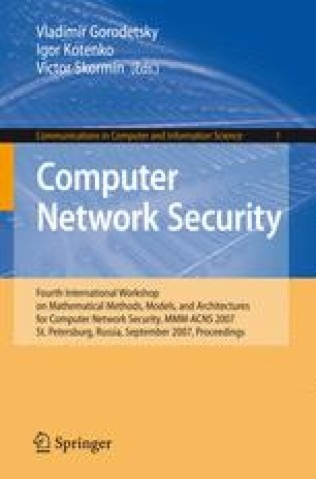
Computer Network Security ; 4th International Conference on Mathematical Methods, Models and Architectures for Computer Network Security, MMM-ACNS 2007, St. Petersburg, Russia, September 13-15, 2007, Proceedings
This volume focus on mathematical aspects of information and computer network security addressing the ever-increasing demands for secure computing and highly dependable computer networks.

ISSE/SECURE 2007 securing electronic business processes : Highlights of the information security solutions Europe/SECURE 2007 Conference
Presents the most interesting talks given at ISSE/SECURE 2007 - the forum for the interdisciplinary discussion of how to adequately secure electronic business processes. Adequate information security is one of the basic requirements of all electronic business processes. It is crucial for effective solutions that the possibilities offered by security technology can be integrated with the commercial requirements of the applications.

Communications and Multimedia Security ; Vol. 175 ; 8th IFIP TC-6 TC-11 Conference on Communications and Multimedia Security, Sept. 15-18, 2004, Windermere, The Lake District, United Kingdom
Communications and Multimedia Security is an essential reference for both academic and professional researchers in the fields of Communications and Multimedia Security. This state-of-the-art volume presents the proceedings of the Eighth Annual IFIP TC-6 TC-11 Conference on Communications and Multimedia Security, September 2004, in Windermere, UK. The papers presented here represent the very latest developments in security research from leading people in the field. The papers explore a wide variety of subjects including privacy protection and trust negotiation, mobile security, applied cryptography, and security of communication protocols. Of special interest are several papers which addressed security in the Microsoft .Net architecture, and the threats that builders of web service applications need to be aware of. The papers were a result of research sponsored by Microsoft at five European University research centers. This collection will be important not only for multimedia security experts and researchers, but also for all teachers and administrators interested in communications security.
Autonomic networking ; 1st International IFIP TC6 Conference, AN 2006, Paris, France, September 27-29, 2006, Proceedings
The autonomic communication paradigm has been defined mainly through the Autonomic Communications Forum (ACF) and particularly as follows: Autonomic communication is centered on selfware – an innovative approach to perform known and emerging tasks of a network control plane, both end-to-end and middle box communication-based. Selfware assures the capacity to evolve; however, it requires generic network instrumentation. Selfware principles and technologies borrow largely from well-established research on distributed systems, fault tolerance among others, from emerging research on non-conventional networking (multihop ad hoc, sensor, peer-to-peer, group communication, etc.
