



الصفحة 1
الصفحة 1

Innovations in Macroeconomics ; 2nd ed.
Modern macroeconomics suffers from an unclear link between short-term Keynesian analysis and long-term growth modelling. Moreover, product and process innovations have been only partially integrated. The analysis suggests new approaches to innovations in open economies in many ways, including the Schumpeterian Mundell-Fleming model and new monetary growth models. A specific focus is on the role of innovations for output, employment and exchange rate developments. A new link between monetary analysis and growth modelling in open economies is presented. Structural change, innovations and growth are considered from a new perspective. This important new book sets a new direction for macroeconomics. By linking several strands of fundamental economic thinking into a coherent, integrated framework it provides a pathbreaking understanding into the fundamental forces shaping macroeconomic performance.

Innovations in Macroeconomics ; 1st ed.
Modern macroeconomics suffers from an unclear link between short-term Keynesian analysis and long-term growth modelling. Moreover, product and process innovations have been only partially integrated. The analysis suggests new approaches to innovations in open economies in many ways, including the Schumpeterian Mundell-Fleming model and new monetary growth models. A specific focus is on the role of innovations for output, employment and exchange rate developments. This book presents a new link between monetary analysis and growth modelling in open economies. Structural change, innovations and growth are considered from a new perspective. With respect to economic policy - in particular innovation policy - the analysis implies major changes, concerning both EU countries and other leading OECD economies.

Innovation, Industrial Dynamics and Structural Transformation : Schumpeterian Legacies
This book provides an account of work in the Schumpeterian and evolutionary tradition of industrial dynamics and the evolution of industries. It is shown that over time industries evolve and change their structure. In this dynamic process change is affected and sometimes constraint by many factors: knowledge and technologies, the capabilities and incentives of actors, new products and processes, and institutions. All these elements and their relations drive innovative activities and affect economic performance in an industry. Investigations into these complex phenomena show a deep interdependence between empirical work delivering a rich account of regularities and stylized facts in the structure of industries and their change, and theoretical analyses ranging from appreciate theorizing to formal modeling.
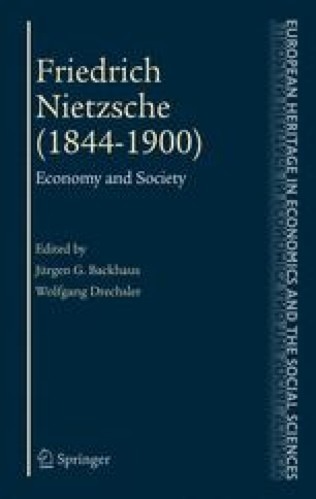
Friedrich Nietzsche (1844-1900) : Economy and Society
Until now, Friedrich Nietzsche’s influence on the development of modern social sciences has not been well documented. This volume reconsiders some of Nietzsche’s writings on economics and the science of state and in doing so pioneers a line of research not previously available in English.

Essays in Honor of Edwin Mansfield: The Economics of R&D, Innovation, and Technological Change
As appreciation and remembrance for his scholarly contributions, eminent scholars have contributed original papers for this edited volume. The authors have followed the "Mansfieldian” approach of emphasizing economic insight and intuition over mathematical rigor and as a result are very accessable.

Entrepreneurship, the new economy and public policy : Schumpeterian perspectives
Silicon Valley is the most salient example of high-tech industrial clusters. Public policy makers throughout the world would like to learn the secrets of Silicon Valley in order to build their own high-tech economies. The existing literature on ind- trial clusters, which traces back to Marshall (1920), focuses on the way in which ?rms bene?t from locating in a cluster; it suggests that once a cluster comes into existence However, a more important question is how to reach this critical mass in the ?rst place. In contrast to the literature, evidence suggests that entrepreneurs rarely move when they est- lish high-tech start-ups. This contradicts the notion that location choice analyses lead entrepreneurs to a high-tech cluster. A high-tech industrial cluster such as Silicon Valley is characterized by c- centrated entrepreneurship.

Digital Integration, Growth and Rational Regulation
This book focuses on the role of information and communication technologies for economic integration, networking and growth. Technological and regulatory dynamics are highlighted with respect to EU countries and the US. The analysis deals with the main issues of rational regulations in open economies. Schumpeterian developments and dynamic efficiency gains are crucial for Europe in the context of telecommunications competition and network modernisation – achieving the goals of the Lisbon Agenda requires adequate incentives for investment and solid capital market prospects. Economic progress in the digital knowledge society will be characterised by enormous structural change and the growth of digital services. New policy conclusions at both the national and international levels – including welfare analysis – are presented.

50 Years of EU Economic Dynamics : Integration, Financial Markets and Innovations
On the occasion of the 50th anniversary of the European Union experts present their analyses of historical developments and new economic challenges for the EU. After a reflection on historical dynamics, the contributors point out the dramatic economic shifts between Europe, Asia and the US. Representatives from major central banks (including the ECB), other leading banks, and academia analyze the dynamics of the Eurozone and financial market integration in the context of globalization and economic growth. Furthermore, the authors discuss the challenges of information and communication technologies by means of various country analyses. Moreover, the Schumpeterian prospects for Europe and the Lisbon Agenda, the long-term challenges of EU pension reforms, emission trading systems in the EU, and options for a new EU constitution are highlighted. At the bottom line of this EU analysis are major implications for investors, managers, policy-makers and the public at large in both the EU and the global economy.
