



الصفحة 1
الصفحة 1

Theoretical and Practical Advances in Computer-based Educational Measurement
Presents a multitude of different, yet related, innovations in educational measurement and provides insight in their practical possibilities. The book not only addresses several improvements in the quality of educational measurement and innovations in (inter)national large scale assessments, but also several advances in psychometrics and improvements in computerized adaptive testing. Moreover, it also offers examples on the impact of new technology in assessment. By bringing together expertise from this variety of fields, advances in assessment are fostered and stimulated. It discussed, among which are review systems tailored for the evaluation of the quality of computer-based educational tests, the Curie-Weiss model as a paradigm for the analysis of educational data, Bayesian techniques to decide on mastery in formative educational measurement and the comparison of Elo chess ratings as strategies for on-the-fly item calibration in computerized adaptive tests.

Probing Experience : From Assessment of User Emotions and Behaviour to Development of Products
Adheres to the vision that in the future compelling user experiences will be key differentiating benefits of products and services. Evaluating the user experience plays a central role, not only during the design process,but also during regular usage: for instance a video recorder that recommends TV programs that fit your current mood, a product that measures your current level of relaxation and produces advice on how to balance your life, or a module that alerts a factory operator when he is getting drowsy.

Linking and Aligning Scores and Scales
In this book, experts in statistics and psychometrics describe classes of linkages, the history of score linkings, data collection designs, and methods used to achieve sound score linkages. They describe and critically discuss applications to a variety of domains including equating of achievement exams, linkages between computer-delivered exams and paper-and-pencil exams, concordances between the current version of the SAT® and its predecessor, concordances between the ACT® and the SAT®, vertical linkages of exams that span grade levels, and linkages of scales from high-stakes state assessments to the scales of the National Assessment of Educational Progress (NAEP).
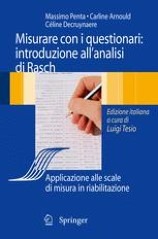
Analisi di Rasch e questionari di misura : Applicazioni in medicina e scienze sociali = Rasch analysis and measurement questionnaires: Applications in medicine and social sciences
Evaluation questionnaires are the most used tools nowadays in the field of medicine and the human sciences to evaluate variables such as disability, altruism or pain. However, clinicians are often unfamiliar with these tools. What do they really measure? How are the results to be interpreted? This book tries to answer these questions.
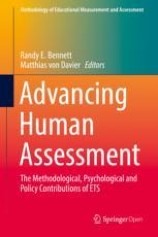
Advancing Human Assessment : The Methodological, Psychological and Policy Contributions of ETS
Describes the extensive contributions made toward the advancement of human assessment by scientists from one of the world’s leading research institutions, Educational Testing Service. The book’s four major sections detail research and development in measurement and statistics, education policy analysis and evaluation, scientific psychology, and validity. Many of the developments presented have become de-facto standards in educational and psychological measurement, including in item response theory (IRT), linking and equating, differential item functioning (DIF), and educational surveys like the National Assessment of Educational Progress (NAEP), the Programme of international Student Assessment (PISA), the Progress of International Reading Literacy Study (PIRLS) and the Trends in Mathematics and Science Study (TIMSS). In addition to its comprehensive coverage of contributions to the theory and methodology of educational and psychological measurement and statistics,
