



الصفحة 1
الصفحة 1

Numerical Methods in Finance
The use of mathematical models and numerical techniques in finance is a growing practice, and an increasing number of applied mathematicians are working on applications in finance and business. This book presents some exciting developments arising from the combination of mathematics, numerical analysis, and finance. It covers a wide range of topics, from portfolio management and asset pricing, to performance, risk, debt and real option evaluation. It also presents applications of a variety of cutting edge approaches and techniques, including robust control, min-max optimisation, Bessel processes, stochastic viability, variational inequalities, and Monte-Carlo test techniques. The book also presents surveys of models and approaches in specific areas in finance, such as corporate debt valuation and portfolio selection

Mutual Funds : Fifty Years of Research Findings
"This book presents an outstanding wealth of information on mutual funds in a remarkably readable format. It is probably the most comprehensive work currently available on funds. The book sheds light on the numerous issues surrounding mutual fund performance and pricing and is an important resource for any serious investor."

Modern Portfolio Management : Moving Beyond Modern Portfolio Theory
In Modern Portfolio Management: Moving Beyond Modern Portfolio Theory, investment executive and advisor Dr. Todd E. Petzel delivers a grounded and insightful exploration of developments in finance since the advent of Modern Portfolio Theory. You’ll find the tools and concepts you need to evaluate new products and portfolios and identify practical issues in areas like operations, decision-making, and regulation.

Modern asset allocation for wealth management
This book provides a complete taxonomy of modern methods for constructing investment portfolios. It goes beyond the simplest models and heuristics that are commonly used today and brings advances that are otherwise buried in Ph.D.-level mathematics to the financial advisor community. It covers all aspects of creating client portfolios, including choosing asset classes to invest in, selecting securities within asset classes, client risk preference assessment, portfolio construction, and portfolio rebalancing.

Investing amid low expected returns : Making the most when markets offer the least
Investing Amid Low Expected Returns: Making the Most When Markets Offer the Least provides an evidence-based blueprint for successful investing when decades of market tailwinds are turning into headwinds.

Implementing machine learning for finance : A systematic approach to predictive risk and performance analysis for investment portfolios
Introduces pattern recognition and future price forecasting that exerts effects on time series analysis models, such as the Autoregressive Integrated Moving Average (ARIMA) model, Seasonal ARIMA (SARIMA) model, and Additive model, and it covers the Least Squares model and the Long Short-Term Memory (LSTM) model. It presents hidden pattern recognition and market regime prediction applying the Gaussian Hidden Markov Model. The book covers the practical application of the K-Means model in stock clustering. It establishes the practical application of the Variance-Covariance method and Simulation method (using Monte Carlo Simulation) for value at risk estimation. It also includes market direction classification using both the Logistic classifier and the Multilayer Perceptron classifier. Finally, the book presents performance and risk analysis for investment portfolios. You will: Understand the fundamentals of the financial market and algorithmic trading, as well as supervised and unsupervised learning models that are appropriate for systematic investment portfolio management / Know the concepts of feature engineering, data visualization, and hyperparameter optimization / Design, build, and test supervised and unsupervised ML and DL models / Discover seasonality, trends, and market regimes, simulating a change in the market and investment strategy problems and predicting market direction and prices / Structure and optimize an investment portfolio with preeminent asset classes and measure the / underlying risk

How the stock market works : A beginner's guide to investment
Cuts through the complex jargon that can alienate newcomers by providing a clear and accessible overview on how the stock market and investing works / Provides guidance on how to safely invest, and covers the responsibilities of being a shareholder to the taxation regime / New to this edition: incorporates changes and fluctuations from 2021 onwards, including the UK's exit from the EU as well as the rise of fake news and its' impact on the financial world and decision making

Fundamentals of investments : Valuation and management
Traditionally, investments textbooks tend to fall into one of two camps. The first type has a greater focus on portfolio management and covers a significant amount of portfolio theory. The second type is more concerned with security analysis and generally contains fairly detailed coverage of fundamental analysis as a tool for equity valuation. Today, most texts try to cover all the bases by including some chapters drawn from one camp and some from anothe
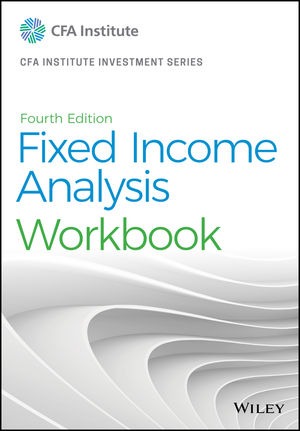
Fixed income analysis workbook
Offers a range of practical information and exercises that will enhance your understanding of the tools, strategies, and techniques associated with fixed-income portfolio management. Written by a team of knowledgeable contributors, this hands-on resource helps busy professionals and those new to the discipline apply the concepts and methodologies that are essential for mastery.

Derivatives
Derivatives is the definitive guide to derivatives and derivative markets. Written by experts working with CFA Institute, this book is an authoritative reference for students and investment professionals interested in the role of derivatives within comprehensive portfolio management. General discussion of the types of derivatives and their characteristics gives way to detailed examination of each market and its contracts, including forwards, futures, options, and swaps, followed by a look at credit derivative markets and their instruments.

Managing Business Interfaces : Marketing and Engineering Issues in the Supply Chain and Internet Domains
Within companies and organizations there is an increased emphasis on making different functional areas work together seamlessly. These developments have led to an increased emphasis on research and practice in business that integrate the functional areas within and between business entities. The research community has recognized the importance of addressing these different, and often conflicting, business perspectives. This has led to research streams that address issues characterizing the domain of business interfaces. These include the benefits of coordination, new product development, product portfolio management, supply chain coordination, and partnerships and collaboration in the Internet space.
Manage IT! : Organizing IT Demand and IT Supply
Discusses the IT management tasks and the objects involved. This book outlines traditional IT management; deals with controlling IT; and, tackles the financial, personnel, purchasing, legal and security aspects in IT. It explains the effects of striving for 'utility computing' and control of IT by means of 'IT portfolio management'.
Liquidity, markets and trading in action : An interdisciplinary perspective
This book addresses four standard business school subjects: microeconomics, macroeconomics, finance and information systems as they relate to trading, liquidity, and market structure. It provides a detailed examination of the impact of trading costs and other impediments of trading that the authors call “frictions”. It also presents an interactive simulation model of equity market trading, TraderEx, that enables students to implement trading decisions in different market scenarios and structures. Addressing these topics shines a bright light on how a real-world financial market operates, and the simulation provides students with an experiential learning opportunity that is informative and fun.

Catastrophe modeling : A new approach to managing risk
Catastrophe Modeling: A New Approach to Managing Risk is the first book that systematically analyzes how catastrophe models can be used for assessing and managing risks of extreme events. It focuses on natural disaster risk, but also discusses the management of terrorism risk. A unique feature of this book is the involvement of three leading catastrophe modeling firms, AIR Worldwide, EQECAT, and Risk Management Solutions, who examine the role of catastrophe modeling in rate setting, portfolio management and risk financing. Given the uncertainties associated with terrorism the book points out the opportunities for utilizing catastrophe models to set insurance rates and to examine public-private partnerships for providing financial assistance in the event of a terrorist attack. This book is strongly recommended for individuals who must make decisions regarding the management of impacts of catastrophe risks including those in both the public and private sector.

Bond Portfolio Optimization
1 The tools of modern portfolio theory are in general use in the equity markets, either in the form of portfolio optimization software or as an accepted frame- 2 work in which the asset managers think about stock selection. In the ?xed income market on the other hand, these tools seem irrelevant or inapplicable. Bond portfolios are nowadays mainly managed by a comparison of portfolio 3 4 risk measures vis ¶a vis a benchmark. The portfolio manager’s views about the future evolution of the term structure of interest rates translate th- selves directly into a positioning relative to his benchmark, taking the risks of these deviations from the benchmark into account only in a very crude 5 fashion, i.e. without really quantifying them probabilistically. This is quite surprising since sophisticated models for the evolution of interest rates are commonly used for interest rate derivatives pricing and the derivation of ?xed 6 income risk measures.
Best practices in software measurement : How to use metrics to improve project and process performance
Not everything that counts can be counted. Not everything that is counted counts. Albert Einstein This is a book about software measurement from the practitioner’s point of view and it is a book for practitioners. Software measurement needs a lot of practical guidance to build upon experiences and to avoid repeating errors. This book t- gets exactly this need, namely to share experiences in a constructive way that can be followed. It tries to summarize experiences and knowledge about software measurement so that it is applicable and repeatable. It extracts experiences and lessons learned from the narrow context of the specific industrial situation, thus facilitating transfer to other contexts. Software measurement is not at a standstill. With the speed software engine- ing is evolving, software measurement has to keep pace. While the underlying theory and basic principles remain invariant in the true sense (after all, they are not specific to software engineering), the application of measurement to specific contexts and situations is continuously extended. The book thus serves as a ref- ence on these invariant principles as well as a practical guidance on how to make software measurement a success.

Advances in pharma business management and research ; Vol. 1
This book presents a unique collection of practical examples from the field of pharma business management and research. It covers a wide range of topics such as: 'Brexit and its Impact on pharmaceutical Law - Implications for Global Pharma Companies', 'Implementation of Measures and Sustainable Actions to Improve Employee's Engagement', 'Global Medical Clinical and Regulatory Affairs (GMCRA)', and 'A Quality Management System for R&D Project and Portfolio Management in a Pharmaceutical Company'.
