



الصفحة 1
الصفحة 1

Numerical Methods for General and Structured Eigenvalue Problems
The purpose of this book is to describe recent developments in solving eig- value problems, in particular with respect to the QR and QZ algorithms as well as structured matrices. Outline Mathematically speaking, the eigenvalues of a square matrix A are the roots of its characteristic polynomial det(A??I). An invariant subspace is a linear subspace that stays invariant under the action of A. In realistic applications, it usually takes a long process of simpli?cations, linearizations and discreti- tions before one comes up with the problem of computing the eigenvalues of a matrix. In some cases, the eigenvalues have an intrinsic meaning, e.g., for the expected long-time behavior of a dynamical system; in others they are just meaningless intermediate values of a computational method. The same applies to invariant subspaces, which for example can describe sets of initial states for which a dynamical system produces exponentially decaying states. Computing eigenvalues has a long history, dating back to at least 1846 when Jacobi [172] wrote his famous paper on solving symmetric eigenvalue problems. Detailed historical accounts of this subject can be found in two papers by Golub and van der Vorst [140, 327].

Number Theory ; Vol. II : Analytic and Modern Tools
The central theme of this graduate-level number theory textbook is the solution of Diophantine equations, i.e., equations or systems of polynomial equations which must be solved in integers, rational numbers or more generally in algebraic numbers. This theme, in particular, is the central motivation for the modern theory of arithmetic algebraic geometry. In this text, this is considered through three aspects.

Number Theory ; Vol. I : Tools and Diophantine Equations
The central theme of this graduate-level number theory textbook is the solution of Diophantine equations, i.e., equations or systems of polynomial equations which must be solved in integers, rational numbers or more generally in algebraic numbers. This theme, in particular, is the central motivation for the modern theory of arithmetic algebraic geometry. In this text, this is considered through three aspects.

New Trends in Optimal Filtering and Control for Polynomial and Time-Delay Systems
0. 1 Introduction Although the general optimal solution of the ?ltering problem for nonlinear state and observation equations confused with white Gaussian noises is given by the Kushner equation for the conditional density of an unobserved state with respect to obser- tions (see [48] or [41], Theorem 6. 5, formula (6. 79) or [70], Subsection 5. 10. 5, formula (5. 10. 23)), there are a very few known examples of nonlinear systems where the Ku- ner equation can be reduced to a ?nite-dimensional closed system of ?ltering eq- tions for a certain number of lower conditional moments.

Multiplicative Ideal Theory in Commutative Algebra : A Tribute to the Work of Robert Gilmer
This volume, a tribute to the work of Robert Gilmer, consists of twenty-four articles authored by his most prominent students and followers. These articles combine surveys of past work by Gilmer and others, recent results which have never before seen print, open problems, and extensive bibliographies.

Modules and Comodules
The 23 articles in this volume encompass the proceedings of the International Conference on Modules and Comodules held in Porto (Portugal) in 2006 and dedicated to Robert Wisbauer on the occasion of his 65th birthday. These articles reflect Professor Wisbauer's wide interests and give an overview of different fields related to module theory, some of which have a long tradition whereas others have emerged in recent years. They include topics in the formal theory of modules bordering on category theory, in ring theory, in Hopf algebras and quantum groups, and in corings and comodules.

Modular Algorithms in Symbolic Summation and Symbolic Integration
Brings together two streams in computer algebra: symbolic integration and summation on the one hand, and fast algorithmics on the other hand. In many algorithmically oriented areas of computer science, the analysis of al gorithms placed into the lime light by DonKnuth’stalkat the 1970ICM –provides a crystal-clear criterion for success. The researcher who designs an algorithm that is faster (asymptotically, in the worst case) than any previous method receives instant gratification : her result will be recognized as valuable. Al as, the downside is that such results come along quite infrequently, despite our best efforts. An alternative evaluation method is to run a new algorithm on examples; this has its obvious problems, but is sometimes the best we can do. George Collins, one of the fathers of computer algebra and a great experimenter,wrote in 1969: “I think this demonstrates again that a simple analysis is often more revealing than a ream of empirical data (although both are important). ” Within computer algebra, some areas have traditionally followed the former methodology, notably some parts of polynomial algebra and linear algebra. Other areas, such as polynomial system solving, have not yet been amenable to this - proach. The usual “input size” parameters of computer science seem inadequate, and although some natural “geometric” parameters have been identified (solution dimension, regularity), not all (potential) major progress can be expressed in this framework. Symbolic integration and summation have been in a similar state.

Modeling, Estimation and Control : Festschrift in Honor of Giorgio Picci on the Occasion of his Sixty-Fifth Birthday
Coefficients of Variations in Analysis of Macro-Policy Effects: An example of two-parameter Poisson-Dirichlet distributions.- How Many Experiments Are Needed to Adapt?- A Mutual Information Based Distance for Multivariate Gaussian Processes.- Differential Forms and Dynamical Systems.- An Algebraic Framework for Bayes Nets of Time Series.- A Birds Eye View on System Identification.- Further Results on the Byrnes-Georgiou-Lindquist Generalized Moment Problem.- Factor Analysis and Alternating Minimization.- Tensored PolynomialModels.- Distances Between Time-Series and Their Autocorrelation Statistics.- Global Identifiability of Complex Models, Constructed from Simple Submodels.- Identification of Hidden MarkovModels - Uniform LLN-s.- Identifiability and Informative Experiments in Open and Closed-Loop Identification.- On Interpolation and the Kimura-Georgiou Parametrization.- The Control of Error in Numerical Methods.- Contour Reconstruction and Matching Using Recursive Smoothing Splines.- Role of LQ Decomposition in Subspace Identification Methods.- Canonical Operators on Graphs.

Méthodes Numériques : Algorithmes, analyse et applications = Numerical Methods : Algorithms, Analysis and Applications
This book aims to present the theoretical and methodological foundations of numerical analysis. Particular attention is paid to the concepts of stability, precision and complexity of algorithms. Modern methods relating to the following topics are presented and analyzed in detail: solving linear and nonlinear systems, polynomial approximation, optimization, numerical integration, orthogonal polynomials, rapid transformations, ordinary differential equations. The techniques presented are illustrated by numerous tables and figures. Many examples and counter-examples are offered to allow the reader to develop his critical sense.

Membrane Computing ; Vol. 3850 ; 6th International Workshop, WMC 2005, Vienna, Austria, July 18-21, 2005, Revised Selected and Invited Papers
The papers in this volume cover all the main directions of research in membrane computing, ranging from theoretical topics in mathematics and computer science, to application issues, especially in biology. More specifically, these papers present research on topics such as: computational power and complexity classes, new types of P systems, relationships to Petri nets, quantum computing, and brane calculi, determinism vs. nondeterminism, hierarchies, the size of small families, algebraic approaches, and designing polynomial solutions to NP-complete problems through the use of membrane systems. Like the previous workshops,

Introduction to Modern Number Theory: Fundamental Problems, Ideas and Theories
"Introduction to Modern Number Theory" surveys from a unified point of view both the modern state and the trends of continuing development of various branches of number theory. Motivated by elementary problems, the central ideas of modern theories are exposed. Some topics covered include non-Abelian generalizations of class field theory, recursive computability and Diophantine equations, zeta- and L-functions. This substantially revised and expanded new edition contains several new sections, such as Wiles' proof of Fermat's Last Theorem, and relevant techniques coming from a synthesis of various theories. Moreover, the authors have added a part dedicated to arithmetical cohomology and noncommutative geometry, a report on point counts on varieties with many rational points, the recent polynomial time algorithm for primality testing, and some others subjects.

Introduction aux méthodes numériques
Au cours de l’histoire, les méthodes de calcul ont été l’expression de pratiques sans cesse renouvelées. Le développement de l’informatique a largement contribué à une rapide progression de l’ensemble des techniques numériques. En moins de cinquante ans, le paysage algorithmique a été complètement transformé. Aujourd’hui, la plupart des logiciels que nous employons font appel à des méthodes de plus en plus efficaces. Dans les simulations, comme dans les modélisations, l’analyse numérique occupe une place centrale. Composants essentiels de la vie scientifique, les méthodes et algorithmes qui sont présentés ici, illustrés par de nombreux exemples, sont mis à la portée de tous. De l’approximation polynomiale à la résolution d’équations aux dérivées partielles par des méthodes de différences, de volumes et d’éléments finis, ce livre offre un large panorama des méthodes numériques actuelles.

Introduction à la résolution des systèmes polynomiaux = Introduction to solving polynomial systems
This book is an introduction to algebraic methods for solving this type of equations. We show how the geometry of algebraic varieties defined by these equations, their dimension, their degree, or their components can be deduced from the properties of the corresponding quotient algebras. For this, we approach methods of effective algebraic geometry, such as Grobner bases, resolution by eigenvalues and vectors, resultants, bezoutians, duality, Gorenstein algebras and algebraic residues.

Interior Point Methods for Linear Optimization
Linear Optimization (LO) is one of the most widely applied and taught techniques in mathematics, with applications in many areas of science, commerce and industry. The dramatically increased interest in the subject is due mainly to advances in computer technology and the development of Interior Point Methods (IPMs) for LO. This book provides a unified presentation of the field. The authors present a self-contained comprehensive interior point approach to both the theory of LO and algorithms for LO (design, convergence, complexity, asymptotic behaviour and computational issues). A common thread throughout the book is the role of strictly complementary solutions, which play a crucial role in the interior point approach and distinguishes the new approach from the classical Simplex-based approach
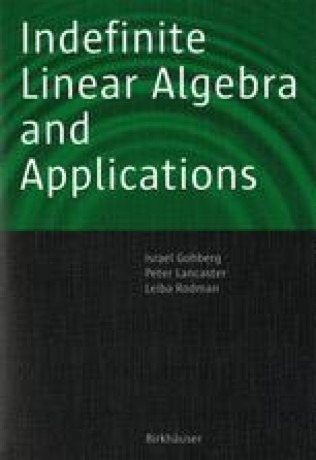
Indefinite Linear Algebra and Applications
This book is dedicated to relatively recent results in linear algebra with indefinite inner product. It also includes applications to differential and difference equations with symmetries, matrix polynomials and Riccati equations. These applications have been developed in the last fifty years, and all of them are based on linear algebra in spaces with indefinite inner product. The latter forms a new more or less independent branch of linear algebra and we gave it the name of indefinite linear algebra. This new subject in linear algebra is presented following the lines and principles of a standard linear algebra course. This book has the structure of a graduate text in which chapters of advanced linear algebra form the core. This together with the many significant applications and accessible style will make it widely useful for engineers, scientists and mathematicians alike.

Identification of nonlinear systems using neural networks and polynomial models : A block-oriented approach
The book gives a comparative study of their gradient approximation accuracy, computational complexity, and convergence rates and furthermore presents some new and original methods concerning the model parameter adjusting with gradient-based techniques. "Identification of Nonlinear Systems Using Neural Networks and Polynomal Models".

Ideals, Varieties, and Algorithms : An Introduction to Computational Algebraic Geometry and Commutative Algebra
Algebraic Geometry is the study of systems of polynomial equations in one or more variables.The solutions of a system of polynomial equations form a geometric object called a variety; the corresponding algebraic object is an ideal. There is a close relationship between ideals and varieties which reveals the intimate link between algebra and geometry. Written at a level appropriate to undergraduates, this book covers such topics as the Hilbert Basis Theorem, the Nullstellensatz, invariant theory, projective geometry, and dimension theory.

Hypoelliptic estimates and spectral theory for Fokker-Planck operators and witten Laplacians
There has recently been a renewal of interest in Fokker-Planck operators, motivated by problems in statistical physics, in kinetic equations and differential geometry. Compared to more standard problems in the spectral theory of partial differential operators, those operators are not self-adjoint and only hypoelliptic. The aim of the analysis is to give, as generally as possible, an accurate qualitative and quantitative description of the exponential return to the thermodynamical equilibrium. While exploring and improving recent results in this direction this volume proposes a review of known techniques on: the hypoellipticity of polynomial of vector fields and its global counterpart; the global Weyl-Hörmander pseudo-differential calculus, the spectral theory of non-self-adjoint operators, the semi-classical analysis of Schrödinger-type operators.
Graph-theoretic concepts in computer science ; 46th International Workshop, WG 2020, Leeds, UK, June 24–26, 2020, Revised Selected Papers
This book constitutes the revised papers of the 46th International Workshop on Graph-Theoretic Concepts in Computer Science, WG 2020, held in Leeds, UK, in June 2020. The workshop was held virtually due to the COVID-19 pandemic. The 32 full papers presented in this volume were carefully reviewed and selected from 94 submissions. They cover a wide range of areas, aiming to present emerging research results and to identify and explore directions of future research of concepts on graph theory and how they can be applied to various areas in computer science.

Geometry of Müntz Spaces and Related Questions
Starting point and motivation for this volume is the classical Muentz theorem which states that the space of all polynomials on the unit interval, whose exponents have too many gaps, is no longer dense in the space of all continuous functions. The resulting spaces of Muentz polynomials are largely unexplored as far as the Banach space geometry is concerned and deserve the attention that the authors arouse. They present the known theorems and prove new results concerning, for example, the isomorphic and isometric classification and the existence of bases in these spaces. Moreover they state many open problems. Although the viewpoint is that of the geometry of Banach spaces they only assume that the reader is familiar with basic functional analysis. In the first part of the book the Banach spaces notions are systematically introduced and are later on applied for Muentz spaces. They include the opening and inclination of subspaces, bases and bounded approximation properties and versions of universality.
