



الصفحة 1
الصفحة 1
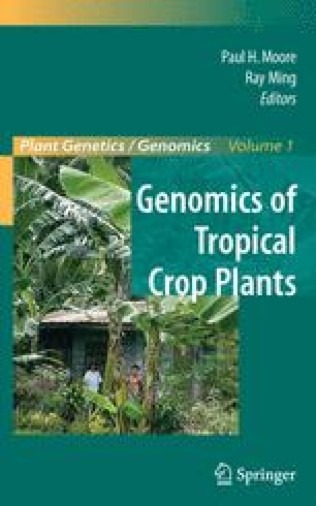
Genomics of Tropical Crop Plants
Genomics of Tropical Crop Plants summarizes recent progress on genomic research, including the development of molecular markers, genomic and cDNA libraries, expressed sequence tags (ESTs), genetic and physical maps, gene expression profiles, and whole genome sequences for 20 tropical crop plants. It offers background information about the evolutionary origin and environments of tropical crop species, international programs that are addressing the needs of tropical agriculture, and the potential for new technologies to increase the productivity and value of tropical crops. This book provides new dimensions to growing information concerning temperate crops and their morphology, physiology, and parallel evolution in diverse plant lineages.

Genetics and Genomics of Soybean
The book covers recent progress on genome research in soybeans, including the genetic map with classical, RFLP, SSR and SNP markers; genomic and cDNA libraries, functional genomics platforms (e.g., cDNA, Affymetrix and oligonucleotide based DNA microarrays); physical maps, and the efforts to fully sequence the genome. Given the pending release of the soybean genome sequence, through the efforts of the Department of Energy’s Joint Genome Institute, this book will stand as a critical source of information on soybean.
Association Mapping in Plants
For the past decade, there has been success in using conventional map-based strategies in identification and cloning of quantitative trait loci (QTL) in model plant species including tomato and Arabidopsis. These quantitative traits are generally the products of many loci with varying degrees of effect upon the observed phenotypes. Recently, a new approach to genetic mapping has emerged called association mapping. This new technique takes into account the thousands of genes to evaluate for QTL effect and is a more efficient approach that does not require generation of segregating populations/large numbers of progeny. As it can utilize all of the historic recombination events in a diverse population of individuals it can generate higher resolution genetic maps and, is needed to complement current map based cloning methods.
