



الصفحة 1
الصفحة 1

Westcotts Plant Disease Handbook
In its revised, improved and expanded 7th Edition, Westcott’s Plant Disease Handbook presents newly discovered diseases and newly identified hosts in the classic format that has won favor with readers at every level of expertise and experience. Dictionary-style entries permit easy access to essential information, and numerous illustrations help identify important diseases. New and updated material includes significant taxonomic changes in fungi, bacteria, viruses and nematodes; recently discovered diseases and new hosts for previously known plant-pathogens; changes in chemicals and pesticides and updates on regulations governing their use; integrated pest management and biological control. The Handbook offers additional conveniences: useful cross references, indexes, illustrative plates of 34 key diseases, and 40 black and white illustrations of other diseases. This updated edition of a long-trusted resource will serve a broad audience, from amateur backyard gardeners to landscape architects, arborists, florists, nursery professionals and plant scientists.

The Epidemiology of Plant Diseases
Plant disease epidemiology is a dynamic science that forms an essential part of the study of plant pathology. This book brings together a team of 35 international experts. Each chapter deals with an essential component of the subject and allows the reader to fully understand how each exerts its influence on the progress of pathogen populations in plant populations over a defined time scale. Since the first edition of the text was published in 1998, many new developments have occurred in the subjects covered, particularly molecular diagnostics, modelling, fungicide resistance and information technology. The second edition of the book is a comprehensive text on all aspects of plant disease epidemiology that should serve as an invaluable reference work for those involved in this fascinating science of crop plants.

New and emerging plant viruses : the threat to food security
Despite intensive efforts to manage and prevent plant viruses and their potential vectors in crop production processes, many crops are damaged each year. This new book reviews the progress made to date and the challenges ahead in the field of plant viruses and agricultural production. It sheds light on previously undiscovered plant viruses, bringing together information on the detection and tracking, host interaction, evolution, and management. The first section covers the various hidden sources of plant viruses such as from wild plants, weeds, and tobacco as well as other undetermined plant virus sources. The second section covers the implications of mixed infection on disease pathogenicity and epidemiology, provides an understanding of the virus and host relationship, and presents an overview of plant viruses from old to new.

Molecular Mechanisms of Plant and Microbe Coexistence
Molecular Mechanisms of Plant and Microbe Coexistence presents studies on the complex and manifold interactions of plants and microbes at the population, genomics and proteomics level. The role of soil microbial diversity in enhancing plant health and plant microbe beneficial symbioses is discussed. Microbial communities are shown in the light of evolution. Main topics include genome coexistence and the functional genomics and proteomics of plant-associated microbes, which could form the basis for new environmentally benign strategies to combat infectious plant diseases and regulate plant growth. Further chapters focus on the role of signaling during the different stages of plant microbe coexistence, in symbiotic or pathogenic relationships, in quorum sensing and plant viral infections. Methods for studying the interactions in the root zone complement the book, which will certainly be of relevance in the practical application to agriculture, food security and for maintaining the balance of our ecosystems.

Frontiers in periodontology: new directions and emerging therapies
Offers a comprehensive overview of emerging advancements in the management of periodontal and peri-implant diseases, providing crucial insights for clinicians and researchers alike. It explores the potential of probiotics in restoring oral microbiome balance and investigates the future applications of epigenetics and stem cell therapies in periodontal regeneration. The book highlights innovative technologies. Emphasizing minimally invasive, non-surgical treatments and novel non-invasive indices for evaluation, this volume advocates for safer and more effective approaches to periodontal care.

Dental implant failure : A clinical guide to prevention, treatment, and maintenance therapy
This book examines the current state of knowledge on why implant failures occur, makes specific recommendations for prevention of failure, and emphasizes the role that maintenance plays in increasing the probability of success. Current recommendations for the treatment of ailing implants are also reviewed.
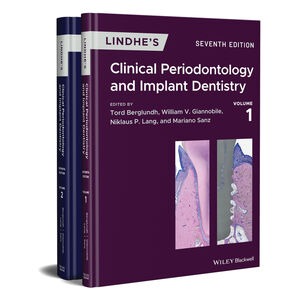
Lindhe's Clinical Periodontology and Implant Dentistry ; 2 Vol. Set ; 7th ed.
Provides an introduction to anatomy, including periodontal tissues, the edentulous ridge, the mucosa at teeth and implants, and osseointegration Discusses the epidemiology of periodontal and peri-implant diseases Explores the microbiology, including dental biofilms and calculus, periodontal infections, peri-implant infections, the pathogenesis of gingivitis and periodontitis, and the genetic susceptibility to periodontal disease Includes the latest perio- and peri-implant disease classifications Contains updated evidence-based preventive and treatment modalities for the treatment of periodontal and peri-implant diseases Features the latest evidence-based therapeutic alternatives on the use of dental implants to rehabilitate the lost dentition

Laser in restorative dentistry
The application of lasers in restorative dentistry has revolutionized dental treatments, offering enhanced precision, reduced discomfort, and improved clinical outcomes. Lasers have become a valuable tool in procedures such as cavity preparation, caries removal, tooth whitening, and composite resin curing. Their ability to selectively target diseased tissue while preserving healthy structures minimizes trauma and promotes faster healing. Moreover, lasers offer a less invasive alternative to traditional mechanical methods, often eliminating the need for anesthesia. This technology's versatility allows for its use in both hard and soft tissue treatments, including gingival recontouring and managing peri-implant diseases. As laser technology continues to advance, its integration into restorative dental practices offers significant potential for improved patient care, greater procedural efficiency, and long-term durability of restorations. Future developments in laser applications are expected to expand their role, making them an indispensable asset in modern dentistry.

ITI treatment guide ; Vol.13 : Prevention and management of peri-implant diseases
Provides clinicians with the latest evidence-based information on the prevention and management of peri-implant diseases. This information is based in part on the proceedings of the 6th ITI Consensus Conference held in Amsterdam in 2018, as well as on a review of the current literature. Seventeen clinical cases presented by experienced clinicians from all over the world illustrate the diagnosis and treatment of peri-implant diseases.

Basic guide to oral health education and promotion ; 3rd ed.
An essential guide to help dental nurses prepare for a qualification in Oral Health Education and thereafter practice as an Oral Health Educator. It will help readers confidently educate patients about diseases and conditions that affect the oral cavity, and support their prevention, treatment, and management. Offers a guide for dental nurses taking a post-registration Certificate in Oral Health Education Is fully updated to reflect changes in the industry, science, and course syllabus Incorporates information on the new classification of periodontal and peri-implant diseases Contains new information on topics including dementia, denture advice, and burning mouth syndrome Includes an expanded section on promotion
Allelochemicals : Biological Control of Plant Pathogens and Diseases
This book is organized around the indication that allelochemicals can be employed for biological control of plant pathogens and plant diseases. Specifically, this volume focuses on (i) discovery and development of natural product based fungicides for agriculture, (ii) direct use of allelochemicals as well as indirect effects through cover crops and organic amendments for plant parasitic pest control and (iii) application of allelopathy in pest management.
