



الصفحة 1
الصفحة 1
New Trends and Technologies in Computer-Aided Learning for Computer-Aided Design ; IFIP International Working Conference: EduTech 2005, Perth, Australia, October 20-21, 2005
Computation and communication technologies underpin work and development in many different areas. Among them, Computer-Aided Design of electronic systems and E-Learning technologies are two areas which are different but share many concerns. The design of CAD and E-Learning systems already touches on a number of parallels, such as system interoperability, user interfaces, standardization, EML-based formats, reusability aspects (of content or designs), and intellectual property rights. Furthermore, the teaching of Design Automation tools and methods is particularly amenable to a distant or blended learning setting, and implies the interconnection of typical CAD tools, such as simulators or synthesis tools, with e-learning tools. There are many other aspects in which synergy can be found when using E-Learning technology for teaching and learning technology. This workshop, sponsored by IFIP WG 10.5 Design and Engineering of Electronic Systems in cooperation with IFIP WG 3.6 Distance Education, will explore the interrelationship between these two subjects, where Computer-Aided Design meets Computer-Aided Learning. New Trends and Technologies in Computer-Aided Learning for Computer-Aided Design documents recent approaches and results presented at the EduTech 2005 Workshop, which was held in October 2005 in Perth, Australia and sponsored by the International Federation for Information Processing (IFIP). The topics chosen for this working conference are very timely: learning environments, tools and applications for education, education technologies and trends, and teaching in the hardware design area.
Mobile Information Systems : Infrastructure and Design for Adaptivity and Flexibility
The book is divided into three parts: core technologies for mobile information systems (e.g., adaptive middleware and flexible e-services), enabling technologies (like data management on small devices or adaptive low-power hardware architectures or wireless networks), and methodological aspects of mobile information systems design (such as service profiling or user interface and e-service design for context-aware applications). It provides researchers in academia and industry with a comprehensive vision on innovative aspects which can be used as a basis for the development of new frameworks and applications.
Intelligent Computing Everywhere
Intelligent Computing Everywhere investigates the relevance and relationship artificial intelligence maintains with "modern strands of computing" i.e. pervasive computing and ambient intelligence, bioinformatics, neuroinformatics, computing and the mind, non-classical computing and novel computing models, as well as DNA computing and quantum computing.
High performance computing and communications ; 3rd International Conference, HPCC 2007, Houston, USA, September 26-28, 2007, Proceedings
The 75 revised full papers address all current issues of parallel and distributed systems and high performance computing and communication, including networking protocols, embedded systems, wireless, mobile and pervasive computing, Web services and internet computing, and programming interfaces for parallel systems.

From grids to service and pervasive computing
Grids are a crucial enabling technology for scientific and industrial development. Peer-to-peer computing, grid, distributed storage technologies, emerging web service technologies, and other types of networked distributed computing have provided new paradigms exploiting distributed resources. Grids are revolutionizing computing as profoundly as e-mail and the Web.From Grids to Service and Pervasive Computing, the 10th edited volume of the CoreGRID series, is based on the 2008 CoreGRID Symposium, held August 25-26 in the Canary Islands, Spain.

Embedded Software and Systems Vol. 3605 ; 1st International Conference, ICESS 2004, Hangzhou, China, December 9-10, 2004, Revised Selected Papers
Welcome to the post proceedings of the First International Conference on Embedded Software and Systems (ICESS 2004), which was held in Hangzhou, P. R. China, 9–10 December 2004. Embedded Software and Systems technology is of increasing importance for a wide range of industrial areas, such as aerospace, automotive, telecommunication, and manufacturing automation. Embedded technology is playing an increasingly dominant role in modern society. This is a natural outcome of amazingly fast developments in the embedded field. The ICESS 2004 conference brought together researchers and developers from academia, industry, and government to advance the science, engineering, and technology in embedded software and systems development, and provided them with a forum to present and exchange their ideas, results, work in progress, and experience in all areas of embedded systems research and development. The ICESS 2004 conference attracted much more interest than expected.
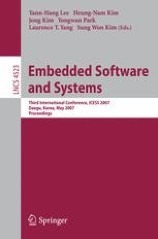
Embedded Software and Systems ; 3rd International Conference, ICESS 2007, Daegu, Korea, May 14-16, 2007, Proceedings
This book introduces sections on embedded architecture, embedded hardware, embedded software, HW-SW co-design and SoC, multimedia and HCI, pervasive/ubiquitous computing and sensor network, power-aware computing, real-time systems, security and dependability, and wireless communication.
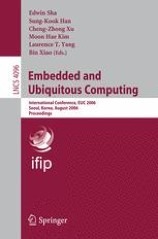
Embedded and Ubiquitous Computing ; International Conference, EUC 2006, Seoul, Korea, August 1-4, 2006, Proceedings
Embedded and ubiquitous computing is an exciting new paradigm that p- vides computing and communication services all the time, everywhere. Now we can attach computing and communication devices to human bodies to mo- tor our health, embed computing chips into brains to cure memory losses, or make smart fabrics so they can change colors or generate heat.
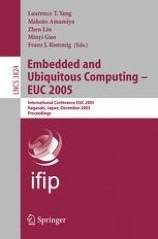
Embedded and Ubiquitous Computing - EUC 2005 ; International Conference EUC 2005, Nagasaki, Japan, December 6-9, 2005, Proceedings
Welcome to the proceedings of the 2005 IFIP International Conference on - bedded and Ubiquitous Computing (EUC 2005), which was held in Nagasaki, Japan, December 6–9, 2005. Embedded and ubiquitous computing is emerging rapidly as an exciting new paradigm to provide computing and communication services all the time, - erywhere. Its systems are now pervading every aspect of life to the point that they are hidden inside various appliances or can be worn unobtrusively as part of clothing and jewelry. This emergence is a natural outcome of research and technological advances in embedded systems, pervasive computing and c- munications, wireless networks, mobile computing, distributed computing and agent technologies, etc. Its tremendous impact on academics, industry, gove- ment, and daily life can be compared to that of electric motors over the past century, in fact it but promises to revolutionize life much more profoundly than elevators, electric motors or even personal computers. The EUC 2005 conference provided a forum for engineers and scientists in academia, industry, and government to address profound issues including te- nical challenges, safety, and social, legal, political, and economic issues, and to present and discuss their ideas, results, work in progress, and experience on all aspects of embedded and ubiquitous computing.

Dependability Metrics : Advanced Lectures
This tutorial book gives an overview of the current state of the art in measuring the different aspects of dependability of systems: reliability, security and performance.

Location- and Context-Awareness ; Vol. 3987 ; 2nd International Workshop, LoCA 2006, Dublin, Ireland, May 10-11, 2006, Proceedings
Contain the papers presented at the 2 International Workshop on Location- and Context-Awareness in May of 2006. As computing moves increasingly into the everyday world, the importance of location and context knowledge grows. The range of contexts encountered while sitting at a desk working on a computer is very limited compared to the large variety of situations experienced away from the desktop. For computing to be relevant and useful in these situations, the computers must have knowledge of the user’s activity, resources, state of mind, and goals, i.e., the user’s context, of which location is an important indicator. This workshop was intended to present research aimed at sensing, inferring, and using location and context data in ways that help the user.

Location- and Context-Awareness ; Vol. 3479 ; First International Workshop, LoCA 2005, Oberpfaffenhofen, Germany, May 12-13, 2005, Proceedings
The workshop was organized by the Institute of Communications and Navigation of the German Aerospace Center (DLR) in Oberpfa?enhofen, and the Mobile and Distributed Systems Group of the University of Munich. During the workshop, novel positioning algorithms and location sensing techniques were discussed, comprising not only enhancements of singular systems, like positioning in GSM or WLAN, but also hybrid technologies, such as the integration of global satellite systems with inertial positioning. Furthermore, improvements in sensor technology, as well as the integration and fusion of sensors, were addressed both on a theoretical and on an implementation level. Personal and confidential data, such as location data of users, have p- found implications for personal information privacy. Thus privacy protection, privacy-oriented location-aware systems, and how privacy aspects the feasibility and usefulness of systems were also addressed in the workshop.
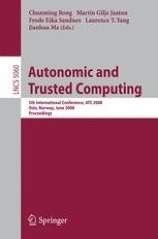
Autonomic and Trusted Computing ; 5th International Conference, ATC 2008, Oslo, Norway, June 23-25, 2008 Proceedings
This book constitutes the refereed procedings of the 5th International Conference on Autonomic and Trusted Computing, ATC 2008, held in Oslo, Norway, in June 2008, co-located with UIC 2008, the 5th International Conference on Ubiquitous Intelligence and Computing.
Architecture of computing systems - ARCS 2007 ; 20th International Conference, Zurich, Switzerland, March 12-15, 2007, Proceedings
The ARCS is reporting hi- quality results in computer architecture and operating systems research.It is also represent a - namic, evolving community that closely follows new research trends and topics. ARCS has evolved towards a strong focus on s- tem aspects of pervasive computing and self-organization techniques (organic and autonomic computing).

Architecture of computing systems - ARCS 2006 ; 19th International Conference, Frankfurt / Main, Germany, March 13-16, 2006, Proceedings
Technological progress is one of the driving forces behind the dramatic devel- mentofcomputersystemarchitecturesoverthe pastthreedecades.Eventhough it is quite clear that this development cannot only be measured by the ma- mum number of components on a chip, Moore’s Law may be and is often taken as a simple measure for the non-braked growth of computational power over the years. The more components are realizable on a chip, the more innovative and unconventional ideas can be realized by system architects. As a result, research in computer system architectures is more exciting than ever before. This book coversthe trends that shape the ?eld of computer system archit- tures.

Ambient Intelligence in Everyday Life : Foreword by Emile Aarts
Originating from the Workshop on Ambient Intelligence in Everyday Life held at the Miramar Congress Center, San Sebastian, Spain, in July 2005, this book is devoted to the cognitive aspects of ambient intelligence. The 15 carefully reviewed and revised articles presented are organized in topical sections on human-centric computing, ambient interfaces, and architectures for ambient intelligence.

Advances in pervasive computing and networking
"Pervasive Computing and Networking aim at providing ubiquitous, ever-present, adaptable, smart, enveloping and immersive environments in which computing components and humans can interact regardless of the location. The combination of an abundance of computational power of the processors and the communication bandwidth provided by the wireless and mobile networking everywhere and all the time makes such environments within the reach of current technology. Yet, to realize the full potential of such environments, many technical and economical challenges needs to be overcome. These challenges and the perspective on the seminal directions of the research in this area were the subject of the Workshop for Pervasive Computing and Networking at Rensselaer Polytechnic Institute, Troy, NY, USA.

Advances in grid and pervasive computing ; 3rd International Conference, GPC 2008, Kunming, China, May 25-28, 2008. Proceedings
This book constitutes the refereed proceedings of the Third International Conference on Grid and Pervasive Computing, GPC 2008, held in Kunming, China, in May 2008.
Advances in grid and pervasive computing ; 2nd International Conference, GPC 2007, Paris, France, May 2-4, 2007, Proceedings
This book address all aspects of grid and pervasive computing and focus on topics such as cluster computing, high performance computing, grid computing, semantic Web and semantic grid, service-oriented computing, peer-to-peer computing, pervasive computing, mobile computing, network storage, as well as grid and pervasive related applications.
Advances in grid and pervasive computing ; 1st International Conference, GPC 2006, Taichung, Taiwan, May 3-5, 2006, Proceedings
This book constitutes the refereed proceedings of the First International Conference on Grid and Pervasive Computing, GPC 2006, held in Taichung, Taiwan, in May 2006.The 64 revised full papers were carefully reviewed and selected from 267 submissions. The papers are organized in topical sections on grid scheduling, peer-to-peer computing, Web/grid services, high performance computing, ad hoc networks, wireless sensor networks, grid applications, data grid, pervasive applications, semantic Web, semantic grid, grid load balancing, wireless ad hoc/sensor networks, and mobile computing.
