



الصفحة 1
الصفحة 1

Intelligent Algorithms for Packing and Cutting Problem
Introduces intelligent solving algorithms for classical packing and cutting problem and their variants / Investigates novel methods, e.g. reinforcement learning algorithms, for rectangular and irregular packing problems / Presents practical engineering application cases in combination of theory and practice / investigates in detail the two-dimensional packing and cutting problems in the field of operations research and management science. It introduces the mathematical models and intelligent solving algorithms for these problems, as well as their engineering applications. Most intelligent methods reported in this book have already been applied in reality, which can provide reference for the engineers. The presented novel methods for the two-dimensional packing problem provide a new way to solve the problem for researchers interested in operations research or computer science. This book also introduces three new variants of packing problems and their solving methods, which offer a different research direction.
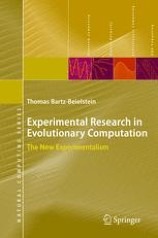
Experimental Research in Evolutionary Computation : The New Experimentalism
This book introduces the new experimentalism in evolutionary computation, providing tools to understand algorithms and programs and their interaction with optimization problems. The book develops and applies statistical techniques to analyze and compare modern search heuristics such as evolutionary algorithms and particle swarm optimization. Treating optimization runs as experiments, the author offers methods for solving complex real-world problems that involve optimization via simulation, and he describes successful applications in engineering and industrial control projects.

Evolutionary Scheduling
Evolutionary scheduling is a vital research domain at the interface of two important sciences - artificial intelligence and operational research. Scheduling problems are generally complex, large scale, constrained, and multi-objective in nature, and classical operational research techniques are often inadequate at solving them effectively. With the advent of computation intelligence, there is renewed interest in solving scheduling problems using evolutionary computational techniques. These techniques, which include genetic algorithms, genetic programming, evolutionary strategies, memetic algorithms, particle swarm optimization, ant colony systems, etc, are derived from biologically inspired concepts and are well-suited to solve scheduling problems since they are highly scalable and flexible in terms of handling constraints and multiple objectives. This edited book gives an overview of many of the current developments in the large and growing field of evolutionary scheduling, and demonstrates the applicability of evolutionary computational techniques to solve scheduling problems, not only to small-scale test problems, but also fully-fledged real-world problems.

Evolutionary computation in combinatorial optimization ; 7th European Conference, EvoCOP 2007, Valencia, Spain, April 11-13, 2007, Proceedings
This book cover evolutionary algorithms as well as various other metaheuristics, like scatter search, tabu search, memetic algorithms, variable neighborhood search, greedy randomized adaptive search procedures, ant colony optimization, and particle swarm optimization algorithms. The papers are specifically dedicat.

Computational Intelligence in Reliability Engineering : New Metaheuristics, Neural and Fuzzy Techniques in Reliability
This volume contains chapters presenting applications of different metaheuristics (ant colony optimization, great deluge algorithm, cross-entropy method and particle swarm optimization) in reliability engineering. It also includes chapters devoted to cellular automata and support vector machines and different applications of artificial neural networks, a powerful adaptive technique that can be used for learning, prediction and optimization. Several chapters describe different aspects of imprecise reliability and applications of fuzzy and vague set theory.
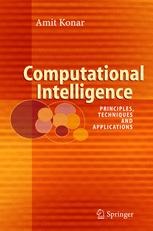
Computational intelligence : Principles, techniques and applications
The book Computational Intelligence: Principles, Techniques and Applications presents both theories and applications of Computational Intelligence in a clear, precise and highly comprehensive style. The textbook addresses the fundamental aspects of Fuzzy Sets and Logic, Neural Networks, Evolutionary Computing and Belief Networks. The application areas include Fuzzy Databases, Fuzzy Control, Image Understanding, Expert Systems, Object Recognition, Criminal Investigation, Telecommunication Networks and Intelligent Robots. The book contains many numerical examples and homework problems with sufficient hints so that the students can solve them on their own. Emerging areas of Computational Intelligence such as artificial life, particle swarm optimization, artificial immune systems, fuzzy chaos theory, rough sets and granular computing have also been addressed with examples in this book. The book ends with a discussion on a number of open- ended research problems in Computational Intelligence. Graduate students interested to pursue their research in this subject will greatly be benefited with these problems.

Learning and Intelligent Optimization ; 2nd International Conference, LION 2007 II, Trento, Italy, December 8-12, 2007. Selected Papers
The papers cover current issues of machine learning, artificial intelligence, mathematical programming and algorithms for hard optimization problems and are organized in topical sections on improving optimization through learning, variable neighborhood search, insect colony optimization, applications, new paradigms, cliques, stochastic optimization, combinatorial optimization, fitness and landscapes, and particle swarm optimization.

Bioinspired optimization methods and their applications ; 9th International conference, BIOMA 2020, Brussels, Belgium, November 19–20, 2020, Proceedings
This book constitutes the refereed proceedings of the 9th International Conference on Bioinspired Optimization Methods and Their Applications, BIOMA 2020, held in Brussels, Belgium, in November 2020. The 24 full papers presented in this book were carefully reviewed and selected from 68 submissions. The papers in this BIOMA proceedings specialized in bioinspired algorithms as a means for solving the optimization problems and came in two categories: theoretical studies and methodology advancements on the one hand, and algorithm adjustments and their applications on the other.

Application of power electronics converters in smart grids and renewable energy systems
Focuses on the applications of Power Electronics Converters in smart grids and renewable energy systems. The topics covered include methods to CO2 emission control, schemes for electric vehicle charging, reliable renewable energy forecasting methods, and various power electronics converters. The converters include the quasi neutral point clamped inverter, MPPT algorithms, the bidirectional DC-DC converter, and the push–pull converter with a fuzzy logic controller.

Algorithm collections for digital signal processing applications using matlab
The Algorithms such as SVD, Eigen decomposition, Gaussian Mixture Model, HMM etc. are scattered in different fields. There is the need to collect all such algorithms for quick reference. Also there is the need to view such algorithms in application point of view. Algorithm Collections for Digital Signal Processing Applications using MATLAB attempts to satisfy the above requirement. Also the algorithms are made clear using MATLAB programs.
Advances in Swarm Intelligence ; 11th International Conference, ICSI 2020, Belgrade, Serbia, July 14–20, 2020, Proceedings
Constitutes the proceedings of the 11th International Conference on Advances in Swarm Intelligence, ICSI 2020, held in July 2020 in Belgrade, Serbia. Due to the COVID-19 pandemic the conference was held virtually. The 63 papers included in this volume were carefully reviewed and selected from 127 submissions. The papers are organized in 12 cohesive topical sections as follows: Swarm intelligence and nature-inspired computing; swarm-based computing algorithms for optimization; particle swarm optimization; ant colony optimization; brain storm optimization algorithm; bacterial foraging optimization; genetic algorithm and evolutionary computation; multi-objective optimization; machine learning; data mining; multi-agent system and robotic swarm, and other applications.
Adaptive and Natural Computing Algorithms ; 8th International Conference, ICANNGA 2007, Warsaw, Poland, April 11-14, 2007, Proceedings, Part I
Constitutes the refereed proceedings of the 8th International Conference on Adaptive and Natural Computing Algorithms, ICANNGA 2007, held in Warsaw, Poland, in April 2007. The 178 revised full papers presented were carefully reviewed and selected from a total of 474 submissions. The 94 papers of the first volume are organized in topical sections on evolutionary computation, genetic algorithms, particle swarm optimization, learning, optimization and games, fuzzy and rough systems, just as classification and clustering. The second volume contains 84 contributions related to neural networks, support vector machines, biomedical signal and image processing, biometrics, computer vision, as well as to control and robotics.
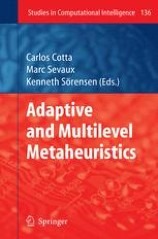
Adaptive and Multilevel Metaheuristics
Presents recent advances in the area of adaptativeness in metaheuristic optimization, including up-to-date reviews of hyperheuristics and self-adaptation in evolutionary algorithms, as well as cutting edge works on adaptive, self-adaptive and multilevel metaheuristics, with application to both combinatorial and continuous optimization.
