



الصفحة 1
الصفحة 1
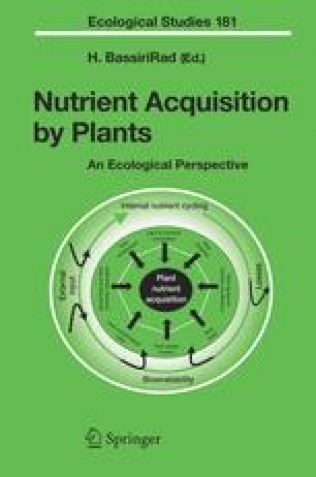
Nutrient Acquisition by Plants : An Ecological Perspective
Adaptation and evolution of terrestrial plants depend, to a large extent, on their ability to acquire nutrients. This is a modern and integrative treatment of the mechanisms controlling plant nutrient uptake and how plants respond to changes in the environment. The following key topics are covered: soil nutrient bioavailability; root responses to variations in nutrient supply; nitrogen fixation; regulation of nutrient uptake by internal plant demand; root characteristics; kinetics of nutrient uptake; root architecture; life span; mycorrhizae; responses to climate change. This integrated view helps us to understand the mechanisms that govern present-day plant communities and is indispensable in models designed to predict the response of plants to a changing climate.
Nitrogen Fixation in Agriculture, Forestry, Ecology, and the Environment
Sustainability has a major part to play in the global challenge of continued development of regions, countries, and continents all around the World and biological nitrogen fixation has a key role in this process. This volume begins with chapters specifically addressing crops of major global importance, such as soybeans, rice, and sugar cane. It continues with a second important focus, agroforestry, and describes the use and promise of both legume trees with their rhizobial symbionts and other nitrogen-fixing trees with their actinorhizal colonization. An over-arching theme of all chapters is the interaction of the plants and trees with microbes and this theme allows other aspects of soil microbiology, such as interactions with arbuscular mycorrhizal fungi and the impact of soil-stress factors on biological nitrogen fixation, to be addressed. Furthermore, a link to basic science occurs through the inclusion of chapters describing the biogeochemically important nitrogen cycle and its key relationships among nitrogen fixation, nitrification, and denitrification. The volume then provides an up-to-date view of the production of microbial inocula, especially those for legume crops.

Mycorrhizae : Sustainable Agriculture and Forestry
This book discusses and goes into detail on a number of topics: the molecular basis of nutrient exchange between arbuscular mycorrhizal (AM) fungi and host plants; the role of AM fungi in disease protection, alleviation of soil stresses and increasing grain production; interactions of AM fungi and beneficial saprophytic mycoflora in terms of plant growth promotion; the role of AM fungi in the restoration of native ecosystems; indirect contributions of AM fungi and soil aggregation to plant growth and mycorrhizosphere effect of multitrophic interaction; the mechanisms by which mycorrhizas change a disturbed ecosystem into productive land; the importance of reinstallation of mycorrhizal systems in the rhizosphere is emphasized and their impact on landscape regeneration, and in bioremediation of contaminated soils; Ectomycorrhizae (ECM) and their importance in forest ecosystems and associations of ECM in tropical rain forests function to maintain tropical monodominance; in vitro mycorrhization of micro-propagated plants, and visualizing and quantifying endorhizal fungi; the use of mycorrhizae, mainly AM and ECM, for sustainable agriculture and forestry.

Mycorrhiza : State of the Art, Genetics and Molecular Biology, Eco-Function, Biotechnology, Eco-Physiology, Structure and Systematics
This third updated and revised edition emphasises strongly on genetics and molecular biology. It contains new chapters, which are written by the leading experts in their respective field of knowledge and expertise.Mycorrhizas are symbioses between fungi and the roots of higher plants. As more than 90% of all known species of plants have the potential to form mycorrhizal associations, the productivity and species composition and the diversity of natural ecosystems are frequently dependent upon the presence and activity of mycorrhizas. The biotechnological application of mycorrhizas is expected to promote the production of food while maintaining ecologically and economically sustainable production systems.

Microorganisms in soils : Roles in genesis and functions
The following key topics are covered: Microorganisms in bioerosion, humification, mineralization and soil aggregation; Microbial energetics and microbes in biogeochemical processes such as carbon and nitrogen cycles and phosphorus bio-availability; Interactions in the mycorrhizosphere, e.g. between mycorrhizal fungi and bacteria; Impact of microbes on plant nutrient cycling and the possible effects of transgenic rhizospheres on soil fungi; Functions of microbes in specific soil compartments such as soil surface or toxic metal polluted soils; Regulation of microbial activities in functional domains that are influenced by biotic or abiotic factors; Use of marker genes and isotopes as examples for modern techniques in soil microbiology.

Microbial Root Endophytes
Plant roots may not only be colonized by mycorrhizal fungi, but also by a myriad of bacterial and fungal root endophytes that are usually not considered by the investigators of classic symbioses. This is the first book dedicated to the interactions of non-mycorrhizal microbial endophytes with plant roots. The phenotypes of these interactions can be extremely plastic, depending on environmental factors, nutritional status, genetic disposition and developmental stages of the two partners. The book deals with diversity, life history strategies, interactions, applications in agriculture and forestry, methods for isolation, cultivation, and both conventional and molecular methods for identification and detection of these endophytes. The comprehensive reviews demonstrate the high diversity of interactions and will provoke further studies to better understand the mechanisms which determine whether a plant-microbial interaction remains asymptomatic, leads to disease or to a mutualistic interaction.
Microbial Activity in the Rhizosphere
The rhizosphere is a very complex environment in which the effects of the plant on soil microorganisms and the effects of the microorganisms on the plant are interacting and are interdependent. Plant root exudates and breakdown products attract microbes and feed them and, in turn, the plants often benefit from the microbes. Interactions among microorganisms and plant roots are essential for nutritional requirements of the plant. Plant growth, development and productivity are largely dependent on the soil environment in the root region rhizosphere. The new techniques of studying the rhizosphere enables us to get a much better understanding of the dynamics of the rhizosphere population, such rhizosphere studies being of interest to agriculturists, soilbiologists, chemists, microbiologists and molecular biologists. The rhizosphere microbes in?uence the root environment in several ways. They may change the oxidation-reduction potential, influence the availability of moisture and nutrients, produce growth inhibiting or growth promoting substances in the form of exudates, provide competition and possibly induce many other effects. My corrhizal associations are beneficial in mineral uptake and in increasing root surface area for effective ion absorption. Antagonism, ompetition and synergism in soil and the rhizoplane (rhizosphere) are the most important microbial interactions to consider in the study of rhizosphere biology. With the growing information on the production of growth regulators, competitiveness of the microbes in the rhizosphere, microsymbionts, and other factors, their effect upon plant growth will become more evident. Experiments on the introduction of microbes or their products in the rhizosphere will help to improve our understandingofthebiologyoftherhizosphere.
In Vitro Culture of Mycorrhizas
biologists have made important progress in understanding better the functioning of AM fungi. An in vitro technique has been developed using mycorrhizal root organ cultures, which made it possible to investigate the genetics, cell biology and physiology of AM fungi. We can now be objective enough to critically evaluate the impacts the in vitro technique has had to improve our knowledge on mycorrhizal symbiosis.

Biology and Ecology of Norway Spruce
This book presents a concise and comprehensive review of the biology, ecology, and management of Norway spruce. It integrates classic and contemporary literature (more than 2000 works cited in the text), highlighting basic research and forestry practices in central and eastern Europe. The topics include anatomy and morphology, physiology and nutrition, reproductive biology and genetics, and ecology. In addition, it examines mycorrhiza, diseases and pests as well as silviculture and wood products. In the light of increasing threats to forest health from air pollution, climate change, and insects and disease, it provides an essential information source to those concerned with the ecology, conservation, and management of the species
Advanced Techniques in Soil Microbiology
"Advanced Techniques in Soil Microbiology" presents a wide range of biotechnological methods for application in soil microbiology analysis. These include all essential methods involving molecular biology, immunology, microbiology, and structural biology, such as transcriptome analysis, RNAi technology, molecular matchmaking, RAPD, T-RFLP and FT/MS. The techniques and procedures have been selected with the aim of offering practical guides for immediate use in the laboratory. The systems investigated range from individual molecules and cells to entire eukaryotic organisms, with a focus on bacteria, fungi, mycorrhiza, and higher plants. This volume of state-of-the-art, practice oriented methods will be of great use both to the first-timer and to the experienced scientist.
