



الصفحة 1
الصفحة 1

Model-Driven Design Using Business Patterns
This book takes exactly this step: it shows you how to apply the pattern ideas in business applications and presents more than 20 structural and behavioral business patterns that use the REA (resources, events, agents) pattern as a common backbone. If you are a developer working on business frameworks, you can use the patterns presented to derive the right abstractions (e.g., business objects) and to design and ensure that the meta-rules (e.g., process patterns) are followed by the developers of the actual applications. And if you are an application developer, you can use these patterns to design your business application, to ensure that it does not violate the domain rules, and to adapt the application to changing requirements without the need to change the overall architecture. As with patterns in general, this approach allows for both more flexible and more solid software architectures and hence better software quality.
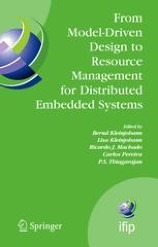
From model-driven design to resource management for distributed embedded systems ; IFIP TC 10 Working conference on distributed and parallel embedded systems (DIPES 2006) October 11-13, 2006, Braga, Portugal
From Model-Driven Design to Resource Management for Distributed Embedded Systems contains 16 original contributions as well as 12 invited papers by distinguished invited speakers. These papers were presented at the Working Conference on Distributed and Parallel Embedded Systems (DIPES 2006), which was held in October 2006 in Braga, Portugal, and sponsored by the International Federation for Information Processing (IFIP). This volume covers the following very timely topics: model-driven design, test and evolution of embedded systems, timing analysis and predictability, scheduling, allocation, communication and resource management in distributed real-time systems.

Advances in Design and Specification Languages for Embedded Systems : Selected Contributions from FDL’06
Advances in Design and Specification Languages for Embedded Systems is the latest contribution to the Chip Design Languages series and it consists of selected papers presented at the Forum on Specifications and Design Languages (FDL'06), which took place in September 2006 at Technische Universität Darmstadt, Germany. FDL, an ECSI conference, is the premier European forum to present research results, to exchange experiences, and to learn about new trends in the application of specification and design languages as well as of associated design and modelling methods and tools for integrated circuits, embedded systems, and heterogeneous systems. Modelling and specification concepts push the development of new methodologies for design and verification to system level, they thus provide the means for a model-driven design of complex information processing systems in a variety of application domains.
