



الصفحة 1
الصفحة 1

Metodi Matematici della Fisica = Mathematical Methods of Physics
This text draws its origin from my old notes, prepared for the course of Mathematical Methods of Physics and gradually arranged, refined and updated over the course of many years of teaching. The aim has always been to provide as simple and direct a presentation as possible of the mathematical methods relevant to Physics: Fourier series, Hilbert spaces, linear operators, functions of complex variables, Fourier and Laplace transforms, distributions. In addition to these basic topics, a brief introduction to the first notions of group theory, Lie algebras and symmetries in view of their applications to Physics is presented in the Appendix.

Introduzione alla Teoria della elasticità : Meccanica dei solidi continui in regime lineare elastico = Introduction to the theory of elasticity : Mechanics of continuous solids in linear elastic regime
Introduces the student to the theory of elasticity through the choice of a selected number of topics of paradigmatic conceptual importance and through the performance of numerous exercises and in-depth problems. The topics range from the formal properties of stress and strain tensors, to the theory of linear elastic continuum, to the thermodynamics of deformations, to the propagation of elastic waves, to the theory of brittle fracture in a linear elastic regime.

Introduction to Relativistic Continuum Mechanics
This mathematically-oriented introduction takes the point of view that students should become familiar, at an early stage, with the physics of relativistic continua and thermodynamics within the framework of special relativity. Therefore, in addition to standard textbook topics such as relativistic kinematics and vacuum electrodynamics, the reader will be thoroughly introduced to relativistic continuum and fluid mechanics. Emphasis in the presentation is on the 3+1 splitting technique, widely used in general relativity for introducing the relative observers point of view.

Integrable Hamiltonian Hierarchies : Spectral and Geometric Methods
This book presents a detailed derivation of the spectral properties of the Recursion Operators allowing one to derive all the fundamental properties of the soliton equations and to study their Hamiltonian hierarchies. Thus it is demonstrated that the inverse scattering method for solving soliton equations is a nonlinear generalization of the Fourier transform. The book brings together the spectral and the geometric approaches and as such will be useful to a wide readership: from researchers in the field of nonlinear completely integrable evolution equations to graduate and post-graduate students.
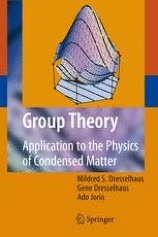
Group theory : Application to the physics of condensed matter
Every process in physics is governed by selection rules that are the consequence of symmetry requirements. The beauty and strength of group theory resides in the transformation of many complex symmetry operations into a very simple linear algebra. This concise and class-tested book has been pedagogically tailored over 30 years MIT and 2 years at the University Federal of Minas Gerais (UFMG) in Brazil. The approach centers on the conviction that teaching group theory in close connection with applications helps students to learn, understand and use it for their own needs. For this reason, the theoretical background is confined to the first 4 introductory chapters (6-8 classroom hours). From there, each chapter develops new theory while introducing applications so that the students can best retain new concepts, build on concepts learned the previous week, and see interrelations between topics as presented.

Gravity, Black Holes, and the Very Early Universe : An Introduction to General Relativity and Cosmology
In the early 1900s, Albert Einstein formulated two theories that would forever change the landscape of physics: the Special Theory of Relativity and the General Theory of Relativity. By 1925, quantum mechanics had been born out of the dissection of these two theories, and shortly after that, relativistic quantum field theory. We now had in place some important ties between the laws of physics and the types of particle interactions the new physics was uncovering. Gravity is one of the four types of forces that are found throughout the universe. In fact, although it is a relatively weak force, it operates at huge distances, and so must be accounted for in any cosmological system. Unfortunately, gravity continues to defy our neat categorization of how all the forces in nature work together.

Geometry and Topology in Hamiltonian Dynamics and Statistical Mechanics
This book explores the foundations of hamiltonian dynamical systems and statistical mechanics, in particular phase transition, from the point of view of geometry and topology. A broad participation of topology in these fields has been lacking and this book will provide a welcome overview of the current research in the area, in which the author himself is a pioneer. Using geometrical thinking to solve fundamental problems in these areas, compared to the purely analytical methods usually used in physics could be highly productive. The author skillfully guides the reader, whether mathematician or physicists through the background needed to understand and use these techniques.
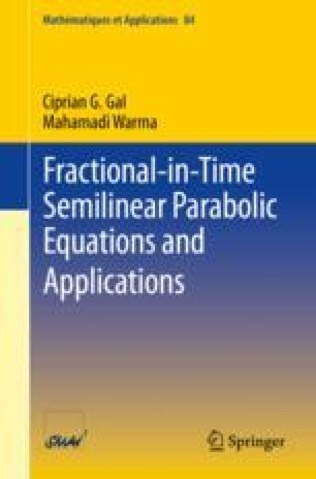
Fractional-in-time semilinear parabolic equations and applications
This book provides a unified analysis and scheme for the existence and uniqueness of strong and mild solutions to certain fractional kinetic equations. This class of equations is characterized by the presence of a nonlinear time-dependent source, generally of arbitrary growth in the unknown function, a time derivative in the sense of Caputo and the presence of a large class of diffusion operators. The global regularity problem is then treated separately and the analysis is extended to some systems of fractional kinetic equations, including prey-predator models of Volterra–Lotka type and chemical reactions models, all of them possibly containing some fractional kinetics.

Fluctuations, Information, Gravity and the Quantum Potential
A main theme of the book outlines the role of the quantum potential in quantum mechanics and general relativity and one of its origins via fluctuations formulated in terms of Fisher information. Another theme is the description of various approaches to Bohmian mechanics and their role in quantum mechanics and general relativity. Along the way various approaches to, for instance, the Dirac equation, the Einstein equations, the Klein-Gordon equation, the Maxwell equations and the Schr?dinger equations are described. Statistics and geometry are intertwined in various ways and, among other matters, the aether, cosmology, entropy, fractals, quantum Kaehler geometry, the vacuum and the zero point field are discussed. There is also some speculative material and some original work along with material extracted from over 1000 references and the work is current up to April 2005.

Computational Multiscale Modeling of Fluids and Solids : Theory and Applications
The book includes the micro-scale, the meso-scale and the macro-scale. The chapters follow this classification. The book will explain in detail many tricks of the trade of some of the most important methods and techniques that are used to simulate materials on the perspective levels of spatial and temporal resolution. Case studies are occasionally included to further illustrate some methods or theoretical considerations. Example applications for all techniques are provided, some of which are from the author’s own contributions to some of the research areas. Methods are explained, if possible, on the basis of the original publications but also references to standard text books established in the various fields are mentioned.

Linearization Methods for Stochastic Dynamic Systems
The aim of this book is to give a systematic introduction to and overview of the relatively simple and popular linearization methods available. The scope is limited to models with continous external and parametric excitations, yet these cover the majority of known approaches. The book contains an application chapter with emphasis on vibration analysis of stochastic mechanical structures as well as a chapter devoted to the assessment of the accuracy of the theoretical methods presented, both with respect to numerical and to experimental studies.

Linear Algebra Thoroughly Explained
Linear Algebra Thoroughly Explained provides a comprehensive introduction to the subject suitable for adoption as a self-contained text for courses at undergraduate and postgraduate level. The clear and comprehensive presentation of the basic theory is illustrated throughout with an abundance of worked examples. The book is written for teachers and students of linear algebra at all levels and across mathematics and the applied sciences, particularly physics and engineering.
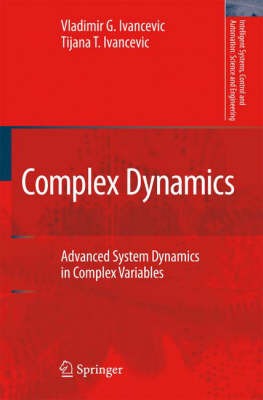
Complex dynamics : Advanced system dynamics in complex variables
Complex Dynamics: Advanced System Dynamics in Complex Variables is a graduate-level monographic textbook. It is designed as a comprehensive introduction into methods and techniques of modern complex-valued nonlinear dynamics with its various physical and non-physical applications.
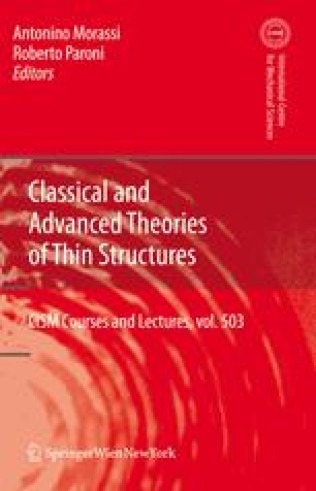
Classical and Advanced Theories of Thin Structures : Mechanical and Mathematical Aspects
The book presents an updated state-of-the-art overview of the general aspects and practical applications of the theories of thin structures, through the interaction of several topics, ranging from non-linear thin-films, shells, junctions, beams of different materials and in different contexts (elasticity, plasticity, etc.).

Chaos : A Program Collection for the PC
This new edition strives yet again to provide readers with a working knowledge of chaos theory and dynamical systems through parallel introductory explanations in the book and interaction with carefully-selected programs supplied on the accompanying diskette. The programs enable readers, especially advanced-undergraduate students in physics, engineering, and math, to tackle relevant physical systems quickly on their PCs, without distraction from algorithmic details. For the third edition of Chaos: A Program Collection for the PC, each of the previous twelve programs is polished and rewritten in C++ (both Windows and Linux versions are included). A new program treats kicked systems, an important class of two-dimensional problems, which is introduced in Chapter 13. Each chapter follows the structure: theoretical background; numerical techniques; interaction with the program; computer experiments; real experiments and empirical evidence; reference.
Basic bundle theory and K-Cohomology invariants
Based on several recent courses given to mathematical physics students, this volume is an introduction to bundle theory with the aim to provide newcomers to the field with solid foundations in topological K-theory. A fundamental theme, emphasized in the book, centers around the gluing of local bundle data related to bundles into a global object. One renewed motivation for studying this subject, which has developed for almost 50 years in many directions, comes from quantum field theory, especially string theory, where topological invariants play an important role.
A Mathematical Introduction to Conformal Field Theory
The first part of this book gives a detailed, self-contained and mathematically rigorous exposition of classical conformal symmetry in n dimensions and its quantization in two dimensions. In particular, the conformal groups are determined and the appearance of the Virasoro algebra in the context of the quantization of two-dimensional conformal symmetry is explained via the classification of central extensions of Lie algebras and groups. The second part surveys some more advanced topics of conformal field theory, such as the representation theory of the Virasoro algebra, conformal symmetry within string theory, an axiomatic approach to Euclidean conformally covariant quantum field theory and a mathematical interpretation of the Verlinde formula in the context of moduli spaces of holomorphic vector bundles on a Riemann surface.
