



الصفحة 1
الصفحة 1
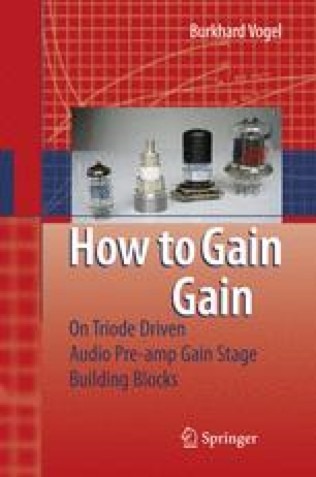
How to Gain Gain : A Reference Book on Triodes in Audio Pre-Amps
The 17 chapters of How to Gain Gain give a detailed insight into a collection of the most common gain producing and constant current generating possibilities (28) of triodes for audio pre-amplifier purposes. These chapters also offer complete sets of formulae to calculate gain, frequency and phase responses of certain building blocks built-up with this type of vacuum valve (tube).

Essentials of mechanical stress analysis
Essentials of Mechanical Stress Analysis, updated for the second edition, covers stress analysis from an interdisciplinary perspective. Discussing techniques and theories essential to analysing structures, the book covers both analytical and numerical approaches. Also covering beams, plates, columns and elastic instability, the book discusses fatigue, life cycle, energy methods and MathCAD sample code.

Differential Models : An Introduction with Mathcad
Differential equations are often used in mathematical models for technological processes or devices. However, the design of a differential mathematical model is crucial and difficult in engineering.

Cours doptique : Simulations et exercices résolus avec Maple, Matlab, Mathematica, Mathcad = Optics course: Simulations and exercises solved with Maple, Matlab, Mathematica, Mathcad
Intended for students at the L and M levels of the university as well as for engineers wishing to study certain subjects in greater depth. It covers all the themes of a traditional optics course, from geometric optics to holography, interference, diffraction, coherence and the use of the Fourier transform for spectroscopy. The presentation is developed from mathematical models deriving from typical situations and fundamental examples which are presented in the form of computer programs ready to be implemented. These programs are also available on the CD accompanying the book, for each of the following scientific programming environments: Matlab, Maple, Mathematica and Mathcad. Thus, the reader will be able to modify the parameters of the examples proposed to adapt them to new situations.

Matematica generale con il calcolatore
By introducing mathematical objects, it teaches students how to use a computer to perform numerical and symbolic calculations, define a function and calculate its values, plot and explore graphs, and execute simple algorithms. The course is rich in examples, applications, and models, drawn from economics, physics, biology, statistics, and mathematics itself. The analysis of these models constitutes, in a certain sense, the true purpose of the mathematical theory covered. Automatic calculation tools (mathematics software, spreadsheets) are used extensively to explore and illustrate concepts and properties. Mathcad® software, in particular, was used, both as a calculation tool and as a simple yet powerful programming language. Considerable space is devoted to approximation, emphasizing the distinction between numerical and symbolic calculation; to algorithms as a synthesis of the syntactic and semantic aspects of mathematical objects; and to computer simulation, interpreted as a "physical" experiment and a source of conjecture. The ability to use a calculator marks a sort of "democratization" of mathematics: even complex results, which have always required a broad background of knowledge and laborious calculations, are now quickly accessible to anyone who understands the meaning of mathematical objects and knows how to use the syntax.
