



الصفحة 1
الصفحة 1

Trustworthy Global Computing ; 2nd Symposium, TGC 2006, Lucca, Italy, November 7-9, 2006, Revised Selected Papers
The papers are organized in topical sections on types to discipline interactions, calculi for distributed systems, flexible modeling, algorithms and systems for global computing, as well as security, anonymity and type safety. The book starts off with activity reviews of four FP6 programmes of the European Union: Aeolus, Mobius, Sensoria, and Catnets

Projective and Cayley-Klein Geometries
Projective geometry, and the Cayley-Klein geometries is one of the foundations of algebraic geometry and has many applications to differential geometry.The book presents a systematic introduction to projective geometry as based on the notion of vector space, which is the central topic of the first chapter. The second chapter covers the most important classical geometries which are systematically developed following the principle founded by Cayley and Klein, which rely on distinguishing an absolute and then studying the resulting invariants of geometric objects. An appendix collects brief accounts of some fundamental notions from algebra and topology with corresponding references to the literature.
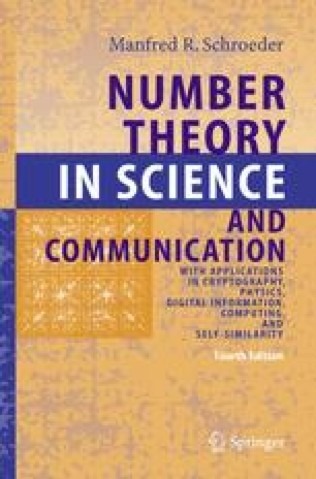
Number theory in science and communication : With applications in cryptography, physics, digital information, computing, and self-similarity
"Number Theory in Science and Communication" is a well-known introduction for non-mathematicians to this fascinating and useful branch of applied mathematics . It stresses intuitive understanding rather than abstract theory and highlights important concepts such as continued fractions, the golden ratio, quadratic residues and Chinese remainders, trapdoor functions, pseudoprimes and primitive elements. Their applications to problems in the real world are one of the main themes of the book. This revised fourth edition is augmented by recent advances in primes in progressions, twin primes, prime triplets, prime quadruplets and quintruplets, factoring with elliptic curves, quantum factoring, Golomb rulers and "baroque" integers.

Hyperbolic Geometry
The geometry of the hyperbolic plane has been an active and fascinating field of mathematical inquiry for most of the past two centuries. The basic approach taken is to define hyperbolic lines and develop a natural group of transformations preserving hyperbolic lines, and then study hyperbolic geometry as those quantities invariant under this group of transformations. Topics covered include the upper half-plane model of the hyperbolic plane, Möbius transformations, the general Möbius group, and their subgroups preserving the upper half-plane, hyperbolic arc-length and distance as quantities invariant under these subgroups, the Poincaré disc model, convex subsets of the hyperbolic plane, hyperbolic area, the Gauss-Bonnet formula and its applications.

Formal Methods for Components and Objects ; 6th International Symposium, FMCO 2007, Amsterdam, The Netherlands, October 24-26, 2007, Revised Lectures
Formal methods have been applied successfully to the verification of medium-sized programs in protocol and hardware design.This book presents 12 revised papers submitted after the symposium by the speakers of each of the following European IST projects: the IST-FP6 project Mobius, developing the technology for establishing trust and security for the next generation of global computers; the IST-FP6 project SelfMan on self management for large-scale distributed systems based on structured overlay networks and components
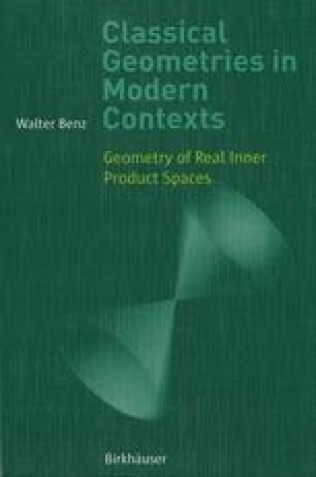
Classical geometries in modern contexts : Geometry of real inner product spaces
This book is based on real inner product spaces X of arbitrary (finite or infinite) dimension greater than or equal to 2. With natural properties of (general) translations and general distances of X, euclidean and hyperbolic geometries are characterized. For these spaces X also the sphere geometries of Möbius and Lie are studied (besides euclidean and hyperbolic geometry), as well as geometries where Lorentz transformations play the key role. The geometrical notions of this book are based on general spaces X as described. This implies that also mathematicians who have not so far been especially interested in geometry may study and understand great ideas of classical geometries in modern and general contexts.
