



الصفحة 1
الصفحة 1

The Web of Data
This book concisely brings together the key standards and best practices relating to modelling, querying, validating and linking machine-readable data and semantics on the Web. Alongside practical examples and formal definitions, the book shows how these standards contribute to – and have been used thus far on – the "Web of Data": a machine readable evolution of the Web marked by increased automation, enabling powerful Web applications capable of discovering, cross-referencing, and organising data from numerous websites in a matter of seconds.

The Semantic Web ; 17th International Conference, ESWC 2020, Heraklion, Crete, Greece, May 31–June 4, 2020, Proceedings
Carefully reviewed and selected from 166 submissions. The papers were submitted to three tracks: the research track, the resource track and the in-use track. These tracks showcase research and development activities, services and applications, and innovative research outcomes making their way into industry. The research track caters for both long standing and emerging research topics in the form of the following subtracks: ontologies and reasoning; natural language processing and information retrieval; semantic data management and data infrastructures; social and human aspects of the Semantic Web; machine learning; distribution and decentralization; science of science; security, privacy, licensing and trust; knowledge graphs; and integration, services and APIs.

The semantic Web – ISWC 2020 ; 19th international semantic web conference, Athens, Greece, November 2–6, 2020, Proceedings, Part II
The two volume set LNCS 12506 and 12507 constitutes the proceedings of the 19th International Semantic Web Conference, ISWC 2020, which was planned to take place in Athens, Greece, during November 2-6, 2020. The conference changed to a virtual format due to the COVID-19 pandemic. The papers included in this volume deal with the latest advances in fundamental research, innovative technology, and applications of the Semantic Web, linked data, knowledge graphs, and knowledge processing on the Web.

The Semantic Web – ISWC 2020 ; 19th International Semantic Web Conference, Athens, Greece, November 2–6, 2020, Proceedings, Part I
The two volume set LNCS 12506 and 12507 constitutes the proceedings of the 19th International Semantic Web Conference, ISWC 2020, which was planned to take place in Athens, Greece, during November 2-6, 2020. The conference changed to a virtual format due to the COVID-19 pandemic. The papers included in this volume deal with the latest advances in fundamental research, innovative technology, and applications of the Semantic Web, linked data, knowledge graphs, and knowledge processing on the Web.

Semantic Systems : The Power of AI and Knowledge Graphs ; 15th International Conference, SEMANTiCS 2019, Karlsruhe, Germany, September 9–12, 2019, Proceedings
This book cover topics such as: web semantics and linked (open) data; machine learning and deep learning techniques; semantic information management and knowledge integration; terminology, thesaurus and ontology management; data mining and knowledge discovery; semantics in blockchain and distributed ledger technologies.

Semantic systems. In the era of knowledge graphs ; 16th International conference on semantic systems, SEMANTiCS 2020, Amsterdam, The Netherlands, September 7–10, 2020, Proceedings
This book constitutes the refereed proceedings of the 17th International Conference on Semantic Systems, SEMANTiCS 2020, held in Amsterdam, The Netherlands, in September 2020.

Process Mining Handbook
Comprises all the single courses given as part of the First Summer School on Process Mining, PMSS 2022, which was held in Aachen, Germany, during July 4-8, 2022. The 17 chapters presented in this volume were organized in the following topical sections: introduction; process discovery; conformance checking; data preprocessing; process enhancement and monitoring; assorted process mining topics; industrial perspective and applications; and closing.

MDATA : A New Knowledge Representation Model: Theory, Methods and Applications
This book introduces a new knowledge representation model called MDATA (Multi-dimensional Data Association and inTelligent Analysis). By modifying the representation of entities and relations in knowledge graphs, dynamic knowledge can be efficiently described with temporal and spatial characteristics. The MDATA model can be regarded as a high-level temporal and spatial knowledge graph model, which has strong capabilities for knowledge representation. This book introduces some key technologies in the MDATA model, such as entity recognition, relation extraction, entity alignment, and knowledge reasoning with spatiotemporal factors. The MDATA model can be applied in many critical applications and this book introduces some typical examples, such as network attack detection, social network analysis, and epidemic assessment.

High performance computing for drug discovery and biomedicine
Explores the application of high-performance computing (HPC) technologies to computational drug discovery (CDD) and biomedicine. Collects CDD approaches that, together with HPC, can revolutionize and automate drug discovery process, such as knowledge graphs, natural language processing (NLP), Bayesian optimization, automated virtual screening platforms, alchemical free energy workflows, fragment-molecular orbitals (FMO), HPC-adapted molecular dynamic simulation (MD-HPC), and the potential of cloud computing for drug discovery. And delves into computational algorithms and workflows for biomedicine, featuring an HPC framework to assess drug-induced arrhythmic risk, digital patient applications relevant to the clinic, virtual human simulations, cellular and whole-body blood flow modeling for stroke treatments, prediction of the femoral bone strength from CT data, and many more subjects.

Database and expert systems applications ; DEXA 2020 International workshops BIOKDD, IWCFS and MLKgraphs, Bratislava, Slovakia, September 14–17, 2020, Proceedings
This volume constitutes the refereed proceedings of the three workshops held at the 31st International Conference on Database and Expert Systems Applications, DEXA 2020, held in September 2020: The 11th International Workshop on Biological Knowledge Discovery from Data, BIOKDD 2020, the 4th International Workshop on Cyber-Security and Functional Safety in Cyber-Physical Systems, IWCFS 2020, the 2nd International Workshop on Machine Learning and Knowledge Graphs, MLKgraphs2019. Due to the COVID-19 pandemic the conference and workshop were held virtually. The 10 papers were thoroughly reviewed and selected from 15 submissions, and discuss a range of topics including: knowledge discovery, biological data, cyber security, cyber-physical system, machine learning, knowledge graphs, information retriever, data base, and artificial intelligent.
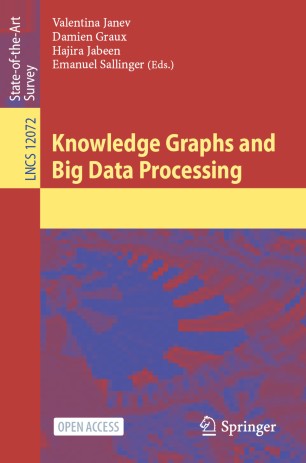
Knowledge graphs and big data processing
This book is part of the LAMBDA Project (Learning, Applying, Multiplying Big Data Analytics), funded by the European Union, GA No. 809965. Data Analytics involves applying algorithmic processes to derive insights.

Boosting Collaborative Networks 4.0 ; 21st IFIP WG 5.5 Working Conference on Virtual Enterprises, PRO-VE 2020, Valencia, Spain, November 23–25, 2020, Proceedings
This book constitutes the refereed proceedings of the 21st IFIP WG 5.5 Working Conference on Virtual Enterprises, PRO-VE 2020, held in Valencia, Spain, in November 2020. The conference was held virtually. The 53 full papers were carefully reviewed and selected from 135 submissions. They provide a comprehensive overview of major challenges and recent advances in various domains related to the digital transformation and collaborative networks and their applications with a strong focus on the following areas related to the main theme of the conference: collaborative business ecosystems; collaborative business models; collaboration platform; data and knowledge services; blockchain and knowledge graphs; maintenance, compliance and liability; digital transformation; skills for organizations of the future
AI, data, and digitalization : First International Symposium, SAIDD 2023, Sogndal, Norway, May 9–10, 2023, Revised Selected Papers
Artificial Intelligence, Big Data and Digitalization allow us more than ever beforeto make use of the data our society and public and private sectors generate every day.Institutions around the world are increasingly turning to such methods and technologiesto help them solve complex problems, promote efficiency and improve performance anddecision-making.
