



الصفحة 1
الصفحة 1
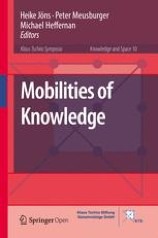
Mobilities of Knowledge
This collection of essays examines how spatial mobilities of people and practices, technologies and objects, knowledge and ideas have shaped the production, circulation, and transfer of knowledge in different historical and geographical contexts. Targeting an interdisciplinary audience, Mobilities of Knowledge combines detailed empirical analyses with innovative conceptual approaches. The first part scrutinizes knowledge circulation, transfer, and adaption, focussing on the interpersonal communication process, early techniques of papermaking, a geographical text, indigenous knowledge in exploration, the genealogy of spatial analysis, and different disciplinary knowledges about the formation of cities, states, and agriculture.

Geographies of the University
Raises awareness of the histories, geographies, and practices of universities and analyzes their role as key actors in today’s global knowledge economy. Universities are centers of research, teaching, and expertise with significant economic, social, and cultural impacts at different geographical scales. Scholars from a variety of disciplines and countries offer original analyses and discussions along five main themes: historical perspectives on the university as a site of knowledge production, cultural encounter, and political interest; institutional perspectives on university governance and the creation of innovative environments; relationships between universities and the city; the impact of universities on national and regional economies and cultures; and the processes of internationalization through student mobility, the creation of education hubs, and global regionalism in higher education.

Emerging States and Economies : Their Origins, Drivers, and Challenges Ahead
This book asks why and how some of the developing countries have “emerged” under a set of similar global conditions, what led individual countries to choose the particular paths that led to their “emergence,” and what challenges confront them. If we are to understand the nature of major risks and uncertainties in the world, we must look squarely at the political and economic dynamics of emerging states. Their rapid economic development has changed the distribution of wealth and power in the world. Yet many of them have middle income status. To global governance issues, they tend to adopt approaches that differ from those of advanced industrialized democracies. At home, rapid economic growth and social changes put pressure on their institutions to change. This volume traces the historical trajectories of two major emerging states. It also analyzes cross-country data to find the general patterns of economic development and sociopolitical change in relation to globalization and to the middle income trap.

Digital transformation management : Challenges and futures in the Asian digital economy
Addresses key topics related to organization design and knowledge management in the digital economy with organizational context, particularly in Asia. the book conceptualizes organization design into three dimensions, people, information, and technology, and offers readers a unique valued insight, bringing new perspectives to understanding emerging business opportunities and challenges in Asia. it presents a valuable collection of 14 chapters with empirical studies from leading researchers. the book addresses digital transformation in companies and organizations in Asia, analysing how disruptive technologies can help them to have more efficient organization processes, create innovative products and services, be more resilient and achieve sustainable goals in post-pandemic time.

Knowledge management : Value creation through organizational learning, 2nd
Features substantial updates to all chapters, reflecting the implications of the digital transformation on knowledge work and knowledge management. It also addresses three new topics: the impact of knowledge management practices on performance; knowledge management in the public sector; and an introduction to ISO 9001:2015 as an implementation framework.The book is intended not only for academic education but also as an essential guide for managers, consultants, trainers, coaches, and all those engaged in business, public administration or non-profit work who are interested in learning about organizations in a knowledge economy.
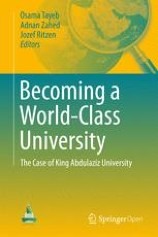
Becoming a world-class university : The case of King Abdulaziz University
This book written by international experts in the field of educational innovation is a guide for universities to become world-class universities. It contributes to the current international intellectual debate on the future of higher education. It also tells the story of King Abdulaziz University in Jeddah (Saudi Arabia) and its effort to become a world-class university. The book discusses excellence in different aspects such as education, research, community services, strategic planning, knowledge economy and international cooperation.
