



الصفحة 1
الصفحة 1

Melting Hadrons, Boiling Quarks - From Hagedorn Temperature to Ultra-Relativistic Heavy-Ion Collisions at CERN : With a Tribute to Rolf Hagedorn
Shows how the study of multi-hadron production phenomena in the years after the founding of CERN culminated in Hagedorn's pioneering idea of limiting temperature, leading on to the discovery of the quark-gluon plasma -- announced, in February 2000 at CERN.
Information — Consciousness — Reality : How a New Understanding of the Universe Can Help Answer Age-Old Questions of Existence
This book chronicles the rise of a new scientific paradigm offering novel insights into the age-old enigmas of existence. It is explores a radical paradigm shift uncovering the ontology of reality. It is found to be information-theoretic and participatory, yielding a computational and programmable universe.

Il cielo sopra Roma : I luoghi dell’astronomia = The sky above Rome : The places of astronomy
Astronomy in Rome has always been there, but a little hidden: it was in the palaces, in the churches or, better, above the churches, speculas scattered along a path that few know by now. Intrigued and frightened, the Romans witnessed the burning of Giordano Bruno in a familiar corner of Campo de 'Fiori, but they probably didn't quite understand what guilt he was accused of. They certainly did not think that he was a philosopher and a scientist who had tried to imagine what the world was like.

Lise Meitner and the Dawn of the Nuclear Age
Documenting the extraordinary life of an aspiring woman scientist whose life was filled with adversity. Surviving both World Wars and gender discrimination, Meitner was a pioneer at the forefront of her discipline involving the study of radio-elements and nuclear fission.
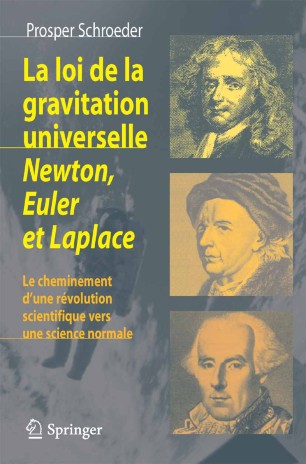
La loi de la gravitation universelle Newton, Euler et Laplace : Le cheminement d’une révolution scientifique vers une science normale = The law of universal gravitation Newton, Euler and Laplace : The progress of a scientific revolution towards a normal science
An analysis of Newton's ideas dismisses this hypothesis by the simple fact that the Principia sought to demonstrate the fallacy of earlier approaches. However, Newton suffered a failure in the application of his theory of gravitation to the explanation of the movement of the Moon, failure which marked the development of celestial mechanics throughout the 18th century. Clairaut, d'Alembert and Euler doubted the validity of Newtonian law almost at the same time and their ideas advanced celestial mechanics which reached the state of "normal science" with Laplace's treatise on celestial mechanics, a century after Newton.
Buchi neri nel mio bagno di schiuma : L’enigma di Einstein = Black holes in my bubble bath : Einstein's riddle
Einstein's Enigma, or black holes in my foam bath, tells the story of the theory of gravitation, from its beginnings to the latest developments in astrophysics, focusing on Albert Einstein's theory of general relativity and the physics of black holes. Through engaging conversations and diagrams scribbled on paper napkins, the rudiments of relativity, space-time and many aspects of modern physics follow one another. In skits narrated with pedagogical skill and remarkable literary talent, the reader will come across the informal lessons that a cosmopolitan astrophysicist gives to his friend Alfie, a free lance organizer of research projects. Join in the intellectual fun and get excited with sparkling ideas, while with your imagination you enjoy a relaxing soak in this magical tub!
A Century of Ideas : Perspectives from Leading Scientists of the 20th Century
Shortly after its inauguration in 1985 the Birla Science Centre, Hyderabad, India, started a series of lectures by Nobel Laureates and other scientists of international renown, usually in Physics and Astronomy, sometimes in Life Sciences and Chemistry. The present collection mostly consists of lectures on frontier topics. The transcript of each lecture is preceded by a short biography of the Nobel Laureate/Scientist in question.
