



الصفحة 1
الصفحة 1

Network Analysis : Methodological Foundations
‘Network’ is a heavily overloaded term, so that ‘network analysis’ means different things to different people. Specific forms of network analysis are used in the study of diverse structures such as the Internet, interlocking directorates, transportation systems, epidemic spreading, metabolic pathways, the Web graph, electrical circuits, project plans, and so on. There is, however, a broad methodological foundation which is quickly becoming a prerequisite for researchers and practitioners working with network models. From a computer science perspective, network analysis is applied graph theory. Unlike standard graph theory books, the content of this book is organized according to methods for specific levels of analysis (element, group, network) rather than abstract concepts like paths, matchings, or spanning subgraphs. Its topics therefore range from vertex centrality to graph clustering and the evolution of scale-free networks. In 15 coherent chapters, this monograph-like tutorial book introduces and surveys the concepts and methods that drive network analysis, and is thus the first book to do so from a methodological perspective independent of specific application areas.
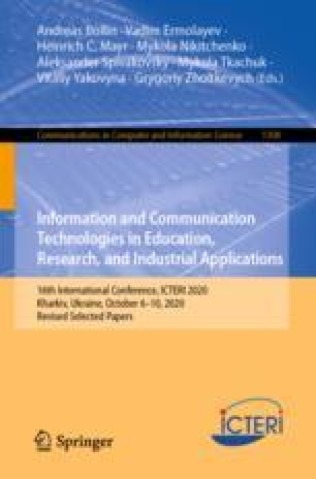
Information and communication technologies in education, research, and industrial applications ; 16th International Conference, ICTERI 2020, Kharkiv, Ukraine, October 6–10, 2020, Revised Selected Papers
This book contains revised and extended versions of the best papers presented at the 16th International Conference on Information and Communication Technologies in Education, Research, and Industrial Applications, ICTERI 2020, held in Kherson, Ukraine, in October 2020. Due to the COVID-19 pandemic the conference was held online. The 8 revised full papers included in this volume were carefully reviewed and selected from 347 initial submissions. The papers are organized in the following topical sections: ICT in education; ICT in research and industry.

Imaging in Drug Discovery and Early Clinical Trials
Efficient tools for the selection and validation of drug targets both at the preclinical and clinical level are required. Non-invasive imaging and in particular molecular imaging methods are becoming essential technologies to support drug discovery and dvelopment. Imaging provides structural, functional, metabolic and molecular readouts that are being applied to characterize a disease phenotype (diagnosis), to elucidate molecular mechanisms involved, to evaluate drug efficacy and safety, and to identify potential biomarkers of the drug's mechanism-of-action, efficacy and safety. Non-invasive imaging techniques constitute a bridge between preclinical and clinical drug evaluation. In this monograph the contribution of imaging modalities to the various stages of drug discovery and development, from early target validation to their use in clinical development programs, is described. Chapters are devoted to the description of the drug discovery process as such, to the various imaging modalities being used both preclinically and clinically, to applications of imaging during the optimization of a lead compound (addressing issues such as bioavailability and efficacy) and during the drug safety evaluation.

How to photograph the moon and planets with your Digital camera
Using just a regular digital camera along with an amateur astronomical telescope, anyone can produce spectacular photographs of the Moon, as well as surprisingly good images of major planets.Purpose-made astronomical CCD cameras are still very expensive, but technology has now progressed so that digital cameras – the kind you use for everyday photos – are more than capable of being used for astronomy. Tony Buick has written this illustrated step-by-step manual for anyone who has a telescope (of any size) and a digital camera. Look inside at the beautiful color images he has produced – you could do the same.

Handbook on Modelling for Discrete Optimization
This handbook couples the difficult, critical-thinking aspects of mathematical modeling with the hot area of discrete optimization. It will be done in an academic handbook treatment outlining the state-of-the-art for researchers across the domains of the Computer Science, Math Programming, Applied Mathematics, Engineering, and Operations Research. Included in the handbook's treatment are results from Graph Theory, Logic, Computer Science, and Combinatorics.
Graph-theoretic concepts in computer science ; Vol. 4271 ; 32nd International Workshop, WG 2006, Bergen, Norway, June 22-23, 2006, Revised Papers
The workshop aims at uniting theory and practice by demonstrating how graph-theoretic concepts can be applied to various areas in computer s- ence, or by extracting new problems from applications. The goal is to present recent research results and to identify and explore directions of future research. The talks showed how recent researchresults from algorithmic graph theory can be used in computer science and which graph-theoreticquestions arisefrom new developments in computer science.

Graph-theoretic concepts in computer science ; Vol. 3787 ; 31st International Workshop, WG 2005, Metz, France, June 23-25, 2005, Revised Selected Papers
that aims to unite theory and practice by demonstrating how graph-theoretic concepts can be applied to various areas in Computer Science. This book provides results for various classes of graphs, graph computations, graph algorithms, and graph-theoretical applications in various fields.
Graph-theoretic concepts in computer science ; 46th International Workshop, WG 2020, Leeds, UK, June 24–26, 2020, Revised Selected Papers
This book constitutes the revised papers of the 46th International Workshop on Graph-Theoretic Concepts in Computer Science, WG 2020, held in Leeds, UK, in June 2020. The workshop was held virtually due to the COVID-19 pandemic. The 32 full papers presented in this volume were carefully reviewed and selected from 94 submissions. They cover a wide range of areas, aiming to present emerging research results and to identify and explore directions of future research of concepts on graph theory and how they can be applied to various areas in computer science.

Graph-theoretic concepts in computer science ; 34th International Workshop, WG 2008, Durham, UK, June 30 – July 2, 2008. Revised Papers
This book constitutes the thoroughly refereed post-conference proceedings of the 34th International Workshop on Graph-Theoretic Concepts in Computer Science, WG 2008, held in Durham, UK, in June/July 2008.The 30 revised full papers presented together with 3 invited paper were carefully reviewed and selected from 76 submissions. The papers feature original results on all aspects of graph-theoretic concepts in Computer Science, e.g. structural graph theory, sequential, parallel, and distributed graph and network algorithms and their complexity, graph grammars and graph rewriting systems.

Graph-theoretic concepts in computer science ; 33rd International workshop, WG 2007, Dornburg, Germany, June 21-23, 2007, Revised Papers
The WG conference traditionally aims at uniting theory and practice by demonstrating how graph-theoretic concepts can be applied to various areas in computer science, or by extracting new problems from applications. The goal is to present recent researchresults and to identify and exploredirections of future research.

Graphs, networks and algorithms ; 3rd ed.
The third edition of this standard textbook contains additional material: two new application sections (on graphical codes and their decoding) and about two dozen further exercises (with solutions, as throughout the text). Moreover, recent developments have been discussed and referenced, in particular for the travelling salesman problem. The presentation has been improved in many places (for instance, in the chapters on shortest paths and on colorings), and a number of proofs have been reorganized, making them more precise or more transparent.

Graphs, networks and algorithms ; 2nd ed.
This book have a chapter on the network simplex algorithm and a section on the five color theorem; this also necessitated some changes in the previous order of the presentation (so that the numbering differs from that of the first edition,beginning with Chapter 8). In addition to this, numerous smaller changes and corrections have been made and several recent developments have been discussed and referenced. There are also several new exercises.

Graphs, Dioids and Semirings : New Models and Algorithms
The primary objectives of GRAPHS, DIOÏDS AND SEMIRINGS: New Models and Algorithms are to emphasize the deep relations existing between the semiring and dioïd structures with graphs and their combinatorial properties, while demonstrating the modeling and problem-solving capability and flexibility of these structures. In addition the book provides an extensive overview of the mathematical properties employed by "nonclassical" algebraic structures, which either extend usual algebra (i.e., semirings), or correspond to a new branch of algebra (i.e., dioïds), apart from the classical structures of groups, rings, and fields.

Graph-based representations in pattern recognition ; 6th IAPR-TC-15 International Workshop, GbRPR 2007, Alicante, Spain, June 11-13, 2007, Proceedings
Constitutes the refereed proceedings of the 6th IAPR-TC-15 International Workshop on Graph-Based Representations in Pattern Recognition, GbRPR 2007, held in Alicante, Spain in June 2007.

Graph-based representations in pattern recognition ; 5th IAPR International Workshop, GbRPR 2005, Poitiers, France, April 11-13, 2005, Proceedings
Many vision problems have to deal with di?erent entities (regions, lines, line junctions, etc.) and their relationships. These entities together with their re- tionships may be encoded using graphs or hypergraphs. The structural inf- mation encoded by graphs allows computer vision algorithms to address both the features of the di?erent entities and the structural or topological relati- ships between them. Moreover, turning a computer vision problem into a graph problem allows one to access the full arsenal of graph algorithms developed in computer science. The Technical Committee (TC15, http://www.iapr.org/tcs.html) of the IAPR (International Association for Pattern Recognition) has been funded in order to federate and to encourage research work in these ?elds. Among its - tivities, TC15 encourages the organization of special graph sessions at many computer vision conferences and organizes the biennial workshop GbR.

Graph-based Knowledge Representation : Computational Foundations of Conceptual Graphs
This book studies a graph-based knowledge representation and reasoning formalism stemming from conceptual graphs, with a substantial focus on the computational properties.Knowledge can be symbolically represented in many ways, and the authors have chosen labeled graphs for their modeling and computational qualities. the authors have attempted to answer, the following question:`how far is it possible to go in knowledge representation and reasoning by representing knowledge with graphs and reasoning with graph operations?''

Graph Transformations ; 4th International Conference, ICGT 2008, Leicester, United Kingdom, September 7-13, 2008. Proceedings
This book constitutes the refereed proceedings of the 4th International Conference on Graph Transformations, ICGT 2008, held in Leicester, UK, in September 2008.The 27 revised full papers presented together with 5 tutorial and workshop papers and 3 invited lectures were carefully selected from 57 submissions. All current aspects in graph drawing are addressed including hypergraphs and termgraph rewriting, applications of graph transformation, execution of graph transformations, compositional systems, validation and verification, graph languages and special transformation concepts, as well as patterns and model transformations.
Graph Transformations ; 3rd International Conference, ICGT 2006, Rio Grande do Norte, Brazil, September 17-23, 2006, Proceedings
ICGT 2006 was the 3rd International Conference on Graph Transformation, following the previous two in Barcelona (2002) and Rome (2004), and a series of six international workshops between 1978 and 1998. The scope of the conference concerned graphical structures of various kinds (like graphs, diagrams and visual sentences) that are useful when describing complex structures and systems in a direct and intuitive way. These structures are often enriched with formalisms that model their evolution via suitable kinds of transformations. The ?eld of the conference was concerned with the theory, applications, and implementation issues of such formalisms. Particularemphasis wasputonmetamodelswhichcanaccommodateavarietyofgraphicalstructures within the same abstract theory.
Graph Transformation ; 13th International Conference, ICGT 2020, Held as Part of STAF 2020, Bergen, Norway, June 25–26, 2020, Proceedings
This book constitutes the refereed proceedings of the 13th International Conference on Graph Transformation, ICGT 2020, in Bergen, Norway, in June 2020.* The 16 research papers and 4 tool paper presented in this book were carefully reviewed and selected from 40 submissions. One invited paper is also included. The papers deal with the following topics: theoretical advances; application domains; and tool presentations.

Graph theory, combinatorics and algorithms: interdisciplinary applications
focuses on discrete mathematics and combinatorial algorithms interacting with real world problems in computer science, operations research, applied mathematics and engineering. The book contains eleven chapters written by experts in their respective fields, and covers a wide spectrum of high-interest problems across these discipline domains.The chapters focus on "real world" applications, all of which will be of considerable interest across the areas of Operations Research, Computer Science, Applied Mathematics, and Engineering. These problems include Internet congestion control, high-speed communication networks, multi-object auctions, resource allocation, software testing, data structures, etc. In sum, this is a book focused on major, contemporary problems, written by the top research scholars in the field, using cutting-edge mathematical and computational techniques.
