



الصفحة 1
الصفحة 1
Mobile response ; 1st International Workshop on mobile information technology, for emergency response, mobile response 2007, Sankt Augustin, Germany, February 22-23, 2007. Revised Selected Papers
This book constitutes the thoroughly refereed post-proceedings of the First International Workshop on Mobile Information Technology for Emergency Response, MobileResponse 2007 held in Sankt Augustin, Germany in February 2007.

International Perspectives on Maps and the Internet
Little notice was taken of the first web map but the development of Internet cartography since has been nothing but remarkable. The new medium of communication changed maps from static entities on paper to dynamic products of interaction. Millions of maps are now created by servers every hour and transmitted through the Internet. When we need to find a place or find out about a place, we turn immediately to these servers through the Internet. In a few short years, the World Wide Web has transformed the Internet into the primary medium for the dissemi- tion of spatial information in the form of maps.

Integration of Information for Environmental Security : Environmental Security - Information Security - Disaster Forecast and Prevention - Water Resources Management
Currently the necessary information exists in a multitude of forms and formats geographically and physically scattered over different countries, institutes and organisations, and are subject to widely different data policies and management schemes. Moreover, there is no complete and updated overview of the existing information, e.g. in the form of a metadata catalogue. As a result, integration of this information in case of emergencies has proven to be extremely difficult, if not impossible. Although in some cases, interesting and impressive "demonstrations" have been shown of the possibilities of the integration of information, for a number of reasons these have reached the "operational" stage.

Human-centered visualization environments : GI-Dagstuhl Research Seminar, Dagstuhl Castle, Germany, March 5-8, 2006, Revised Papers
This tutorial book features an augmented selection of the material presented at the GI-Dagstuhl Research Seminar on Human-Centered Visualization Environments, HCVE 2006, held in Dagstuhl Castle, Germany in March 2006. It presents eight tutorial lectures that are the thoroughly cross-reviewed and revised versions of the summaries and findings presented and discussed at the seminar.

High Performance Computing for Geospatial Applications
This volume fills a research gap between the rapid development of High Performance Computing (HPC) approaches and their geospatial applications. With a focus on geospatial applications, the book discusses in detail how researchers apply HPC to tackle their geospatial problems. Based on this focus, the book identifies the opportunities and challenges revolving around geospatial applications of HPC. Readers are introduced to the fundamentals of HPC, and will learn how HPC methods are applied in various specific areas of geospatial study.

Headway in Spatial Data Handling ; 13th International Symposium on Spatial Data Handling
For sustainable development, climate change or more simply resource sharing and economic development, this information helps to - cilitate human activities and to foresee the impact of these activities in space as well as, inversely, the impact of space on our lives. The Inter- tional Symposium on Spatial Data Handing (SDH) is a primary research forum where questions related to spatial and temporal modelling and analysis, data integration, visual representation or semantics are raised.

GIS for Health and the Environment : Development in the Asia-Pacific Region
This book is a result of the International Conference in GIS and Health held on 27-29 June 2006 in Hong Kong. The selected chapters are organized into four themes: GIS Informatics; Human and Environmental Factors; Disease modeling; and Public health, population health technologies, and surve- lance.

Geospatial Vision : New Dimensions in Cartography
This book reflects the diverse nature of interests of contributors in the field. The GeoCart conferences are held every two years and attract attendees from Australasia and globally. They offer a forum for reflecting on past practices, exploring future possibilities and reporting on the findings of - search undertakings. They make valuable contributions to the theory and praxis of Geoinformation and Cartography.

Geo-Spatial Technologies in Urban Environments : Policy, Practice, and Pixels
This book expands the current frame of reference of remote sensing and geographic information specialists to include an array of socio-economic and related planning issues.

Geo-spatial technologies in urban environments : Policy, practice, and pixels
The purpose of this book is to investigate and develop alternate methodological approaches to understand urban environments and urban change. In particular, the study demonstrates the application of remote-sensing data and geographic information systems to the exploration of issues often ignored by the mainstream community of geo-technical specialists such as urban forestry, urban traffic, migration or quality of life in urban areas. Case studies show how disciplines like environmental science and planning, sociology, landscape ecology and architecture, regional science and policy design, and assessment can benefit from employing remote-sensing data and GIS.

Geospatial Technologies and Homeland Security : Research Frontiers and Future Challenges
This book presents an overview of the latest development of geospatial technologies (including, but not limited to, GIS, RS, GPS, LBS, spatial analysis and modelling etc.) and their applications in piecing together the complex puzzles facing the challenges of the homeland security research and education. A wide variety of topics, ranging from conceptual and methodological to technical and social/legal issues

Geospatial Services and Applications for the Internet
This book covers a wide spectrum of techniques, algorithms and modeling methodologies that address the challenges in service-oriented architectural design for GIS, and intelligent processing for spatial queries. This book presents in-depth studies on performance improvement, data integration, service personalization and interoperation between geospatial services. These studies provide the reader with a wide spectrum of examples and case studies on the development of GIS for hydrological applications, electrical power supply applications, land usage and urban planning, and NASA’s Earth image datasets dissemination.

GeoSpatial semantics ; 2nd International Conference, GeoS 2007, Mexico City, Mexico, November 29-30, 2007
This paper reports a simple case study of extracting the two types of such hierarchies from formal texts of traffic code. Problems of concurrent use of both hierarchies for ontology reasoning are dis-cussed, particularly, in context of the different views on geospatial ontologies.

GeoSpatial semantics ; 1st International Conference, GeoS 2005, Mexico City, Mexico, November 29-30, 2005, Proceedings
Constitutes the refereed proceedings of the First International Conference on GeoSpatial Semantics, GeoS 2005, held in 2005. The papers are organized in topical sections on theories for the semantics of geospatial information, formal representations for geospatial data, similarity comparison of spatial data sets, and geospatial semantic Web.
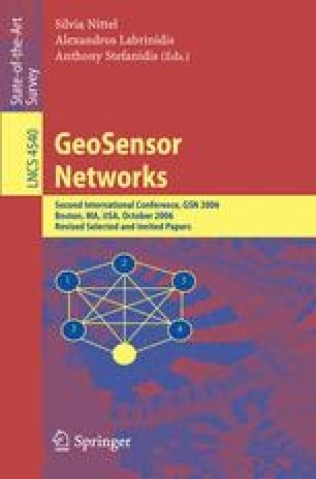
GeoSensor Networks : 2nd International Conference, GSN 2006, Boston, MA, USA, October 1-3, 2006, Revised Selected and Invited Papers
This book constitutes the thoroughly refereed proceedings of the Second GeoSensor Networks Conference, held in Boston, Massachusetts, USA, in October 2006. The conference addressed issues related to the collection, management, processing, analysis, and delivery of real-time geospatial data using distributed geosensor networks. This represents an evolution of the traditional static and centralized geocomputational paradigm.

Geomatics Solutions for Disaster Management
Natural and anthropogenic disasters have caused a large number of victims and significant social and economic losses in the last few years. There is no doubt that the risk prevention and disaster management sector needs drastic measures and improvements in order to decrease damage and save lives of inhabitants. Effective utilization of satellite positioning, remote sensing, and GIS in disaster monitoring and management requires research and development in numerous areas: data collection, access and delivery, information extraction and analysis, management and their integration with other data sources (airborne and terrestrial imagery, GIS data, etc.), data standardization, organizational and legal aspects of sharing of remote sensing information. This book provides researchers and practitioners with a good overview of what is being developed in this topical area.
Geographic Information Science ; 4th International Conference, GIScience 2006, Münster, Germany, September 20-23, 2006, Proceedings
The GIScience conference series (www. giscience. org) was created as a forum for all researchers who are interested in advancing research in the fundam- tal aspects of geographic information science.The conferences focus on emerging topics and basic research ?ndings across all s- tors of geographic information science. After three highly successful conferences in the United States, this year’s GIScience conference was held in Europe for the ?rst time. The GIScience conferences have been a meeting point for researchers coming from various disciplines, including cognitive science, computer science, engine- ing, geography,information science, mathematics, philosophy, psychology,social science, and statistics. The advancement of geographic information science - quiressuchinterdisciplinarybreadth,andthisisalsowhatmakestheconferences so exciting. In order to account for the di?erent needs of the involved scienti?c disciplines with regard to publishing their research results.
Frontiers of Geographic Information Technology
Although designed primarily for desktop mapping and analysis, Geographic Information Systems have, for some years, been ‘coupled’ to other ‘allied’ technologies. This coupling or integration has occurred for some time due to the limitations in commercially available systems. It has occurred in several areas including visualisation (virtual reality), simulation (pedestrian, urban modelling), data storage and management (distributed or Internet GIS) and decision support. The chapters of the book, written by an international group of experts examine several of these discrete areas, focussing on the use of GIS and the technology it has been allied to.

Earth Observation Open Science and Innovation
The digital transformation is revolutionizing our ability to monitor our planet and transforming the way we access, process and exploit Earth Observation data from satellites.This book reviews these megatrends and their implications for the Earth Observation community as well as the wider data economy. It provides insight into new paradigms of Open Science and Innovation applied to space data, which are characterized by openness, access to large volume of complex data, wide availability of new community tools, new techniques for big data analytics such as Artificial Intelligence, unprecedented level of computing power, and new types of collaboration among researchers, innovators, entrepreneurs and citizen scientists. In addition, this book aims to provide readers with some reflections on the future of Earth Observation, highlighting through a series of use cases not just the new opportunities created by the New Space revolution, but also the new challenges that must be addressed in order to make the most of the large volume of complex and diverse data delivered by the new generation of satellites.

Developments in spatial data handling ; 11th International Symposium on Spatial Data Handling
The International Symposium on Spatial Data Handling is the premier research forum for Geographic Information Science. The papers published in this volume are carefully refereed by an international programme committee composed of experts in various areas of GIS who are especially renowned for their scientific innovation.
