



الصفحة 1
الصفحة 1
On the move to meaningful internet systems 2005 : OTM 2005 Workshops ; OTM Confederated International Workshops and Posters, AWeSOMe, CAMS, GADA. MIOS+INTEROP, ORM, PhDS, SeBGIS. SWWS. and WOSE 2005, Agia Napa, Cyprus, October 31 - November 4, 2005, Proceedings
This book constitutes the joint refereed proceedings of nine international workshops held as part of OTM 2005 in Agia Napa, Cyprus in October/November 2005.The 145 revised full papers presented were carefully reviewed and selected from a total of 268 submissions. Topics addressed are agents, Web services and ontologies merging (AWeSOMe 2005), context-aware mobile systems (CAMS 2005), grid computing and its application to data analysis (GADA 2005), inter-organizational systems and interoperability of enterprise software and applications (MIOS+INTEROP 2005), object-role modeling (ORM 2005), a PHD symposium (PhDS 2005), semantic-based geographical information systems (SeBGIS 2005), Web semantics (SWWS 2005), and ontologies, semantics and e-learning (WOSE 2005)

Observing our Changing Earth ; Proceedings of the 2007 IAG General Assembly, Perugia, Italy, July 2 - 13, 2007
Contains a selection of 99 papers from the International Association of Geodesy (IAG) quadrennial General Assembly, held in Perugia, Italy, from July 2 to 13, 2007, in conjunction with the XXIV General Assembly of the International Union of Geodesy and Geophysics (IUGG).

Object-Based Image Analysis and Treaty Verification : New Approaches in Remote Sensing – Applied to Nuclear Facilities in Iran
This book describes recent progress in object-based image interpretation, and also presents many new results in its application to verification of nuclear non-proliferation. A comprehensive workflow and newly developed algorithms for object-based high resolution image (pre-) processing, feature extraction, change detection, classification and interpretation are developed, applied and evaluated. The entire analysis chain is demonstrated with high resolution imagery acquired over Iranian nuclear facilities.

Object-Based Image Analysis : Spatial Concepts for Knowledge-Driven Remote Sensing Applications
This book discusses means, technologies and approaches related to the processing and analysis of multi-sensor, multi-resolution data with a focus on the generation, modelling and classification of objects. The applications also address the integration of Geographic Information and the concurrent developments of GIScience and vanquish limitations of pixelwise image processing by exploiting image information context-driven and "intelligently".

Nearest Neighbor Search : A Database Perspective
Modern applications are both data and computationally intensive and require the storage and manipulation of voluminous traditional (alphanumeric) and nontraditional data sets (images, text, geometric objects, time-series). Examples of such emerging application domains are: Geographical Information Systems (GIS), Multimedia Information Systems, CAD/CAM, Time-Series Analysis, Medical Information Sstems, On-Line Analytical Processing (OLAP), and Data Mining. These applications pose diverse requirements with respect to the information and the operations that need to be supported. From the database perspective, new techniques and tools therefore need to be developed towards increased processing efficiency. This monograph explores the way spatial database management systems aim at supporting queries that involve the space characteristics of the underlying data, and discusses query processing techniques for nearest neighbor queries. It provides both basic concepts and state-of-the-art results in spatial databases and parallel processing research, and studies numerous applications of nearest neighbor queries.

Integration of Information for Environmental Security : Environmental Security - Information Security - Disaster Forecast and Prevention - Water Resources Management
Currently the necessary information exists in a multitude of forms and formats geographically and physically scattered over different countries, institutes and organisations, and are subject to widely different data policies and management schemes. Moreover, there is no complete and updated overview of the existing information, e.g. in the form of a metadata catalogue. As a result, integration of this information in case of emergencies has proven to be extremely difficult, if not impossible. Although in some cases, interesting and impressive "demonstrations" have been shown of the possibilities of the integration of information, for a number of reasons these have reached the "operational" stage.
Information Fusion and Geographic Information Systems ; Proceedings of the Third International Workshop
This volume contains the papers presented at the International Workshop “Inf- mation Fusion and Geographical Information Systems” (IF&GIS’07) held in St. Petersburg, Russia, 2007. Research in the Geosciences field interprets the concept of Information Fusion as a synonym of an approach that permits research into all the problems and issues which program-makers and scientific researchers are faced with. Thus, topics that are to be covered during the workshop relate to issues such as harmonization, - tegration and information fusion. At the same time the spectrum of problems - der discussion exceeds the current bounds of developing GIS applications. This is a significant modern trend since GIS technology is more often used as an interface in support and decision making systems. As a result, it is difficult to consider Geoinformation Science without considering related scientific directions such as Ontology, Artificial Intelligent Systems and Situation Management.

Headway in Spatial Data Handling ; 13th International Symposium on Spatial Data Handling
For sustainable development, climate change or more simply resource sharing and economic development, this information helps to - cilitate human activities and to foresee the impact of these activities in space as well as, inversely, the impact of space on our lives. The Inter- tional Symposium on Spatial Data Handing (SDH) is a primary research forum where questions related to spatial and temporal modelling and analysis, data integration, visual representation or semantics are raised.

Geospatial Vision : New Dimensions in Cartography
This book reflects the diverse nature of interests of contributors in the field. The GeoCart conferences are held every two years and attract attendees from Australasia and globally. They offer a forum for reflecting on past practices, exploring future possibilities and reporting on the findings of - search undertakings. They make valuable contributions to the theory and praxis of Geoinformation and Cartography.

Geospatial Technologies and Homeland Security : Research Frontiers and Future Challenges
This book presents an overview of the latest development of geospatial technologies (including, but not limited to, GIS, RS, GPS, LBS, spatial analysis and modelling etc.) and their applications in piecing together the complex puzzles facing the challenges of the homeland security research and education. A wide variety of topics, ranging from conceptual and methodological to technical and social/legal issues

GeoSpatial semantics ; 2nd International Conference, GeoS 2007, Mexico City, Mexico, November 29-30, 2007
This paper reports a simple case study of extracting the two types of such hierarchies from formal texts of traffic code. Problems of concurrent use of both hierarchies for ontology reasoning are dis-cussed, particularly, in context of the different views on geospatial ontologies.
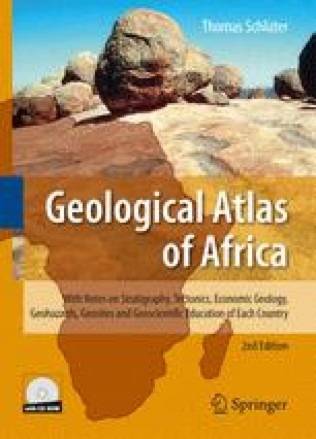
Geological atlas of Africa : With notes on stratigraphy, tectonics, economic geology, geohazards, geosites and geoscientific education of each country
T is atlas is intended primarily for anybody who is in-some background for the arrangement of how the terested in basic geology of Africa. Its originality lies atlas was done. T e second chapter is devoted to the in the fact that the regional geology of each African history of geological mapping in Africa, necessary nation or territory is reviewed country-wise by maps for a fuller appreciation of why this work in Africa is and text, a view normally not presented in textbooks worth doing. Chapter 3 provides an executive s- of regional geology. It is my belief, that there has long mary on the stratigraphy and tectonics of Africa as a been a need in universities and geological surveys, whole, i. e. in the context of no political boundaries.
Geographic Hypermedia : Concepts and Systems
This book introduces a new paradigm, Geographic Hypermedia, which emerges from the convergence of Geographic Information Science and - permedia technology. Both GI Science and hypermedia have been rapidly evolving fields. The initial idea of Geographic Hypermedia was born in 2004 when the editors had been invited to organize a workshop in conju- tion with the ‘Hypertext’ conference organized annually by the Special - terest Group of the Association for Computing Machinery. The purpose of the workshop was to examine how hypermedia concepts and tools may be applied in geographical domains. The workshop was eventually held in conjunction with the Maps and the Internet Commission of the International Cartographic Association at the annual meeting of the Association of American Geographers in Denver, Colorado, in April 2005. The Denver workshop was a successful event, bringing together mul- disciplinary researchers and professionals in the area of Geographic - permedia.

Geodetic and geophysical observations in Antarctica : An overview in the IPY perspective
This book is a collection of papers on various aspects of the scientific investigation and observation techniques of the polar regions at both temporary and permanent observatories. Most papers focus on regional models based on data acquired in polar regions. Geodetic satellite positions systems (GNSS: GPS, GLONASS, GALILEO) will also be discussed as well as other space techniques (DORIS, VLBI). Gravimetry, absolute gravimetry, and tidal gravimetry are also discussed, as well as seismology and meteorology.
Exploratory Analysis of Spatial and Temporal Data : A Systematic Approach
Exploratory data analysis (EDA) is about detecting and describing patterns, trends, and relations in data, motivated by certain purposes of investigation. As something relevant is detected in data, new questions arise, causing specific parts to be viewed in more detail. So EDA has a significant appeal: it involves hypothesis generation rather than mere hypothesis testing.

Encyclopedia of GIS "Geographical Information Sciences"
provides up-to-date information on emerging topics such as spatial big data, smart-phone GIS, urban computing and mobile recommender systems. It also expands the first edition’s rich set of GIS-related commercial and societal applications such as geo-targeting, geo-fencing and understanding climate changes, while enabling more comprehensive coverage of classical GIS topics such as map projections, global positioning systems and spatial cognition. The entries explain the key software, data sets and processes used by geographers and computational scientists. Additionally, the reference emphasizes the role of GIS in business and mobile intelligence. By offering more diversified GIS-related topics from theory and research than most of the other available literature, the authors equip newcomers to the field with principles as well as applications.

Earth Observation of Global Change : The Role of Satellite Remote Sensing in Monitoring the Global Environment
Global Change is increasingly considered a critical topic in environmental research. Remote sensing methods provide a relevant tool to monitor global variables, since they offer a systematic coverage of the Earth Surface, at different spatial, spectral and temporal resolutions. The data provided by Earth Observation Satellites are being operationally used for monitoring atmospheric conditions, ice sheets and glaciar movements, crop dynamism and land use changes, deforestation and desertification processes, as well as water conditions. The book includes an analysis of the leading missions in global Earth observation, and then reviews the main fields in which remote sensing methods are providing vital data for global change studies.

Digital Soil Mapping with Limited Data
This book focuses on digital soil mapping methodologies and applications for areas where data are limited, and has the following sections (i) introductory papers, (ii) dealing with limited spatial data infrastructures, (iii) methodology development, and (iv) examples of digital soil mapping in various parts of the globe (including USA, Brazil, UK, France, Czech Republic, Honduras, Kenya, Australia). The final chapter summarises priorities for digital soil mapping.

Computational earthquake physics ; Part II
Exciting developments in earthquake science have benefited from new observations, improved computational technologies, and improved modeling capabilities. Designing realistic supercomputer simulation models for the complete earthquake generation process is a grand scientific challenge due to the complexity of phenomena and range of scales involved from microscopic to global. The present volume - Part II - incorporates computational environment and algorithms, data assimilation and understanding, model applications and iSERVO. Topics covered range from iSERVO and QuakeSim: implementing the international solid earth research virtual observatory by integrating computational grid and geographical information web services; LURR (Load-Unload Response Ratio) described in six papers involving this promising earthquake forecasting model; pattern informatics and phase dynamics and their applications, which was also a highlight in the Workshop; computational algorithms, including continuum damage models and visualization and analysis of geophysical datasets; evolution of mantle material; the state vector approach; and assimilation of data such as geodetic data, GPS data, and seismicity and laboratory experimental data.

Cloud-Resolving Modeling of Convective Processes
Introduces the framework of cloud-resolving model, methodologies for analysis of modeling outputs, and validation of simulations with observations. The book details important scientific findings in the aspects of surface rainfall processes, precipitation efficiency, dynamic and thermodynamic processes associated with tropical convection, diurnal variations, radiative and cloud microphysical processes associated with development of cloud clusters, air-sea coupling on convective scales, climate equilibrium states, and remote sensing applications.
