



الصفحة 1
الصفحة 1

Object-Based Image Analysis : Spatial Concepts for Knowledge-Driven Remote Sensing Applications
This book discusses means, technologies and approaches related to the processing and analysis of multi-sensor, multi-resolution data with a focus on the generation, modelling and classification of objects. The applications also address the integration of Geographic Information and the concurrent developments of GIScience and vanquish limitations of pixelwise image processing by exploiting image information context-driven and "intelligently".
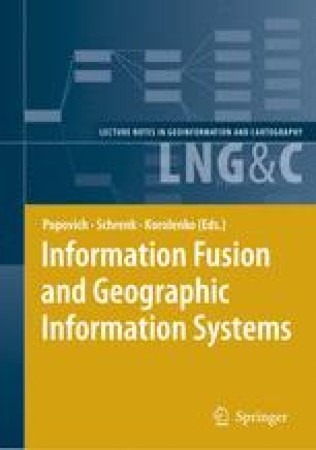
Information Fusion and Geographic Information Systems ; Proceedings of the Third International Workshop
This volume contains the papers presented at the International Workshop “Inf- mation Fusion and Geographical Information Systems” (IF&GIS’07) held in St. Petersburg, Russia, 2007. Research in the Geosciences field interprets the concept of Information Fusion as a synonym of an approach that permits research into all the problems and issues which program-makers and scientific researchers are faced with. Thus, topics that are to be covered during the workshop relate to issues such as harmonization, - tegration and information fusion. At the same time the spectrum of problems - der discussion exceeds the current bounds of developing GIS applications. This is a significant modern trend since GIS technology is more often used as an interface in support and decision making systems. As a result, it is difficult to consider Geoinformation Science without considering related scientific directions such as Ontology, Artificial Intelligent Systems and Situation Management.

GIS for Health and the Environment : Development in the Asia-Pacific Region
This book is a result of the International Conference in GIS and Health held on 27-29 June 2006 in Hong Kong. The selected chapters are organized into four themes: GIS Informatics; Human and Environmental Factors; Disease modeling; and Public health, population health technologies, and surve- lance.

Geo-Spatial Technologies in Urban Environments : Policy, Practice, and Pixels
This book expands the current frame of reference of remote sensing and geographic information specialists to include an array of socio-economic and related planning issues.

Geo-spatial technologies in urban environments : Policy, practice, and pixels
The purpose of this book is to investigate and develop alternate methodological approaches to understand urban environments and urban change. In particular, the study demonstrates the application of remote-sensing data and geographic information systems to the exploration of issues often ignored by the mainstream community of geo-technical specialists such as urban forestry, urban traffic, migration or quality of life in urban areas. Case studies show how disciplines like environmental science and planning, sociology, landscape ecology and architecture, regional science and policy design, and assessment can benefit from employing remote-sensing data and GIS.
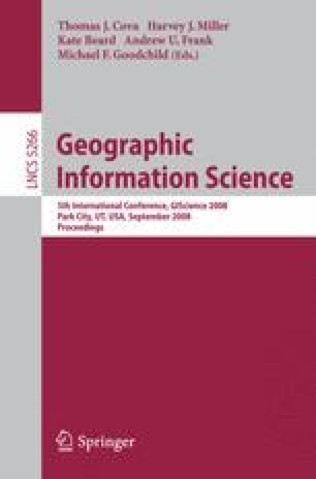
Geographic Information Science ; 5th International Conference, GIScience 2008, Park City, UT, USA, September 23-26, 2008. Proceedings
This book constitutes the refereed proceedings of the 5th International Conference on Geographic Information Secience, GIScience 2008, held in Park City, UT, USA, in September 2008.The 24 revised full papers presented were carefully reviewed and selected from 77 submissions. Among the traditional topics addressed are spatial relations, geographic dynamics, and spatial data types. A significant number of papers deal with navigation networks, location-based services, and spatial information query and retrieval. Geo-sensors, mobile computing, and Web mapping rank among the important new directions.
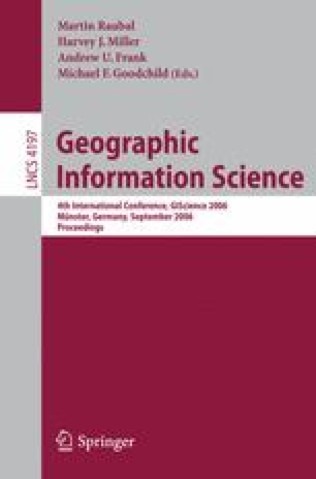
Geographic Information Science ; 4th International Conference, GIScience 2006, Münster, Germany, September 20-23, 2006, Proceedings
The GIScience conference series (www. giscience. org) was created as a forum for all researchers who are interested in advancing research in the fundam- tal aspects of geographic information science.The conferences focus on emerging topics and basic research ?ndings across all s- tors of geographic information science. After three highly successful conferences in the United States, this year’s GIScience conference was held in Europe for the ?rst time. The GIScience conferences have been a meeting point for researchers coming from various disciplines, including cognitive science, computer science, engine- ing, geography,information science, mathematics, philosophy, psychology,social science, and statistics. The advancement of geographic information science - quiressuchinterdisciplinarybreadth,andthisisalsowhatmakestheconferences so exciting. In order to account for the di?erent needs of the involved scienti?c disciplines with regard to publishing their research results.

Geographic information metadata for spatial data infrastructures : Resources, interoperability and information retrieval
Metadata play a fundamental role in both DLs and SDIs. Commonly defined as "structured data about data" or "data which describe attributes of a resource" or, more simply, "information about data", it is an essential requirement for locating and evaluating available data. Therefore, this book focuses on the study of different metadata aspects, which contribute to a more efficient use of DLs and SDIs. The three main issues addressed are: the management of nested collections of resources, the interoperability between metadata schemas, and the integration of information retrieval techniques to the discovery services of geographic data catalogs (contributing in this way to avoid metadata content heterogeneity).
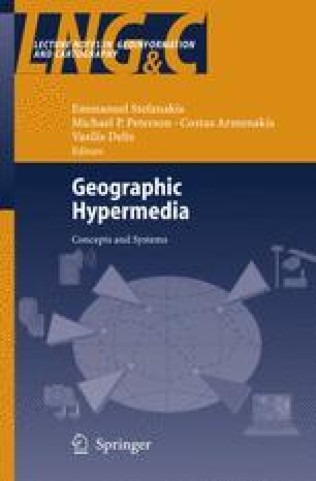
Geographic Hypermedia : Concepts and Systems
This book introduces a new paradigm, Geographic Hypermedia, which emerges from the convergence of Geographic Information Science and - permedia technology. Both GI Science and hypermedia have been rapidly evolving fields. The initial idea of Geographic Hypermedia was born in 2004 when the editors had been invited to organize a workshop in conju- tion with the ‘Hypertext’ conference organized annually by the Special - terest Group of the Association for Computing Machinery. The purpose of the workshop was to examine how hypermedia concepts and tools may be applied in geographical domains. The workshop was eventually held in conjunction with the Maps and the Internet Commission of the International Cartographic Association at the annual meeting of the Association of American Geographers in Denver, Colorado, in April 2005. The Denver workshop was a successful event, bringing together mul- disciplinary researchers and professionals in the area of Geographic - permedia.

Fuzzy Modeling with Spatial Information for Geographic Problems
This book focuses on research advances in approaches for incorporating explicit handling of uncertainty, especially by fuzzy sets, to address geographic problems. It has two aims: to stimulate research in the theory and application of fuzzy sets to spatial information management and geographic problem solving; and to highlight advances that have matured so much that geoscientists, computer scientists, geographers, et al. use fuzzy modeling. The book includes examples of the use of fuzzy sets in representational issues such as terrain features, landscape morphology, spatial extents and approaches for spatial interpolation, plus applications using fuzzy sets covering data mining, spatial decision making, ecological simulation, and reliability in GIS.
Frontiers of high performance computing and networking – ISPA 2006 workshops ; ISPA 2006 International workshops FHPCN, XHPC, S-GRACE, GridGIS, HPC-GTP, PDCE, ParDMCom, WOMP, ISDF, and UPWN, Sorrento, Italy, December 4 -7, 2006, Proceedings
This book constitutes the refereed joint proceedings of ten internationl workshops held in conjunction with the 4th International Symposium on Parallel and Distributed Processing and Applications, ISPA 2006, held in Sorrento, Italy in December 2006 (see LNCS 4330). Topics addressed are frontiers of high performance computing and networking (FHPCN 2006), XEN in HPC cluster and grid computing environments (XHPC 2006), semantic grid applications in computing and engineering (S-GRACE 2006), fertilization of grid computing and geographic information system (GridGIS 2006), high performance computing in genomic proteomic and transcriptomic (HPC-GTP 2006), parallel and distributed computing in engineering (PDCE 2006), parallel and distributed multimedia computing (ParDMCom 2006), middleware performance (WOMP 2006), information security and digital forensics (ISDF 2006), and ubiquitous processing for wireless networks (UPWN 2006).
Frontiers of Geographic Information Technology
Although designed primarily for desktop mapping and analysis, Geographic Information Systems have, for some years, been ‘coupled’ to other ‘allied’ technologies. This coupling or integration has occurred for some time due to the limitations in commercially available systems. It has occurred in several areas including visualisation (virtual reality), simulation (pedestrian, urban modelling), data storage and management (distributed or Internet GIS) and decision support. The chapters of the book, written by an international group of experts examine several of these discrete areas, focussing on the use of GIS and the technology it has been allied to.

Evaluation of Multilingual and Multi-modal Information Retrieval ; 7th Workshop of the Cross-Language Evaluation Forum, CLEF 2006, Alicante, Spain, September 20-22, 2006, Revised Selected Papers
This book covers Multilingual Textual Document Retrieval, Domain-Specifig Information Retrieval, i-CLEF, QA@CLEF, ImageCLEF, CLSR, WebCLEF and GeoCLEF.

Essential Fish Habitat Mapping in the Mediterranean
This book presents latest advances in EFH mapping and modelling and introduces the environmental approach to EFH identification through the combined use of latest technologies and advanced techniques, such as Remote Sensing, Geographic Information Systems and Spatial Statistics.The contents of this book include overviews and comparisons of different approaches on species habitat modelling, methods to identify teleconnection patterns between large-scale meteo-oceanic phenomena and local environmental variation, and EFH maps for cephalopod, shrimp, hake, anchovy, sardine, and swordfish resources in the Mediterranean.

Digital landscape architecture : Logic, structure, method and application
Readers will get a comprehensive understanding of digital landscape architecture, know about multiple digital methods for landscape planning and design, and learn a lot of practical projects with digital technology.

Developments in spatial data handling ; 11th International Symposium on Spatial Data Handling
The International Symposium on Spatial Data Handling is the premier research forum for Geographic Information Science. The papers published in this volume are carefully refereed by an international programme committee composed of experts in various areas of GIS who are especially renowned for their scientific innovation.

Buried Waste in the Seabed – Acoustic Imaging and Bio-Toxicity : Results from the European SITAR Project
Buried waste on the seabed is a major source of pollution. But, very often, waste sites are not known until a serious problem occurs, or are not adequately mapped. Recent examples around Europe include WWI and WWII ammunition dump sites (e.g. Beufort Dyke in the UK), dumped nuclear submarines in the Arctic Seas, clandestine or hidden toxic-waste in the Baltic Sea and the North Sea.. Even if properly documented, waste sites evolve with time (dumped material can move with currents and tides, especially on a scale of decades; toxic-material barrels can corrode and leak). This book shows the results of a concerted EU-funded effort to tackle this problem and find innovative ways to identify and map toxic waste sites ona the seabed, whether they have been covered with sediments or not. These results are applicable to any region on the seabed in the entire world.
Advances in spatial and temporal databases ; 7th International symposium, SSTD 2001, Redondo Beach, CA, USA, July 12-15, 2001 Proceedings
The Seventh International Symposium on Spatial and Temporal Databases (SSTD 2001), held in Redondo Beach, CA, USA, July 12{15, 2001, brought together leading researchers and developers in the area of spatial, temporal, and spatio-temporal databases to discuss the state of the art in spatial and temporal data management and applications, and to understand the challenges and - search directions in the advancing area of data management for moving objects. The symposium served as a forum for disseminating research in spatial and temporal data management, and for maximizing the interchange of knowledge among researchers from the established spatial and temporal database com- nities. The exchange of research ideas and results not only contributes to the academic arena, but also bene ts the user and commercial communities.
Advances in spatial and temporal databases ; 10th International symposium, SSTD 2007, Boston, MA, USA, July 16.-18, 2007, Proceedings
The book is classified in numerous categories, each corresponding to a conference session. These include continuous monitoring; indexing and query processing; and mining.

Advances in Geoinformatics : VIII Brazilian Symposium on Geoinformatics, GEOINFO 2006, Campos do Jordão (SP), Brazil, November 19-22, 2006
The GeoInfo series of scientific conferences is an annual forum for exploring research, development and innovative applications in geographic information science and related areas. This book provides a privileged view of what is currently happening in the field of geoinformatics, and a preview of what could be the hotter developments and research topics a few years from now. Additionally, it includes recent research results on spatial databases, spatial ontologies, computational geometry and visualization for geographic information systems, geostatistics and spatial statistics, spatial analysis, interoperability, and innovative applications of geotechnologies.
