



الصفحة 1
الصفحة 1

Molecular Electronics Materials, Devices and Applications
another goal of Molecular Electronics Materials, Devices and Applications is also to promote a practical approach. As a starting point for future developments, a pragmatic methodology for VHDL-AMS device modelling and circuit design based on experimental data is then proposed. It includes an original fault tolerant memory architecture based on molecular electronics.

High-Level Synthesis : From Algorithm to Digital Circuit
This book presents an excellent collection of contributions addressing different aspects of high-level synthesis from both industry and academia. High-Level Synthesis: from Algorithm to Digital Circuit should be on each designer’s and CAD developer’s shelf, as well as on those of project managers who will soon embrace high level design and synthesis for all aspects of digital system design.
Fundamentals of switching theory and logic design : A hands on approach
Switching theory and logic design provide mathematical foundations and tools for digital system design that is an essential part in the research and development in almost all areas of modern technology. The vast complexity of modern digital systems implies that they can only be handled by computer aided design tools that are built on sophisticated mathematical models. Fundamentals of Switching Theory and Logic Design is aimed at providing an accessible introduction to these mathematical techniques that underlie the design tools and that are necessary for understanding their capabilities and limitations.
Fine- and Coarse-Grain Reconfigurable Computing
The FPGA technology is defined, which includes architecture, logic block structure, interconnect, and configuration methods and existing fine-grain reconfigurable architectures emerged from both academia and industry. Additionally, the implementation techniques and CAD tools developed to facilitate the implementation of a system in reconfigurable hardware by the industry and academia are provided.

Fault-Tolerance Techniques for SRAM-Based FPGAs
This book discusses fault-tolerance techniques for SRAM-based Field Programmable Gate Arrays (FPGAs). It starts by showing the model of the problem and the upset effects in the programmable architecture. In the sequence, it shows the main fault tolerance techniques used nowadays to protect integrated circuits against errors. A large set of methods for designing fault tolerance systems in SRAM-based FPGAs is described. Some presented techniques are based on developing a new fault-tolerant architecture with new robustness FPGA elements. Other techniques are based on protecting the high-level hardware description before the synthesis in the FPGA.

Evolvable systems : From biology to hardware ; 6th International Conference, ICES 2005, Sitges, Spain, September 12-14, 2005, Proceedings
The flying machines proposed by Leonardo da Vinci in the fifteenth century, the se- reproducing automata theory proposed by John von Neumann in the middle of the twentieth century and the current possibility of designing electronic and mechanical systems using evolutionary principles are all examples of the efforts made by humans to explore the mechanisms present in biological systems that permit them to tackle complex tasks. These initiatives have recently given rise to the emergent field of b- inspired systems and evolvable hardware. The inaugural workshop, Towards Evolvable Hardware, took place in Lausanne in October 1995, followed by the successive events of the International Conference on Evolvable Systems: From Biology to Hardware, held in Tsukuba (Japan) in October 1996, in Lausanne (Switzerland) in September 1998, in Edinburgh (UK) in April 2000, in Tokyo (Japan) in October 2001, and in Trondheim (Norway) in March 2003. Following the success of these past events the sixth international conference was aimed at presenting the latest developments in the field, bringing together researchers who use biologically inspired concepts to implement real systems in artificial intelligence, artificial life, robotics, VLSI design, and related domains. The sixth conference consolidated this biennial event as a reference meeting for the community involved in bio-inspired systems research. All the papers received were reviewed by at least three independent reviewers, thus guaranteeing a high-quality bundle for ICES 2005.
Embedded Systems -- Modeling, Technology, and Applications ; Proceedings of the 7th International Workshop held at Technische Universität Berlin, June 26/27, 2006
This book synthesizes the results of the seventh in a successful series of workshops that were established by Shanghai Jiao Tong University and Technische Universitat Berlin, bringing together researchers from both universities in order to present research results to an international community.
Embedded Computer Systems : Architectures, Modeling, and Simulation; 20th International Conference, SAMOS 2020, Samos, Greece, July 5–9, 2020, Proceedings
This book constitutes the refereed proceedings of the 20th International Conference on Embedded Computer Systems: Architectures, Modeling, and Simulation, SAMOS 2020, held in Samos, Greece, in July 2020.* The 16 regular papers presented were carefully reviewed and selected from 35 submissions. In addition, 9 papers from two special sessions were included, which were organized on topics of current interest: innovative architectures for security and European projects on embedded and high performance computing for health applications.

Digital VLSI Systems Design : A Design Manual for Implementation of Projects on FPGAs and ASICs Using Verilog
The book presents new material and theory as well as synthesis of recent work with complete Project Designs using industry standard CAD tools and FPGA boards, enabling the serious readers to design VLSI Systems on their own. The reader is taken step by step through the design right from implementing a single digital gate to a massive design consuming well over 100,000 gates. The Verilog codes developed for these designs are universal and can work on any FPGA or ASIC and are technology independent. The book presents the development of novel algorithms and architectures for optimum realization of high tech. products. All the design codes developed in this book are Register Transfer Level (RTL) compliant and can be readily used or amended to suit new projects.

Digital Signal Processing with Field Programmable Gate Arrays
Field-Programmable Gate Arrays (FPGAs) are revolutionizing digital signal processing as novel FPGA families are replacing ASICs and PDSPs for front-end digital signal processing algorithms. So the efficient implementation of these algorithms is critical and is the main goal of this book. It starts with an overview of today's FPGA technology, devices, and tools for designing state-of-the-art DSP systems. A case study in the first chapter is the basis for more than 40 design examples throughout. The following chapters deal with computer arithmetic concepts, theory and the implementation of FIR and IIR filters, multirate digital signal processing systems, DFT and FFT algorithms, advanced algorithms with high future potential, and adaptive filters. Each chapter contains exercises. The VERILOG source code and a glossary are given in the appendices. This edition has a new chapter on microprocessors, new sections on special functions using MAC calls, intellectual property core design and arbitrary sampling rate converters, and over 100 new exercises.

Designing Embedded Processors : A Low Power Perspective
Designing Embedded Processors examines the many ways in which processor based systems are designed to allow low power devices. It looks at processor design methods, memory optimization, dynamic voltage scaling methods, compiler methods, and multi processor methods. Each section has an introductory chapter to give a breadth view, and have a few specialist chapters in the area to give a deeper perspective. The book provides a good starting point to engineers in the area, and to research students embarking upon the exciting area of embedded systems and architectures.

Design of Systems on a Chip : Design and Test
Design of Systems on a Chip: Design&Test is the second of two volumes addressing the design challenges associated with new generations of the semiconductor technology. The various chapters are the compilations of tutorials presented at workshops in the recent years by prominent authors from all over the world. Technology, productivity and quality are the main aspects under consideration to establish the major requirements for the design and test of upcoming systems on a chip. In particular this second book include contributions on three different, but complementary axes: core design, computer-aided design tools and test methods. A collection of chapters deal with the heterogeneity aspect of core designs, showing the diversity of parts that may share the same substrate in a state-of-the-art system on a chip.

Computer safety, reliability, and security ; 39th International Conference, SAFECOMP 2020, Lisbon, Portugal, September 16–18, 2020, Proceedings
This book constitutes the proceedings of the 39th International Conference on Computer Safety, Reliability and Security, SAFECOMP 2020, held in Lisbon, Portugal, in September 2020.* The 27 full and 2 short papers included in this volume were carefully reviewed and selected from 116 submissions. They were organized in topical sections named: safety cases and argumentation; formal verification and analysis; security modelling and methods; assurance of learning-enabled systems; practical experience and tools; threat analysis and risk mitigation; cyber-physical systems security; and fault injection and fault tolerance.

Logic Synthesis for Compositional Microprogram Control Units
In this book control algorithms are represented by the linear graph-schemes of algorithms (GSA), where the number of operator vertices is not less than 75% of the total number of all algorithm vertices. A special class of control units named as compositional microprogram control units (CMCU) is proposed as the best way for interpretation of linear control algorithms.
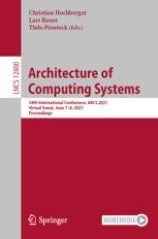
Architecture of computing systems ; 34th International Conference, ARCS 2021, Virtual Event, June 7–8, 2021, Proceedings
This book constitutes the proceedings of the 34th International Conference on Architecture of Computing Systems, ARCS 2021, held virtually in July 2021. The 12 full papers in this volume were carefully reviewed and selected from 24 submissions. 2 workshop papers (VEFRE) are also included. ARCS has always been a conference attracting leading-edge research outcomes in Computer Architecture and Operating Systems, including a wide spectrum of topics ranging from fully integrated, self-powered embedded systems up to high-performance computing systems. It also provides a platform covering newly emerging and cross-cutting topics, such as autonomous and ubiquitous systems, reconfigurable computing and acceleration, neural networks and artificial intelligence. The selected papers cover a variety of topics from the ARCS core domains, including heterogeneous computing, memory optimizations, and organic computing.
