



الصفحة 1
الصفحة 1

Handbook of big data analytics ; Vol.2 : Applications in ICT, security and business analytics
Big Data analytics is the complex process of examining big data to uncover information such as correlations, hidden patterns, trends and user and customer preferences, to allow organizations and businesses to make more informed decisions. These methods and technologies have become ubiquitous in all fields of science, engineering, business and management due to the rise of data-driven models as well as data engineering developments using parallel and distributed computational analytics frameworks, data and algorithm parallelization, and GPGPU programming. However, there remain potential issues that need to be addressed to enable big data processing and analytics in real time.

Handbook of big data analytics ; Vol.1 : Methodologies
Big Data analytics is the complex process of examining big data to uncover information such as correlations, hidden patterns, trends and user and customer preferences, to allow organizations and businesses to make more informed decisions. These methods and technologies have become ubiquitous in all fields of science, engineering, business and management due to the rise of data-driven models as well as data engineering developments using parallel and distributed computational analytics frameworks, data and algorithm parallelization, and GPGPU programming. However, there remain potential issues that need to be addressed to enable big data processing and analytics in real time. This volume presents several methodologies to support Big Data analytics including database management, processing frameworks and architectures, data lakes, query optimization strategies, towards real-time data processing, data stream analytics, Fog and Edge computing, and Artificial Intelligence and Big Data.

GPU-Based Interactive Visualization Techniques
This book focuses on efficient visualization techniques, which are the prerequisite for the interactive exploration of complex data sets. High performance is primarily achieved by devising algorithms for the fast graphics processing units (GPUs) of modern graphics hardware. Other aspects discussed in the book include parallelization on cluster computers with several GPUs, adaptive rendering methods, multi-resolution models, and non-photorealistic rendering techniques for visualization. Covering both the theoretical foundations and practical implementations of algorithms, this book provides the reader with a basis to understand and reproduce modern GPU-based visualization approaches.

Euro-Par 2020 : Parallel Processing ; 26th International Conference on Parallel and Distributed Computing, Warsaw, Poland, August 24–28, 2020, Proceedings
This book constitutes the proceedings of the 26th International Conference on Parallel and Distributed Computing, Euro-Par 2020, held in Warsaw, Poland, in August 2020. The conference was held virtually due to the coronavirus pandemic. The 39 full papers presented in this volume were carefully reviewed and selected from 158 submissions. They deal with parallel and distributed computing in general, focusing on support tools and environments; performance and power modeling, prediction and evaluation; scheduling and load balancing; high performance architectures and compilers; data management, analytics and machine learning; cluster, cloud and edge computing; theory and algorithms for parallel and distributed processing; parallel and distributed programming, interfaces, and languages; multicore and manycore parallelism; parallel numerical methods and applications; and accelerator computing.
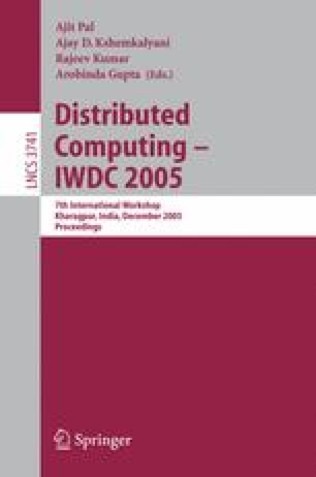
Distributed computing – IWDC 2005 ; 7th International Workshop, Kharagpur, India, December 27-30, 2005, Proceedings
This book constitutes the refereed proceedings of the 7th International Workshop on Distributed Computing, IWDC 2004, held in Kharagpur, India in December 2005. The 28 revised full papers and 33 revised short papers presented together with 5 invited keynote talks were carefully reviewed and selected from 253 submissions. The papers are organized in topical sections on theory of distributed computing, sensor networks, fault tolerance, optical networks, peer-to-peer networks, wireless networks, network security, grid and networks, middleware and data management, mobility management, and distributed artificial intelligence.

Data parallel C++programming accelerated systems using C++ and SYCL
Full of practical advice, detailed explanations, and code examples to illustrate key topics. SYCL enables access to parallel resources in modern accelerated heterogeneous systems. Now, a single C++ application can use any combination of devices–including GPUs, CPUs, FPGAs, and ASICs–that are suitable to the problems at hand. This book teaches data-parallel programming using C++ with SYCL and walks through everything needed to program accelerated systems. The book begins by introducing data parallelism and foundational topics for effective use of SYCL. Later chapters cover advanced topics, including error handling, hardware-specific programming, communication and synchronization, and memory model considerations.
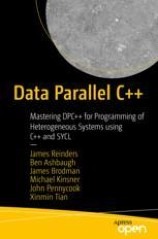
Data parallel C++ : Mastering DPC++ for programming of heterogeneous systems using C++ and SYCL
This book teaches data-parallel programming using C++ and the SYCL standard from the Khronos Group and walks through everything needed to use SYCL for programming heterogeneous systems. The book begins by introducing data parallelism and foundational topics for effective use of SYCL and Data Parallel C++ (DPC++), the open source compiler used in this book.

Cryptographics : Exploiting Graphics Cards For Security
CryptoGraphics: Exploiting Graphics Cards for Security explores the potential for implementing ciphers within graphics processing units (GPUs), and describes the relevance of GPU-based encryption and decryption to the security of applications involving remote displays.
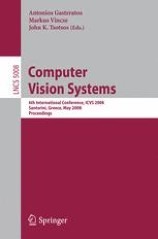
Computer vision systems ; 6th International conference, ICVS 2008 Santorini, Greece, May 12-15, 2008 Proceedings
This book constitutes the refereed proceedings of the 6th International Conference on Computer Vision Systems, ICVS 2008, held in Santorini, Greece, May 12-15, 2008.

Biomedical Simulation ; 3rd International Symposium, ISBMS 2006, Zurich, Switzerland, July 10-11, 2006, Proceedings
This book contains the written contributions to the Third International Sym- sium on Biomedical Simulation (ISBMS), which was held in Zurich, Switzerland, on July 10-11, 2006. The manuscripts are organized around three thematic sections which cover several of the major aspects of our rapidly growing ?eld: anatomical modeling and tissue properties, simulation of biophysical processes, as well as systems and applications. The symposium provided an international forum for researchers interested in using biomedical simulation technology for the improvement of patient care. It was held in the spirit and continuation of the symposia on Surgical Simulation and Soft Tissue Modeling (IS4TM) organized in 2003 by INRIA, and on Medical Simulation (ISMS) in 2004 by CIMIT.

Artificial intelligence hardware design : Challenges and solutions
Learn foundational and advanced topics in Neural Processing Unit design with real-world examples from leading voices in the field. A thorough introduction to neural networks and neural network development history, as well as Convolutional Neural Network (CNN) models Explorations of various parallel architectures, including the Intel CPU, Nvidia GPU, Google TPU, and Microsoft NPU, emphasizing hardware and software integration for performance improvement Discussions of streaming graph for massive parallel computation with the Blaize GSP and Graphcore IPU An examination of how to optimize convolution with UCLA Deep Convolutional Neural Network accelerator filter decomposition

Advanced machine learning and deep learning approaches for remote sensing
Provides research on how technologies such as artificial intelligence-based machine learning and deep learning can be applied to remote sensing. Through this, we can see the process of solving the existing problems of image and image signal processing for remote sensing. These techniques are computationally intensive and require the help of high-performance computing devices. With the development of devices such as GPUs, remote sensing technology, and aerial sensing technology, it is possible to monitor the Earth with high-resolution images and to obtain vast amounts of Earth observation data. The papers published in this reprint describe recent advances in big data processing and artificial intelligence-based technologies for remote sensing technology.
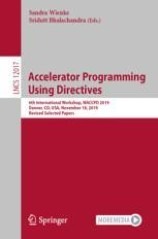
Accelerator Programming Using Directives ; 6th International Workshop, WACCPD 2019, Denver, CO, USA, November 18, 2019, Revised Selected Papers
This book constitutes the refereed post-conference proceedings of the 6th International Workshop on Accelerator Programming Using Directives, WACCPD 2019, held in Denver, CO, USA, in November 2019. The 7 full papers presented have been carefully reviewed and selected from 13 submissions. The papers share knowledge and experiences to program emerging complex parallel computing systems. They are organized in the following three sections: porting scientific applications to heterogeneous architectures using directives; directive-based programming for math libraries; and performance portability for heterogeneous architectures.
