



الصفحة 1
الصفحة 1

Novel Trends in Brain Science : Brain Imaging, Learning and Memory, Stress and Fear, and Pain
With the development of neural science, knowledge of the molecules and neurons that comprise the brain has increased exponentially in the past two decades. In Novel Trends in Brain Science, leading neuroscientists from Japan and Taiwan describe the latest and most relevant research in brain science, including state-of-the-art brain-imaging technologies such as fMRI, MR-DTI, TMS, and MEG, and also discuss learning, memory, emotions, and pain. With a wide range of contributors, the book presents valuable insights into functional neuroimaging, white matter tractography, synaptic plasticity, emoti.

MRI in Clinical Practice
The book covers the basic Physics behind MRI, quality assurance, up-to-date safety guidelines and a useful gallery of image artefacts. Part of the book focuses on the specific areas of the body in which MRI is currently exploited, describing how MRI is performed in practice. In each of these sections, a common theme is followed with illustrations of MR images acquired with clinically relevant settings and typical imaging protocols are also explicitly stated. Additional information is provided which includes a subjective view of the strengths and weaknesses of MRI in comparison to other imaging modalities. As well as covering routine clinical techniques, the latest advanced methods (e.g. spectroscopy, fMRI, diffusion, high field MRI) are discussed and placed into the context of clinical application.

Imaging of Orbital and Visual Pathway Pathology
This is one of the first books to deal with imaging of pathology of the entire visual system. It is divided into two parts, general and special. In the general part, the most important basics of modern imaging methods are discussed in detail, but with less emphasis on the physical background than in purely neuro-/radiological books. A chapter is devoted to the meticulous presentation of imaging anatomy of the orbit and intracranial visual pathway.
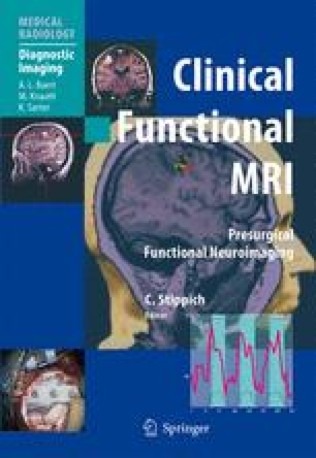
Clinical Functional MRI : Presurgical Functional Neuroimaging
Functional magnetic resonance imaging (fMRI) has contributed significantly to progress in neuroscience by permitting noninvasive imaging of the "human brain at work" under physiological conditions. Within clinical neuroimaging, fMRI is opening up a new diagnostic field by measuring and visualizing brain function. However, fMRI is not yet a standard diagnostic imaging procedure. This textbook is devoted to preoperative fMRI in patients with brain tumors and epilepsies, which are the most well-established clinical applications. By localizing and lateralizing specific brain functions in individual patients, as well as epileptogenic zones, fMRI facilitates the selection of a safe treatment and the planning and performance of function-preserving neurosurgery.
Atlas of Morphology and Functional Anatomy of the Brain
Divided into a morphological and a functional imaging section. The morphological atlas includes 3D surface images, axial, coronal, and sagittal scans acquired with high-definition T2 fast spin echo (FSE) sequences, and standard and inverted-contrast images. The MR scans are shown side by side with the corresponding anatomical brain sections, provided by Prof. Henri Duvernoy, for more effective comparison. The anatomical nomenclature adopted for both the MR and the anatomical images is listed in an jacket flap for easier consultation.
