



الصفحة 1
الصفحة 1
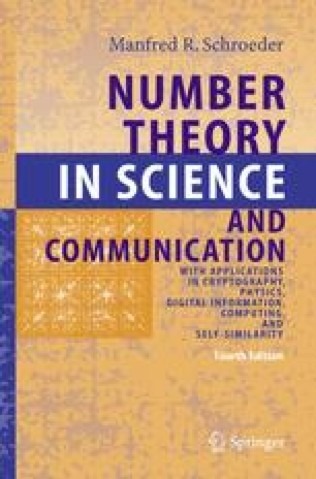
Number theory in science and communication : With applications in cryptography, physics, digital information, computing, and self-similarity
"Number Theory in Science and Communication" is a well-known introduction for non-mathematicians to this fascinating and useful branch of applied mathematics . It stresses intuitive understanding rather than abstract theory and highlights important concepts such as continued fractions, the golden ratio, quadratic residues and Chinese remainders, trapdoor functions, pseudoprimes and primitive elements. Their applications to problems in the real world are one of the main themes of the book. This revised fourth edition is augmented by recent advances in primes in progressions, twin primes, prime triplets, prime quadruplets and quintruplets, factoring with elliptic curves, quantum factoring, Golomb rulers and "baroque" integers.

Introduction to Modern Number Theory: Fundamental Problems, Ideas and Theories
"Introduction to Modern Number Theory" surveys from a unified point of view both the modern state and the trends of continuing development of various branches of number theory. Motivated by elementary problems, the central ideas of modern theories are exposed. Some topics covered include non-Abelian generalizations of class field theory, recursive computability and Diophantine equations, zeta- and L-functions. This substantially revised and expanded new edition contains several new sections, such as Wiles' proof of Fermat's Last Theorem, and relevant techniques coming from a synthesis of various theories. Moreover, the authors have added a part dedicated to arithmetical cohomology and noncommutative geometry, a report on point counts on varieties with many rational points, the recent polynomial time algorithm for primality testing, and some others subjects.

Intersections de deux quadriques et pinceaux de courbes de genre 1 = Intersections of two quadrics and pencils of curves of genus 1
This research monograph focuses on the arithmetic, over number fields, of surfaces fibred into curves of genus 1 over the projective line, and of intersections of two quadrics in projective space. The first half contains a complete account of the technique initiated by Swinnerton-Dyer in 1993 for studying rational points on pencils of curves of genus 1, while incorporating and generalising most of its subsequent refinements. The second half, which builds upon the first, is devoted to quartic del Pezzo surfaces and higher-dimensional intersections of two quadrics.

Information security, practice and experience ; 3rd International Conference, ISPEC 2007, Hong Kong, China, May 7-9, 2007, Proceedings
ISPEC is an annual conference that brings together researchers and practitioners to provide a con?uence of new information security technologies, their applications and their integration with IT systems in various vertical s- tors. In 2005 and 2006,the ?rst and second conferences were held successfully in Singapore and Hangzhou, China, respectively.

Information security practice and experience ; 4th International Conference, ISPEC 2008 Sydney, Australia, April 21-23, 2008 Proceedings
The 4 th Information Security Practice and Experience Conference (ISPEC2008) was held at Crowne Plaza, Darling Harbour, Sydney, Australia, during April 21-23, 2008. The previous three conferences were held in Singapore in 2005, Hangzhou, China in 2006 and Hong Kong, China in 2007. As with the previous three conference proceedings, the proceedings of ISPEC 2008 were published in the LNCS series by Springer. The conference received 95 submissions, out of which the Program Committee selected 29 papers for presentation at the conference. These papers are included in the proceedings. The accepted papers cover a range of topics in mathem- ics, computer science and security applications.

Information security and privacy ; 13th Australasian Conference, ACISP 2008, Wollongong, Australia, July 7-9, 2008. Proceedings
This book constitutes the refereed proceedings of the 13th Australasian Conference on Information Security and Privacy, ACISP 2008, held in Wollongong, Australia, in July 2008.The 33 revised full papers presented were carefully reviewed and selected from 111 submissions. The papers cover a range of topics in information security, including authentication, key management, public key cryptography, privacy, anonymity, secure communication, ciphers, network security, elliptic curves, hash functions, and database security.

Cryptology and Network Security ; 19th International Conference, CANS 2020, Vienna, Austria, December 14–16, 2020, Proceedings
This book constitutes the refereed proceedings of the 19th International Conference on Cryptology and Network Security, CANS 2020, held in Vienna, Austria, in December 2020.* The 30 full papers were carefully reviewed and selected from 118 submissions. The papers focus on topics such as cybersecurity; credentials; elliptic curves; payment systems; privacy-enhancing tools; lightweight cryptography; and codes and lattices.

Cryptography Arithmetic : Algorithms and Hardware Architectures
Modern cryptosystems, used in numerous applications that require secrecy or privacy - electronic mail, financial transactions, medical-record keeping, government affairs, social media etc. - are based on sophisticated mathematics and algorithms that in implementation involve much computer arithmetic. And for speed it is necessary that the arithmetic be realized at the hardware (chip) level. This book is an introduction to the implementation of cryptosystems at that level.
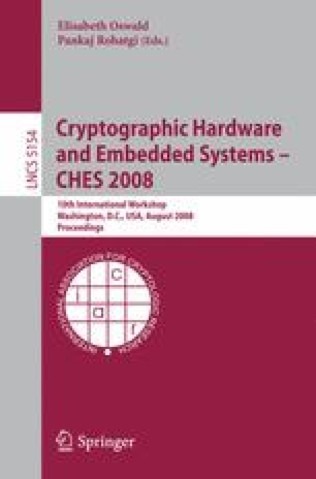
Cryptographic hardware and embedded systems - CHES 2008 ; 10th International Workshop, Washington, D.C., USA, August 10-13, 2008. Proceedings
This book constitutes the refereed proceedings of the 10th Interntaional Workshop on Cryptographic Hardware and Embedded Systems, CHES 2008, held in Washington, D.C., USA, during August 10-13, 2008.

Conics and Cubics : A Concrete Introduction to Algebraic Curves
Its focus on curves of degree at most three keeps results tangible and proofs transparent. Theorems follow naturally from high school algebra and two key ideas: homogenous coordinates and intersection multiplicities. By classifying irreducible cubics over the real numbers and proving that their points form Abelian groups, the book gives readers easy access to the study of elliptic curves. It includes a simple proof of Bezout's Theorem on the number of intersections of two curves.The book is a text for a one-semester course on algebraic curves for junior-senior mathematics majors. The only prerequisite is first-year calculus.
Aritmetica, crittografia e codici = Arithmetic, cryptography and codes
The basic techniques of algebra and number theory useful in recent applications to cryptography and codes are developed, with the aim of being elementary and self-sufficient. The emphasis is on computational problems. This part of the volume can be useful as a textbook for a first course in algebra for mathematicians, computer scientists or engineers. Important applications of algebra and geometry to cryptography and codes are then illustrated. Both, cryptography and codes have significant applications in daily life which are illustrated here. Cryptography is developed in detail in much of its classic and current aspects, and both private and public key cryptography are developed. Cryptography with the use of elliptic curves on finite fields is also illustrated. A chapter introducing the subject is dedicated to linear codes.

Applied algebra, algebraic algorithms and error-correcting codes ; 17th International Symposium, AAECC-17, Bangalore, India, December 16-20, 2007, Proceedings
Among the subjects addressed are block codes, including list-decoding algorithms; algebra and codes: rings, fields, algebraic geometry codes; algebra: rings and fields, polynomials, permutations, lattices; cryptography: cryptanalysis and complexity; computational algebra: algebraic algorithms and transforms; sequences and boolean functions.
Advances in cryptology – ASIACRYPT 2007 ; 13th International conference on the theory and application of cryptology and information security, Kuching, Malaysia, December 2-6, 2007, Proceedings
The book are organized in topical sections on number theory and elliptic curve, protocol, hash function design, group/broadcast cryptography, mac and implementation, multiparty computation, block ciphers, foundation, public key encryption, and cryptanalysi.
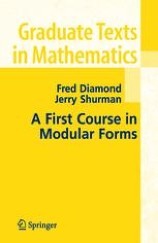
A First Course in Modular Forms
This book introduces the theory of modular forms with an eye toward the Modularity Theorem: All rational elliptic curves arise from modular forms. The topics covered include: • elliptic curves as complex tori and as algebraic curves, • modular curves as Riemann surfaces and as algebraic curves, • Hecke operators and Atkin–Lehner theory, • Hecke eigenforms and their arithmetic properties, • the Jacobians of modular curves and the Abelian varieties associated to Hecke eigenforms, • elliptic and modular curves modulo p and the Eichler–Shimura Relation, • the Galois representations associated to elliptic curves and to Hecke eigenforms. As it presents these ideas, the book states the Modularity Theorem in various forms, relating them to each other and touching on their applications to number theory.
