



الصفحة 1
الصفحة 1

New Developments in Formal Languages and Applications
The theory of formal languages is widely recognized as the backbone of theoretical computer science, originating from mathematics and generative linguistics, among others. As a foundational discipline, formal language theory concepts and techniques are present in a variety of theoretical and applied fields of contemporary research which are concerned with symbol manipulation: discrete mathematics, bioinformatics, natural language processing, pattern recognition, text retrieval, learning, cryptography, compression, etc.

Multiobjective Optimization : Interactive and Evolutionary Approaches
Multiobjective optimization deals with solving problems having not only one, but multiple, often conflicting, criteria. Such problems can arise in practically every field of science, engineering and business, and the need for efficient and reliable solution methods is increasing. The task is challenging due to the fact that, instead of a single optimal solution, multiobjective optimization results in a number of solutions with different trade-offs among criteria, also known as Pareto optimal or efficient solutions. Hence, a decision maker is needed to provide additional preference information and to identify the most satisfactory solution. Depending on the paradigm used, such information may be introduced before, during, or after the optimization process. Clearly, research and application in multiobjective optimization involve expertise in optimization as well as in decision support.
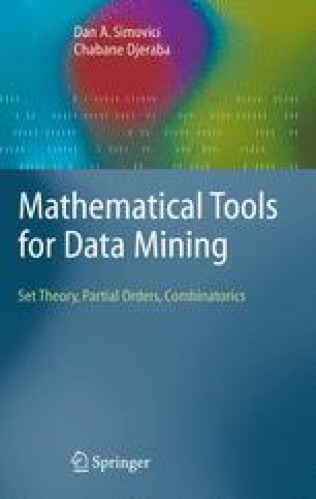
Mathematical Tools for Data Mining : Set Theory, Partial Orders, Combinatorics
Mathematics is presented in a thorough and rigorous manner offering a detailed explanation of each topic, with applications to data mining such as frequent item sets, clustering, decision trees also being discussed. More than 400 exercises are included and they form an integral part of the material. Some of the exercises are in reality supplemental material and their solutions are included. The reader is assumed to have a knowledge of elementary analysis.

Integration of AI and OR Techniques in Constraint Programming for Combinatorial Optimization Problems ; 5th International Conference, CPAIOR 2008 Paris, France, May 20-23, 2008 Proceedings
The 5th International Conference on Integration of AI and OR Techniques in Constraint Programming for Combinatorial Optimization Problems (CPAIOR 2008) was held in Paris, France May 20–23, 2008. The purpose of this conference series is to bring together researchers in the felds of constraint programming, artifcial intelligence, and operations research to explore ways of solving large-scale, practical optimization problems through integration and hybridization of the felds’ diferent techniques. Through the years, this research community is discovering that the felds have much in c- mon, and there has been tremendous richness in the resulting cross-fertilization of felds.
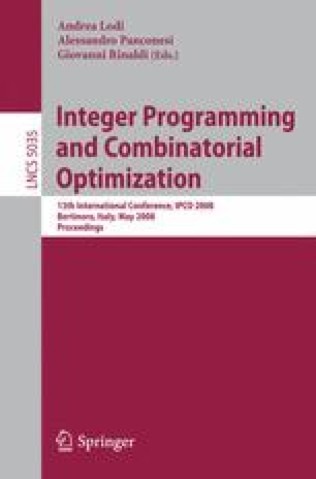
Integer programming and combinatorial optimization ; 13th International Conference, IPCO 2008 Bertinoro, Italy, May 26-28, 2008 Proceedings
The volume contains the papers selected for presentation at IPCO 2008, the 13th International Conference on Integer Programming and Combinatorial - timization that was held in Bertinoro (Italy), May 26–28, 2008. The IPCO series of conferences, sponsored by the Mathematical Progr- ming Society, highlights recent developments in theory, computation, and app- cation of integer programming and combinatorial optimization. The frst conf- ence took place in 1990; starting from IPCO 1995, the proceedings are published in the Lecture Notes in Computer Science series. The 12 previous IPCO conferences were held in Waterloo (Canada) 1990.
Integer Programming and Combinatorial Optimization ; 11th International IPCO Conference, Berlin, Germany, June 8-10, 2005, Proceedings
Since its start in 1990, the IPCO conference series (held under the auspices of theMathematicalProgrammingSociety)hasbecomeanimportantforumforthe presentation of recent results in Integer Programming and Combinatorial Op- mization. This volume compiles the papers presented at IPCO XI, the eleventh conference in this series, held June 8–10, 2005, at the Technische Universit¨ at Berlin. The high interest in this conference series is evident in the large number of submissions. For IPCO XI, 119 extended abstracts of up to 10 pages were submitted. During its meeting on January 29–30, 2005, the Program Committee carefully selected 34 contributions for presentation in non-parallel sessions at the conference. The ?nal choices were not easy at all, since, due to the limited number of time slots, many very good papers could not be accepted. During the selection process the contributions were refereed according to the standards of refereed conferences. As a result of this procedure, you have in your hands a volume that contains papers describing high-quality research e?orts. The page limit for contributions to this proceedings volume was set to 15. You may ?nd full versions of the papers in scienti?c journals in the near future. We thank all the authors who submitted papers. Furthermore, the Program Committee is indebted to the many reviewers who, with their speci?c expertise, helped a lot in making the decisions.

Horizons of Combinatorics
Hungarian mathematics has always been known for discrete mathematics, including combinatorial number theory, set theory and recently random structures, combinatorial geometry as well. The recent volume contains high level surveys on these topics with authors mostly being invited speakers for the conference "Horizons of Combinatorics" held in Balatonalmadi, Hungary in 2006. The collection gives a very good overview of recent trends and results in a large part of combinatorics and related topics, and offers an interesting reading for experienced specialists as well as to young researchers and students.

Handbook on Scheduling : From Theory to Applications
This handbook covers not only in a unified approach the most important scheduling models and methods, it also put special emphasis to their relevance to practical situations. Many applications from industry and service operations management and case studies are described. Because the book offers some preliminaries concerning basic notions from discrete mathematics, it can also be used by beginners. As a consequence, the handbook is an indispensable source for a broad audience, ranging from researchers to practitioners, graduate and advanced undergraduate students in computer science/engineering, operations research, industrial and real-time engineering, management science, business administration, information systems, and applied mathematics curricula.

Handbook of mathematics
This guide book to mathematics contains in handbook form the fundamental working knowledge of mathematics which is needed as an everyday guide for working scientists and engineers, as well as for students. Easy to understand, and convenient to use, this guide book gives concisely the information necessary to evaluate most problems which occur in concrete applications. In the newer editions emphasis was laid on those fields of mathematics that became more important for the formulation and modeling of technical and natural processes, namely Numerical Mathematics, Probability Theory and Statistics, as well as Information Processing. For the 5th edition, the chapters "Computer Algebra Systems" and "Dynamical Systems and Chaos" were fundamentally revised, updated and expanded. In the chapter "Algebra and Discrete Mathematics" a section on "Finite Fields and Shift Registers" was added.
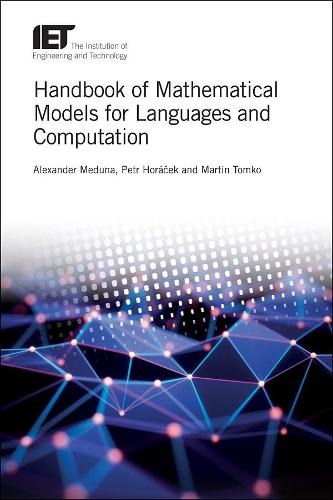
Handbook Of Mathematical Models For Languages And Computation
Introduces a variety of concepts in discrete mathematics and mathematical modeling for languages and computation. The authors pay special attention to the implementation of mathematical concepts to explain clearly how to encode them in computational practice. All computer programs are written in C#. The theory of computation is used to address challenges arising in many computer science areas such as artificial intelligence, language processors, compiler writing, information and coding systems, programming language design, computer architecture and more. To grasp topics concerning this theory readers need to familiarize themselves with its computational and language models, based on concepts of discrete mathematics including sets, relations, functions, graphs and logic.

Graph-theoretic concepts in computer science ; Vol. 3787 ; 31st International Workshop, WG 2005, Metz, France, June 23-25, 2005, Revised Selected Papers
that aims to unite theory and practice by demonstrating how graph-theoretic concepts can be applied to various areas in Computer Science. This book provides results for various classes of graphs, graph computations, graph algorithms, and graph-theoretical applications in various fields.

Graph-theoretic concepts in computer science ; 34th International Workshop, WG 2008, Durham, UK, June 30 – July 2, 2008. Revised Papers
This book constitutes the thoroughly refereed post-conference proceedings of the 34th International Workshop on Graph-Theoretic Concepts in Computer Science, WG 2008, held in Durham, UK, in June/July 2008.The 30 revised full papers presented together with 3 invited paper were carefully reviewed and selected from 76 submissions. The papers feature original results on all aspects of graph-theoretic concepts in Computer Science, e.g. structural graph theory, sequential, parallel, and distributed graph and network algorithms and their complexity, graph grammars and graph rewriting systems.

Graph-based Knowledge Representation : Computational Foundations of Conceptual Graphs
This book studies a graph-based knowledge representation and reasoning formalism stemming from conceptual graphs, with a substantial focus on the computational properties.Knowledge can be symbolically represented in many ways, and the authors have chosen labeled graphs for their modeling and computational qualities. the authors have attempted to answer, the following question:`how far is it possible to go in knowledge representation and reasoning by representing knowledge with graphs and reasoning with graph operations?''

Graph theory, combinatorics and algorithms: interdisciplinary applications
focuses on discrete mathematics and combinatorial algorithms interacting with real world problems in computer science, operations research, applied mathematics and engineering. The book contains eleven chapters written by experts in their respective fields, and covers a wide spectrum of high-interest problems across these discipline domains.The chapters focus on "real world" applications, all of which will be of considerable interest across the areas of Operations Research, Computer Science, Applied Mathematics, and Engineering. These problems include Internet congestion control, high-speed communication networks, multi-object auctions, resource allocation, software testing, data structures, etc. In sum, this is a book focused on major, contemporary problems, written by the top research scholars in the field, using cutting-edge mathematical and computational techniques.

Graph theory
Graph theory is a flourishing discipline containing a body of beautiful and powerful theorems of wide applicability. Its explosive growth in recent years is mainly due to its role as an essential structure underpinning modern applied mathematics – computer science, combinatorial optimization, and operations research in particular – but also to its increasing application in the more applied sciences. The versatility of graphs makes them indispensable tools in the design and analysis of communication networks, for instance. The primary aim of this book is to present a coherent introduction to the subject, suitable as a textbook for advanced undergraduate and beginning graduate students in mathematics and computer science. It provides a systematic treatment of the theory of graphs without sacrificing its intuitive and aesthetic appeal. Commonly used proof techniques are described and illustrated, and a wealth of exercises - of varying levels of difficulty - are provided to help the reader master the techniques and reinforce their grasp of the material.

Graph drawing ; 15th International symposium, GD 2007, Sydney, Australia, September 24-26, 2007. Revised Papers
The 16th International Symposium on Graph Drawing (GD 2008) was held in Hersonissos, near Heraklion, Crete, Greece, September 21-24, 2008, and was attended by 91 participants from 19 countries. In response to the call for papers the Program Committee received 83 s- missions,eachdescribing originalresearchand/or a systemdemonstration.Tamassia showed how graph drawing techniques can be used as an e?ective tool in computer security and pointed to future research directions in this area. Following what is now a tradition, the 15th Annual Graph Drawing Contest was held during the conference, also including a Graph Drawing Challenge to the conference attendees.
FSTTCS 2006 : Foundations of software technology and theoretical computer science ; 26th International Conference, Kolkata, India, December 13-15, 2006, Proceed
This book constitutes the refereed proceedings of the 26th International Conference on the Foundations of Software Technology and Theoretical Computer Science, FSTTCS 2006, held in Kolkata, India, in December 2006. It contains 38 papers that cover a broad variety of current topics from the theory of computing, ranging from formal methods, discrete mathematics, complexity theory, and automata theory to theoretical computer science in general.
Frontiers in Algorithmics ; 2nd Annual International Workshop, FAW 2008, Changsha, China, June 19-21, 2008, Proceeedings
This book constitutes the refereed proceedings of the Second International Frontiers of Algorithmics Workshop, FAW 2008, held in Changsha, China, in June 2008.The 33 revised full papers presented together with the abstracts of 3 invited talks were carefully reviewed and selected from 80 submissions. The papers were selected for 9 special focus tracks in the areas of biomedical informatics, discrete structures, geometric information processing and communication, games and incentive analysis.

Foundations of software science and computation structures ; 23rd International conference, FOSSACS 2020, Held as part of the European joint conferences on theory and practice of software, ETAPS 2020, Dublin, Ireland, April 25–30, 2020, proceedings
This book constitutes the proceedings of the 23rd International Conference on Foundations of Software Science and Computational Structures, FOSSACS 2020, which took place in Dublin, Ireland, in April 2020, and was held as Part of the European Joint Conferences on Theory and Practice of Software, ETAPS 2020.
Foundations of software science and computation structures ; 22nd International conference, FOSSACS 2019, Held as part of the European joint conferences on theory and practice of software, ETAPS 2019, Prague, Czech Republic, April 6–11, 2019, proceedings
This book constitutes the proceedings of the 22nd International Conference on Foundations of Software Science and Computational Structures, FOSSACS 2019, which took place in Prague, Czech Republic, in April 2019, held as part of the European Joint Conference on Theory and Practice of Software, ETAPS 2019. The 29 papers presented in this volume were carefully reviewed and selected from 85 submissions. They deal with foundational research with a clear significance for software science.
