



الصفحة 1
الصفحة 1

Modeling Communication with Robots and Virtual Humans ; Second ZiF Research Group International Workshop on Embodied Communication in Humans and Machines, Bielefeld, Germany, April 5-8, 2006, Revised Selected Papers
The 17 articles in this state-of-the-art survey address artificial intelligence research on communicative agents and also provide an interdisciplinary perspective from linguistics, behavioral research, theoretical biology, philosophy, communication psychology, and computational neuroscience. The topics include studies on human multimodal communication; the modeling of feedback signals, facial expression, eye contact, and deception; the recognition and comprehension of hand gestures and head movements; communication interfaces for humanoid robots; the evolution of cognition and language; emotion and social appraisal in nonverbal communication; dialogue models and methodologies; theory of mind and intentionality; complex systems, dynamic field theory, and connectionist modeling.

Intelligence and Security Informatics ; Vol. 3975 ; IEEE International Conference on Intelligence and Security Informatics, ISI 2006, San Diego, CA, USA, May 23-24, 2006.
In the past few years, intelligence and security informatics (ISI) research, which is concerned with the study of the development and use of advanced information te- nologies and systems for national and international security-related applications, has experienced tremendous growth and attracted substantial interest from academic - searchers in related fields as well as practitioners from both government agencies and industry. The ISI community is maturing, and a core set of research methodologies and technical approaches has emerged and is becoming the underpinning of ISI research.

Intelligence and Security Informatics ; Vol. 3917 ; International Workshop, WISI 2006, Singapore, April 9, 2006, Proceedings
Intelligence and security informatics (ISI) can be broadly defined as the study of the development and use of advanced information technologies and systems for national and international security-related applications. The First and Second Symposiums on ISI were held in Tucson, Arizona, in 2003 and 2004, respectively. In 2005, the IEEE International Conference on ISI was held in Atlanta, Georgia. These ISI conferences brought together academic researchers, law enforcement and intelligence experts, information technology consultants and practitioners to discuss their research and practice related to various ISI topics including ISI data management, data and text mining for ISI applications, terrorism informatics, deception detection, terrorist and criminal social network analysis, crime analysis, monitoring and surveillance, policy studies and evaluation, and information assurance, among others. We continued these stream of ISI conferences by organizing the Workshop on Intelligence and Security Informatics (WISI 2006) in conjunction with the Pacific Asia Conference on Knowledge Discovery and Data Mining (PAKDD 2006).

Intelligence and security informatics ; Vol. 3495 : IEEE International Conference on Intelligence and Security Informatics, ISI 2005, Atlanta, GA, USA, May 19-20, 2005, Proceedings
Intelligence and security informatics (ISI) can be broadly defined as the study of the development and use of advanced information technologies and systems for national and international security-related applications, through an integrated technological, organizational, and policy-based approach. In the past few years, ISI research has experienced tremendous growth and attracted substantial interest from academic researchers in related fields as well as practitioners from both government agencies and industry. The first two meetings (ISI 2003 and ISI 2004) in the ISI symposium and conference series were held in Tucson, Arizona, in 2003 and 2004, respectively. They provided a stimulating intellectual forum for discussion among previously disparate communities: academic researchers in information technologies, computer science, public policy, and social studies; local, state, and federal law enforcement and intelligence experts; and information technology industry consultants and practitioners.

Human Creation Between Reality and Illusion
Identifying quickly illusion with deception, we tend to oppose it to the reality of life. However, investigating in this collection of essays illusion's functions in the Arts, which thrives upon illusion and yet maintains its existential roots and meaningfullness in the real, we might wonder about the nature of reality itself.
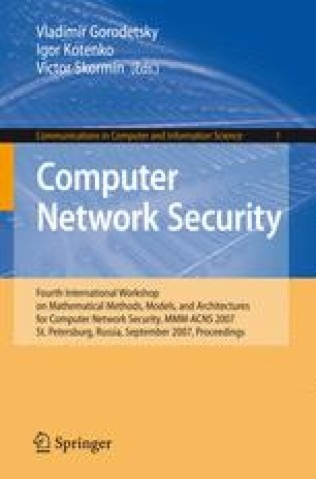
Computer Network Security ; 4th International Conference on Mathematical Methods, Models and Architectures for Computer Network Security, MMM-ACNS 2007, St. Petersburg, Russia, September 13-15, 2007, Proceedings
This volume focus on mathematical aspects of information and computer network security addressing the ever-increasing demands for secure computing and highly dependable computer networks.

Cognitive Development in Chimpanzees
From an evolutionary perspective, understanding chimpanzees offers a way of understanding the basis of human nature. This book on cognitive development in chimpanzees is the first of its kind to focus on infants reared by their own mothers within a natural setting, illustrating various aspects of chimpanzee cognition and the developmental changes that accompany them. The subjects of this book are chimpanzees of three generations inhabiting an enriched environment as well as a wild community in West Africa; and phenomena such as face recognition, concept formation, object manipulation, tool manufacture and use, decision making, learning, communication, self-awareness, intentionality, understanding others’ minds, cooperation, deception, altruism, and reciprocity observed within these groups are reported herein. Unique approaches both in the field and in the laboratory go hand in hand to illustrate the cognitive world of our closest living evolutionary relatives.
Adaptive Autonomous Secure Cyber Systems
Establishes scientific foundations for adaptive autonomous cyber systems and ultimately brings about a more secure and reliable Internet. The recent advances in adaptive cyber defense (ACD) have developed a range of new ACD techniques and methodologies for reasoning in an adaptive environment.
